

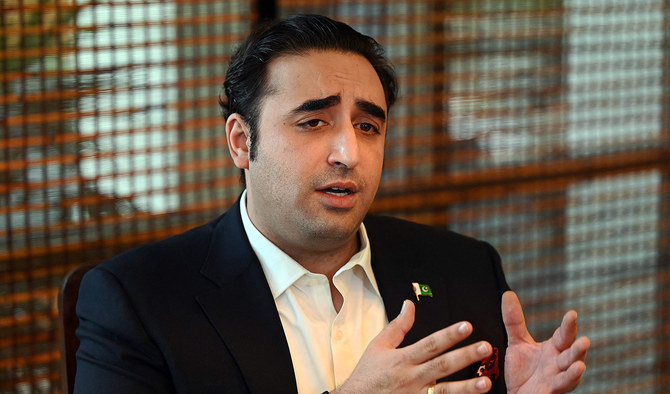

MUZAFFARABAD: India is "abusing" its presidency of the G20 by holding a tourism conference in the portion of disputed Kashmir it controls, Pakistan's Foreign Minister Bilawal Bhutto Zardari told AFP.
It is the first diplomatic event in the territory since Pakistan suspended trade and diplomatic ties with India in 2019, when New Delhi imposed direct rule on the part of Muslim-majority Kashmir it controls and enforced a heavy security lockdown.
"I wish I could say I was surprised, but I think that this is a continuation in what is becoming a norm now, of India's arrogance on the international stage," Bhutto Zardari told AFP in an interview Monday in Muzaffarabad, the capital of Pakistan-administered Kashmir.
"They're abusing their presidency of the G20 to push their colonial agenda, but if they think that by holding one event in occupied Kashmir they can silence the voice of the Kashmiri people, then I believe that they are truly mistaken."
His comments prompted a sharp rebuke from Indian officials.
The Indian-controlled portion of Kashmir has been roiled for decades by an insurgency seeking independence or a merger with Pakistan, with tens of thousands of civilians, soldiers and Kashmiri rebels killed in the conflict.
Non-G20 member Pakistan controls a smaller part, and says holding the tourism meeting from Monday to Wednesday in the territory violates international law, UN Security Council resolutions and bilateral agreements.
China, which also claims the Indian state of Arunachal Pradesh in full as part of Tibet, has stood by Pakistan in condemning the meeting to promote tourism in the area -- renowned for its lakes, meadows and snow-capped mountains.
It did not attend, while Muslim nations Saudi Arabia and Turkey did not send government representation and some Western countries scaled back their presence.
Indian officials rejected Bhutto Zardari's comments, saying he had no right to make them.
Harsh Vardhan Shringla, chief co-ordinator of New Delhi's G20 presidency, told reporters: "Pakistan has no locus standi when it comes to the G20. They have no locus standi when it comes to Jammu and Kashmir, which is an integral part of India, and the meeting that is being held here today has nothing to do with them."
And Manoj Sinha, who as lieutenant governor is the most senior official appointed by New Delhi to run Indian-administered Kashmir, said Pakistan "should make arrangements for food et cetera for its people. It is essential that civic amenities are restored there. India has moved much ahead from concerns like these."
India is attempting to portray what officials have called "normalcy and peace" in Kashmir by inviting the international community to a well-guarded venue on the shores of Dal Lake in Srinagar.
But residents have chafed under stepped-up security measures, with hundreds detained according to a senior official and thousands including shopkeepers receiving calls warning them against any "signs of protest or trouble".
"One of the most militarized zones in the world can never be seen as normal," said Bhutto Zardari.
The nuclear-armed South Asian neighbors have fought three wars since they were created at the partition of the Indian subcontinent in 1947.
Since New Delhi revoked Indian-administered Kashmir's limited autonomy in 2019, the rebels have largely been crushed -- although young men continue to join the insurgency.
Dissent has been criminalized, media freedoms curbed and public protests limited, in what critics say is a drastic curtailment of civil liberties.
The Pakistani foreign minister ruled out any chance of a warming of ties unless New Delhi reversed the constitutional changes in Kashmir.
"Until this topic is addressed, it really stands in the way of peace in all of South Asia," said Bhutto Zardari, the son of assassinated former prime minister Benazir Bhutto and the grandson of deposed and executed former premier Zulfikar Ali Bhutto.
Without it, no "meaningful dialogue" could begin on shared threats including militancy and worsening climate change. "We are patient people," he added.
On the streets of Srinagar, the capital of Indian-administered Kashmir, a resident lamented the region's plight.
"We are crushed between two countries because they have the enmity between two," he said. "They are not giving the importance to the people who are living, who are crushed... they are fighting for the land, not for the people."
He has a tourism business but declined to give his name for fear of consequences.
"Kashmir is the adopted child, we are not linked to India right from the beginning," he said. "Everyone knows how adopted kids are treated -- they are always outcasts."


