

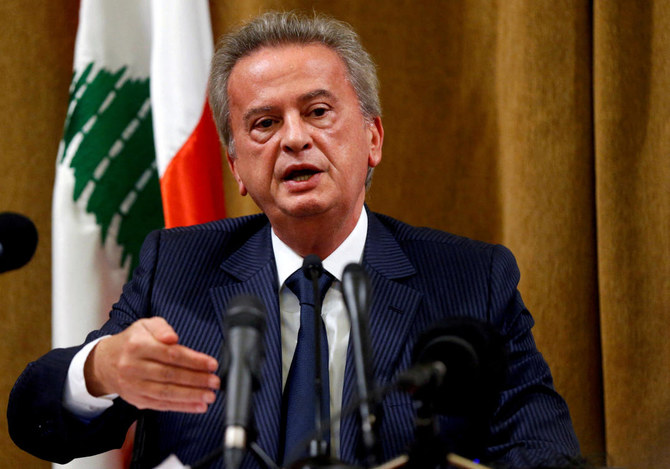

BEIRUT: Lebanon Central Bank Gov. Riad Salameh will appear before General Prosecutor Imad Qabalan on Wednesday to be informed of the Interpol warrant issued against him by the French judiciary.
It is part of an investigation into Salameh surrounding charges of “corruption, forgery, money laundering and embezzlement,” a judicial source said.
Salameh had failed to appear before a Paris court on May 16 for questioning, prompting French financial investigating judge Aude Buresi to issue an Interpol arrest warrant.
The governor’s brother, Raja Salameh, and his assistant, Marian Howayek, were told on Tuesday to appear before the Paris criminal investigation department of the Public Prosecution, on the scheduled dates of May 31 and June 13, respectively.
The Internal Security Forces, which were previously tasked with notifying the governor of his court hearing, reported to the judiciary that they were “unable to locate” Salameh.
The judicial source said Qabalan “will inform Salameh of the red notice on Wednesday, confiscate his passport and leave him subject to investigation.”
Qabalan is expected to request “the file for Salameh’s extradition from France, with a request for his surrender along with evidence against him.”
Meanwhile, a judicial source denied to Arab News that Lebanon had received an arrest warrant from the German judiciary against Riad Salameh, similar to the Interpol warrant.
The source said: “No one has contacted the public prosecutor, Judge Ghassan Oueidat, to inform him orally about the warrant.”
The source added that he believes “there is a unification of judicial procedures in Europe, and therefore the notification of the German side about the French warrant is part of these procedures between France and Germany.”
The Lebanese judiciary refuses to extradite Lebaneses citizen based on foreign requests, except under specific conditions according to the penal code.
If the French judiciary sends Salameh’s file to the Lebanese judiciary, “the request will be studied to determine the extent of the availability of the French charges against Salameh, after which the public prosecutor will submit a report to the justice minister, who will, in turn, submit the extradition request to the Cabinet for consideration,” the source added.
There is no judicial treaty between Lebanon and France for the exchange of wanted individuals, though the idea has previously been floated.
In the case of the governor, who is also being pursued in Lebanon for a financial case, “he is being prosecuted for both cases before the Lebanese judiciary due to their connection to each other,” the source added.
The arrest warrant against the governor was discussed during a joint parliamentary committee meeting on Tuesday.
After the session, Deputy Speaker Elias Bou Saab said: “We did not accept the presence of a representative of the governor during the session. There are arrest warrants against him, and there is frustration among MPs about what we have reached.
“There is a wish that the governor resigns from his position, as the government will not take any action. The situation is not good, and Lebanon cannot continue like this. This becomes a precedent.”
Salameh’s term ends at the end of July, but the Lebanese government cannot dismiss a Central Bank governor.
Other parliamentary blocs have refrained from expressing their opinion on Salameh, and are waiting for “the judicial decision and the government's decision, away from political bidding.”
Parliamentary committees permitted the Central Bank to print currency notes of larger denominations, with a higher value than the current 100,000 Lebanese pound note.
As a result of the Salameh case, there are rumors that Lebanon could be placed on the gray list of countries failing to combat money laundering.
A ministerial source said that such a move “would be a major new blow to Lebanon, which has been suffering from a financial deterioration since 2019 and has not yet reached a final agreement with the International Monetary Fund.”


