

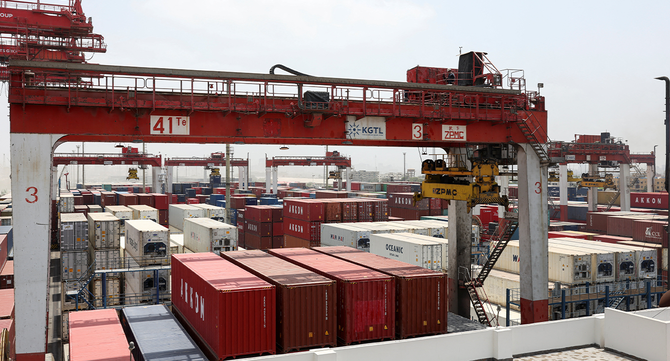

KARACHI: Authorities at Pakistan’s second-largest seaport, Port Qasim, are deepening and widening its 49-kilometer navigational channel under a $250 million capital dredging project to accommodate larger vessels, officials said on Wednesday, citing more than four-time surge in transshipment at the country’s ports.
Port Qasim Authority (PQA) has handled 20,000 twenty-foot equivalent units (TEUs) or containers since Feb. 28, when the US launched a war on Iran that has disrupted global energy supplies through the Strait of Hormuz and reshaped shipping routes across the region.
The port had handled 4,000 containers during the corresponding period last year (March 2025 till mid-August 2025), according to Muhammad Khalid, the PQA director-general of operations. It has set a target of 50,000 TEUs after completion of the dredging of project.
In an interview with Arab News, Khalid said the US-Iran war has created an opportunity for Pakistani ports, with Dubai Port World’s Qasim International Container Terminal at Port Qasim recording a more than four-time increase in transshipment cargo since the conflict began.
“The deepening and straightening and widening of the navigation channel is being done at the moment,” Khalid told Arab News in an interview on Wednesday.
“It will help not only the other components or the commodities which are being handled at Port Qasim but also the transshipment.”
PQA started the project in May and aims to complete it by mid-2028 to enable the port to handle larger vessels of 15-meter draught.
Pakistan’s geographical proximity with the Strait of Hormuz has diverted transshipment trade to the South Asian nation, which is experiencing increased shipping and trade activity.
Karachi Port Trust (KPT), which operates the country’s largest Karachi Port, handled 55.4 million tons cargo last fiscal year that ended in June, including a record 2.75 million containers, according to official data.
However, officials are not sure how long it will last.
“This (transshipment) is an opportunity till the time the geopolitical situation is going on in this region,” Khalid said.
“Will it be permanent one or not, then I must say that at the moment it is temporary.”
Arab News approached Pakistan’s maritime affairs ministry spokesman Muhammad Arshad and Karachi Port Trust’s (KPT) Sharique Amin Farooqui for comment on the subject, but they did not respond to the queries.
The government has also announced various concessions to attract shipping lines and make Karachi a regional transshipment hub.
At Port Qasim, Khalid said, PQA has zeroed wharfage charges for transshipment, increased the number of free days to 28 and reduced wet charges by up to 50 percent depending on how much transshipment cargo a vessel carries.
Mohammed A. Rajpar, chairman of the Pakistan Ship’s Agents Association (PSAA), said the industry hopes the current increase in transshipment cargo would not disappear once Hormuz disruptions end.
“The effort of the government and the private stakeholders is to convert this into a sustainable business model,” he told Arab News, adding that Karachi, the country’s main commercial hub, has the capacity to absorb additional traffic.
“We have a 6.2 million TEU annual handling capacity, and we currently utilize around 3.5 to 3.8 million TEU of that capacity.”
NEW SHIPPING ROUTES
However, the more consequential change may be taking place on the regional shipping routes themselves.
With the Strait of Hormuz inaccessible, ship owners and operators have had to create new routes and divert vessels, according to Rajpar. Some services are now operating directly to East and South Africa, while others are avoiding the Red Sea, Hormuz and Suez altogether.
“They’re going via the Cape of Good Hope in South Africa,” the industry expert said, adding that some Far East services that previously transshipped through Gulf ports were also coming directly to Pakistan.
“So, yes, there has been a reconfiguration, and probably for the better.”
Rajpar said much would depend on how Gulf ports respond in a post-war scenario.
Pakistan’s opportunity, he said, is simply not based on the current diversion of vessels but also on the risk calculations that could remain after the conflict subsides.
Last month, Pakistan was removed from an international list of high-risk maritime areas used by marine insurers to determine whether ships should pay additional war-risk insurance premiums, Pakistan’s maritime affairs ministry said.
“One thing which goes in Pakistan’s favor is the insurance risk premium is not going to change for the Gulf now,” he said.


