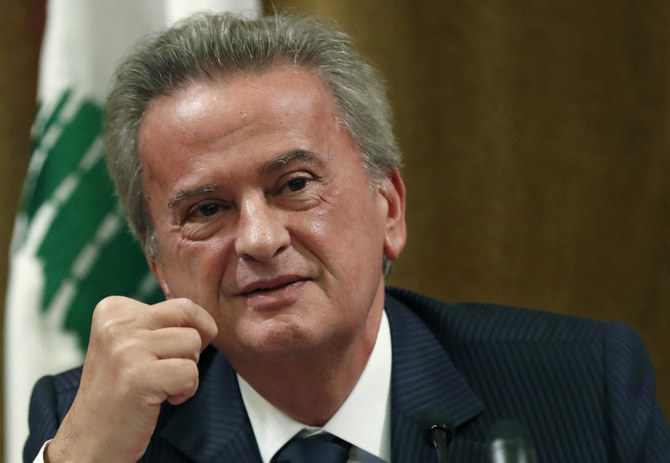
BEIRUT: Lebanon has received an Interpol red notice requesting the arrest of Central Bank Governor Riad Salameh after a French magistrate issued a warrant this week.
Salameh, 72, has been the target of a series of judicial investigations both at home and abroad on allegations including fraud, money laundering and illicit enrichment.
Lebanon’s top prosecutor Judge Ghassan Oueidat said he was studying the notice to set a date for Salameh’s hearing next week and take the necessary legal actions.
French Judge Aude Buresi is leading an investigation into allegations of money laundering involving Salameh, particularly the transfer of over $330 million from the Banque du Liban to European banks through Forry Associates, a company owned by Salameh’s brother, Raja Salameh.
Lebanon’s caretaker Interior Minister Bassam Mawlawi said on Friday that Interpol’s request to arrest Salameh was being seriously discussed by authorities. He demanded Salameh’s resignation.
A judicial source however told Arab News: “The Interior Minister does not have the authority to arrest or dismiss Salameh. Only the Lebanese judiciary can arrest him, and a decision from the Cabinet can accept it.”
The source added that the judiciary “does not have the right to arrest Salameh at this stage because it does not have the necessary documents to do so.”
Judge Oueidat needed to request the file on Salameh from the French judiciary, along with the documents relied upon in the red notice, the source said.
They added: “The judiciary previously requested the file on the Lebanese businessman Carlos Ghosn, who has been pursued in Japan and France on corruption charges since 2019.
“However, the Japanese judiciary did not respond to the Lebanese request, and his file did not reach the Lebanese judiciary.
“Lebanon also made the same request to the French authorities to obtain Ghosn’s file in 2022, but the file has not yet reached Lebanon, despite France sending a judicial team to interrogate Ghosn in Beirut.”
Judge Jean Tannous, who conducted the preliminary investigations as a public prosecution lawyer, said: “Lebanon does not extradite any Lebanese citizen to any foreign country, even if they hold another nationality.
“Therefore, any arrest warrant issued against a Lebanese is not legally enforceable. Instead, Lebanon must try the Lebanese citizen for the criminal acts for which the arrest warrant was issued.”
The Lebanese Cabinet is expected to hold a session next week when caretaker Prime Minister Najib Mikati returns from the Arab League Summit in Jeddah. If the session takes place and no objections are raised, Salameh’s case will be on the agenda. However, given the cabinet’s caretaker nature and the current presidential vacuum, the outcome remains uncertain.
If Salameh resigns, the first deputy governor would in theory assume his duties. However, parliament Speaker Nabih Berri would likely object given that the first deputy is from the Shia sect and the position is officially occupied by a Maronite.
The appointment of the next governor is usually suggested by the Lebanese president, a position that also remains unfilled.


![]()

Interpol asks Lebanon to arrest its central bank chief
Short Url
https://arab.news/68rww
Interpol asks Lebanon to arrest its central bank chief
- Lebanon’s caretaker Interior Minister Bassam Mawlawi said on Friday that Interpol’s request to arrest Salameh was being seriously discussed by authorities
- He demanded Salameh’s resignation


Latest updates


© 2026 SAUDI RESEARCH & PUBLISHING COMPANY, All Rights Reserved And subject to Terms of Use Agreement.