Brazilian leader says ‘upset’ at not meeting Ukraine’s Zelensky

1 / 2
Brazilian President Luiz Inacio Lula da Silva speaks during a news conference after attending the Group of Seven nations' summit in Hiroshima, Japan, on May 21, 2023. (AP)
2 / 2
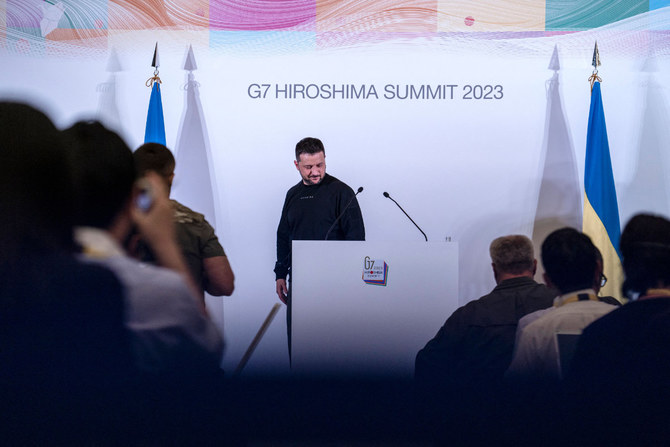
Ukraine's President Volodymyr Zelensky reacts during a news conference following the G7 Leaders' Summit in Hiroshima on May 21, 2023. (POOL/AP)
Short Url
Updated 22 May 2023
Follow

Brazilian leader says ‘upset’ at not meeting Ukraine’s Zelensky

  • Lula is pushing for peace talks and has proposed Brazil as a mediator
  • However, neither Zelensky nor Putin appeared not to want peace at this time, he said

HIROSHIMA, Japan: Brazilian President Luiz Inacio Lula da Silva said Monday he was “upset” he and Volodymyr Zelensky did not meet at the G7 summit, adding his Ukrainian counterpart seemed uninterested in negotiating peace with Russia.

Zelensky, who emerged from the summit in Hiroshima with fresh diplomatic support and pledges of more military aid, had sought a one-on-one meeting with Lula, who has faced accusations of being soft on Russia over its invasion.
Both leaders said scheduling conflicts had prevented them from meeting — which Zelensky quipped had likely left his Brazilian counterpart “disappointed.”
“I wasn’t disappointed. I was upset, because I’d like to meet him and discuss the matter,” Lula told a news conference before heading home from Japan.
But “Zelensky is a grown-up. He knows what he’s doing,” he added.
Lula said his team had scheduled a meeting with Zelensky for Sunday afternoon. But the Ukrainian leader ran late, and his own agenda was full after that, he said.
Zelensky got resounding support from G7 leaders at the summit, including long-sought US backing for access to F-16 fighter jets.
He also wooed non-G7 countries invited to the gathering, notably winning a pledge from Indian Prime Minister Narendra Modi to do “whatever we can” to resolve the conflict.
“I understand your pain,” Modi told him.
There was no such show of support from Brazil.
Lula said he did not see a point in meeting Zelensky now, saying neither he nor Russian President Vladimir Putin appeared to want peace.
“For now, they’re both convinced they’re going to win the war,” he said.
Lula is pushing for peace talks and has proposed Brazil as a mediator, along with other “neutral” countries, including China and Indonesia.
But the veteran leftist faced criticism last month when he accused the United States of “encouraging” the war.
After the White House accused him of “parroting Russian and Chinese propaganda,” Lula toned down his rhetoric, saying Brazil condemned Russia’s invasion.
But he renewed his criticism Monday.
US President Joe Biden, he said, is sending the message that “Putin has to surrender and pay for everything he wrecked.”
“That message isn’t helping,” he said.


Palestinian envoy pledges return to UN’s founding ideals in his bid for presidency of General Assembly

Updated 5 sec ago
Follow

Palestinian envoy pledges return to UN’s founding ideals in his bid for presidency of General Assembly

  • Riyad Mansour presents a vision for his candidacy grounded in the 3 core pillars of the UN: human rights, development, and peace and security
  • World of today ‘needs more, not less, United Nations,’ he says. ‘It needs us to honor our commitments … uphold our responsibilities … respect the rules of international law’

As Palestine’s envoy to the UN, Riyad Mansour, launched his candidacy for president of the 81st session of the UN General Assembly, he urged member states to recommit, at this time of growing global division, to multilateral cooperation, the principles of international law and the founding ideals of the UN.

Mansour, whose candidacy was endorsed by the UN’s Arab Group, presented a vision grounded in the three core pillars of the UN: human rights, development, and peace and security.

In his vision statement, he said: “The world we live in today needs more, not less, United Nations. It needs us to honor our commitments, not renege on them; to uphold our responsibilities, not abandon them; to respect the rules of international law, not grow accustomed to their breach.”

The 81st session of the UN General Assembly begins in September, and the election of its president will take place on June 2 in the General Assembly Hall at the UN headquarters in New York. In accordance with the established regional rotation of the position, the next president will be chosen from among the Asia-Pacific group of states.

Two others candidates have announced their intentions to stand so far: veteran diplomats Touhid Hossain from Bangladesh and Andreas S. Kakouris from Cyprus.

Mansour, who has served as the permanent observer of the State of Palestine to the UN since 2005, framed his candidacy through the lens of personal experience, describing himself as “a refugee, a migrant, the son of a steelworker,” who had lived through conflict, poverty and displacement.

“I know what it means when the United Nations is at its best, and I know only too well its shortcomings,” he said.

In his vision, Mansour reflected on the origins of the UN in the aftermath of a global conflict, describing the institution as a response to humanity’s “darkest moments” and a platform designed to replace war with cooperation.

He credited the General Assembly with enabling collective action that has delivered tangible gains, including advances in development, health, human rights and environmental protections.

“Together, we rejected the impulses of war and destruction and chose cooperation, common security and shared prosperity,” he said, citing milestones such as the Millennium Development Goals, the 2030 Agenda for Sustainable Development, and international agreements on climate change, disarmament and gender equality.

Despite those achievements, however, Mansour warned that many pledges have not been kept and trust in the international system is eroding.

“Too many promises remain unfulfilled, and too much suffering continues,” he said. “The international order has grown increasingly uncertain, and the ideals of the United Nations are too often left unenforced.”

He cautioned against a return to a world in which “conflict prevails over dialogue” and “coercion replaces diplomacy,” arguing that the scale of present-day crises — from armed conflict and humanitarian emergencies to climate change and technological risks — requires a renewed, collective resolve.

“We cannot risk a return to a world where disorder undermines the rule of international law,” Mansour said. “We must rise above division and recommit to partnership.”

He called for reforms within the UN system itself with the aim of improving efficiency, inclusivity and engagement, saying that such changes were necessary to restore confidence in the organization’s ability to deliver peace and security.

“This moment demands engagement grounded in mutual interest and sustained by persistent action,” he said, adding that reform was essential “to restore trust in our United Nations and its enduring capacity to contribute to international peace and security.”

He described his vision as pragmatic rather than ideological, shaped by decades of multilateral diplomacy and a belief in the UN as “an anchor for a more peaceful and just world.”

He continued: “At a time of profound strain on the multilateral system, my vision seeks to mobilize member states and stakeholders to preserve and safeguard what we have accomplished, and to pursue progress with urgency, so that dignity, opportunity and hope are extended to all.”

The president of the General Assembly is elected annually and is responsible for presiding over its sessions, representing its decisions, and facilitating negotiations among member states.