

Saudi astronauts successfully launch toward Space Station

1 / 3
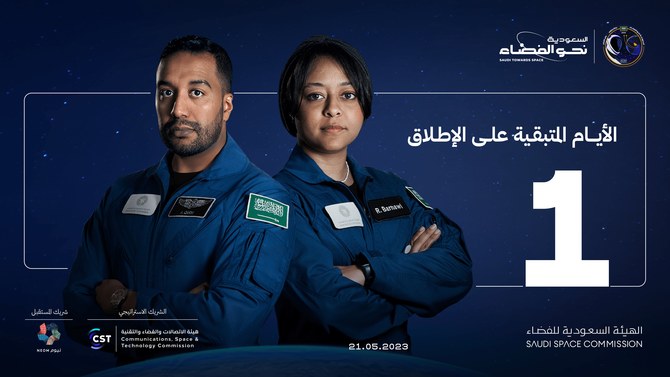
Rayyanah Barnawi (far left), and her colleague Ali Al-Qarni (far right) are set to launch into space on Sunday evening. (Screenshot/Axiom)
2 / 3
Rayyanah Barnawi (far left), and her colleague Ali Al-Qarni (far right) are set to launch into space on Sunday evening. (AFP)
3 / 3
Saudi Arabia is set to make history as its first female astronaut, Rayyanah Barnawi, and her colleague Ali al-Qarni prepare for their journey to the International Space Station. (Saudi Space Authority)
Short Url
Updated 22 May 2023
Follow

Saudi astronauts successfully launch toward Space Station

  • During their eight-day stay on the ISS, the team will aim to conduct 20 research projects

RIYADH: Saudi Arabia made history on Sunday as its first female astronaut, Rayyanah Barnawi, and her colleague Ali Al-Qarni launched toward the International Space Station (ISS).

The duo were on board the Axiom Space 2 mission, which launched at 5:37 p.m. (EDT time). Astronaut Peggy Whitson and business pioneer and pilot John Shoffner are also part of the mission.

Before the launch, Barnawi, a breast cancer researcher, expressed her excitement and honor at representing Saudi Arabia and the Saudi Space Commission as the country's first female astronaut. She highlighted her passion for research and described the opportunity as a dream come true for everyone involved.

During their eight-day stay on the ISS, Whitson, Shoffner, Al-Qarni, and Barnawi aim to conduct 20 research projects. Among them are 14 projects developed by Saudi scientists, covering various areas such as human physiology, cell biology, and technology development.

The launch was with a SpaceX Falcon 9 rocket, and had a backup launch opportunity scheduled on Monday at 5:14 p.m in case of a launch failure. 

It’s the same spot where Saudi Arabia’s first astronaut, Prince Sultan bin Salman, soared in 1985.

On Saturday astronaut Al-Qarni shared pictures on his Twitter account the contents of his space travel bag. 


Interactive experiences bring stories of courage and patience to life at Prince Turki bin Saud Palace

Updated 19 January 2026
Follow

Interactive experiences bring stories of courage and patience to life at Prince Turki bin Saud Palace

RIYADH: At the historic Prince Turki bin Saud Palace in Diriyah, past and present converge as immersive experiences revive stories of courage, patience and resilience rooted in the era of the First Saudi State.

The palace is one of the key landmarks featured in the “Hal Al-Qusoor” program, a flagship initiative of Diriyah Season 25/26, drawing visitors eager to explore a site rich in cultural and social significance.

Prince Turki was born in the At-Turaif District of historic Diriyah in the late 12th century AH (18th century). He grew up in an environment shaped by courage, horsemanship and leadership, influenced by his father, Imam Saud bin Abdulaziz, the commander of the First Saudi State’s armies.

Located in the southern part of the At-Turaif District, the palace was constructed in the early 13th century AH and reflects the traditional Najdi architectural style.

Built using mud bricks, stone and tamarisk wood, the structure consists of two floors arranged around a central courtyard.

Its wide gates and multiple exits reflect both the architectural traditions of the time and the practical realities of life during that era.

As visitors move through the palace, they can imagine the discussions and strategic decisions that once took place within its walls and contributed to Diriyah’s resilience.

Today, interactive experiences enhanced by sound and lighting technologies bring these historical narratives to life, offering an engaging window into the past.

From private living spaces to formal reception and meeting halls, the palace presents a vivid picture of daily life during the First Saudi State, with architectural details that echo stories of bravery and steadfastness.

Diriyah Season 25/26 supports the vision of the Diriyah Gate Development Authority by reinforcing Diriyah’s role as the birthplace of the Saudi State.