

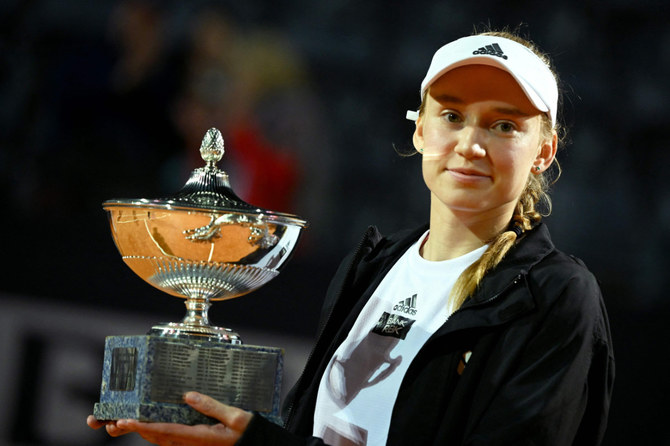

ROME: Wimbledon champion Elena Rybakina won the Italian Open when Ukrainian opponent Anhelina Kalinina retired due to a left thigh injury early in the second set of the rain-delayed final on Saturday.
Rybakina was leading 6-4, 1-0, 15-0 when Kalinina called for a trainer and grasped her left leg as she teared up. She then decided she couldn’t continue.
The final began at almost 11 p.m. on Saturday and ended just after midnight on Sunday.
“I’m really sorry that I couldn’t play,” Kalinina said during the trophy ceremony as the crowd whistled after waiting under the rain for hours before the night session started. “I was trying to do my best.”
Holger Rune will face Daniil Medvedev in the men’s final on Sunday.
The 20-year-old Rune rallied past Casper Ruud 6-7 (2), 6-4, 6-2 and Medvedev performed a little celebratory dance after beating Stefanos Tsitsipas 7-5, 7-5 in a semifinal that was suspended twice in the first set for a total of nearly 4 ½ hours due to rain.
Rybakina earned her biggest tournament win on clay. Her only other title on the surface was in Bucharest in 2019.
It’s been quite a year for Rybakina, who reached the final of the Australian Open, also won an elite title in Indian Wells and was the runner-up in Miami. On Monday, she’ll move up to a career-high No. 4 in the rankings and will be considered a contender at the French Open, which starts next weekend.
The 47th-ranked Kalinina was playing in the biggest final of her career, and has been dedicating her performances to her war-torn country.
Kalinina’s family home was destroyed in a Russian attack last year. Also, her elderly grandparents have had to relocate from the southern city of Nova Kakhovka — which is held by Russian forces — to Kyiv. Kalinina’s parents work as tennis coaches in Kyiv and she said on Friday there was a “huge, huge bomb near them, near their academy” a few days ago.
Rybakina was born in Moscow and has represented Kazakhstan since 2018, when that country offered funding to support her tennis career.
Kalinina spent more than four hours longer on court than Rybakina entering the final, having won the longest match on the women’s circuit this season — 3 hours, 41 minutes against Beatriz Haddad Maia in the quarterfinals. She also required three sets to beat Russia’s Veronika Kudermetova in an emotionally charged semifinal.
Rune, who eliminated six-time Rome champion Novak Djokovic in the quarterfinals, improved to 7-1 in his career against players ranked in the top five.
“I play some of my best tennis when I play the top guys of the world,” Rune said. “You need it against those players.”
Making the final marked quite a turnaround for Medvedev, who lost his opening match in Rome in his three previous appearances. If he beats Rune, Medvedev will return to No. 2 in the rankings and thus be seeded second for the French Open, which starts next weekend.
It will be just the second clay-court final for Medvedev, and first since 2019.
He celebrated with a little dance after converting his first match point more than six hours after the match started.
“It’s like being in the club completely drunk. When you are dancing — and I have a lot of friends like this — you feel like you are the god of the dance floor. But then when they show you the video it was not the thing,” Medvedev said. “So I don’t know how did it go but I was just happy to be in my first clay Masters final.”
Medvedev embraced the challenge of the delays: “Sometimes it can throw you off, you can be a little bit angry. Today, I don’t know why, I was just kind of laughing.”
The seventh-ranked Rune was down a set and a break before he overcame Ruud, who had won all four of their previous meetings.
“It’s crazy. I really played some of my best tennis, especially the last two matches, first against Novak and then against Casper,” Rune said. “Two so difficult players to play, so I had to find my best tennis. And I actually didn’t find it today, only at the end.”
It will be Rune’s third clay-court final this season after losing to Andrey Rublev in Monte Carlo and beating Botic van de Zandschulp in Munich.
“He plays very fearless, takes the ball early, which is really impressive to do on clay,” Ruud said. “It’s not very typical to sort of do too well on clay because you have some wrong bounces. ... A couple times I played heavy, he just went on the rise, hit the clean winner back.”
The semifinal was filled with memorable points as both players routinely ran down drop shots and rushed back and forth across the baseline.
“There were some great rallies,” Ruud said. “It was a fun match to play.”


