Pakistani PM, Iranian president jointly inaugurate border market, electricity transmission line

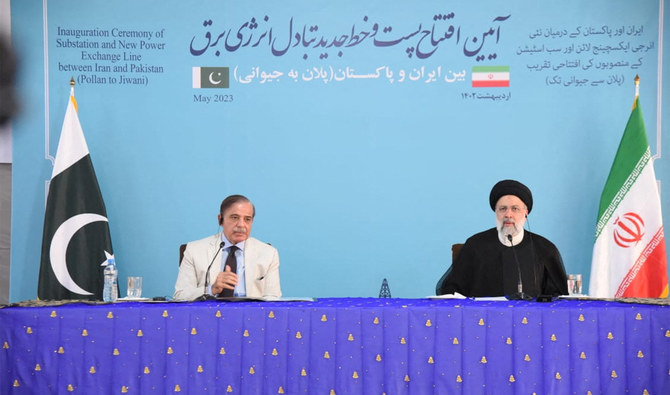
Pakistan's Prime Minister Shehbaz Sharif, and Iran's President Ebrahim Raisi speak during a Joint Inauguration of the Polan-Gabd Electricity Transmission Line, at Mand-Pishin border crossing point, in Pishin, Pakistan May 18, 2023. (REUTERS)
Short Url
Updated 18 May 2023
Follow

Pakistani PM, Iranian president jointly inaugurate border market, electricity transmission line

  • Pakistan and Iran plan to build six border markets to facilitate people on both sides by providing them livelihood opportunities
  • The electricity transmission line will bring an addition 100MW from Iran to meet the energy needs of households and businesses

ISLAMABAD: Pakistani Prime Minister Shehbaz Sharif and Iranian President Seyed Ebrahim Raisi jointly inaugurated a border market and an electricity transmission line on Thursday at a border crossing between the two neighboring countries.

Pakistan and Iran share a 959-kilometer frontier that begins at the Koh-i-Malik Salih mountain and ends at Gwadar Bay in the Gulf of Oman. The trade volume between the two countries currently stands at approximately $2 billion, and Iran exports around 100 megawatts (MW) of electricity to the areas of Pakistan that border it.

“The Mand-Pishin border sustenance marketplace will provide a thriving platform for increasing cross-border trade, fostering economic growth, and opening up new avenues of opportunity for local businesses,” said the Associated Press of Pakistan (APP) while reporting the development.

“This is one of the six border markets which will be constructed along the Pak-Iran common border,” it added.


Pakistan's Prime Minister Shehbaz Sharif, greets Iran's President Ebrahim Raisi during a Joint Inauguration of the Polan-Gabd Electricity Transmission Line, at Mand-Pishin border crossing point, in Pishin, Pakistan on May 18, 2023. (REUTERS)

The two leaders planted a sapling as a gesture of friendship and vowed to further strengthen bilateral relationship between their countries.

Pakistan’s foreign minister Bilawal Bhutto-Zardari, energy minister Khurram Dastagir Khan, information minister Marriyum Aurangzeb and senior officials belonging to the two countries were also present at the occasion.

The PM Office said on Wednesday Sharif and Raisi were also going to inaugurate Polan-Gabd Electricity Transmission Line to bring in an additional 100MW from Iran and help meet the energy needs of households and businesses in the border region.

According to Pakistan’s foreign office, the prime minister discussed “all aspects of bilateral relations and explore new areas of cooperation” during his meeting with the Iranian president.

“The border markets are envisaged along the Pakistan-Iran border to facilitate the people on both sides of the border with enhanced cross-border trade, fostering economic growth and opening up of new avenues of opportunity for local businesses,” it said in a statement on Thursday.
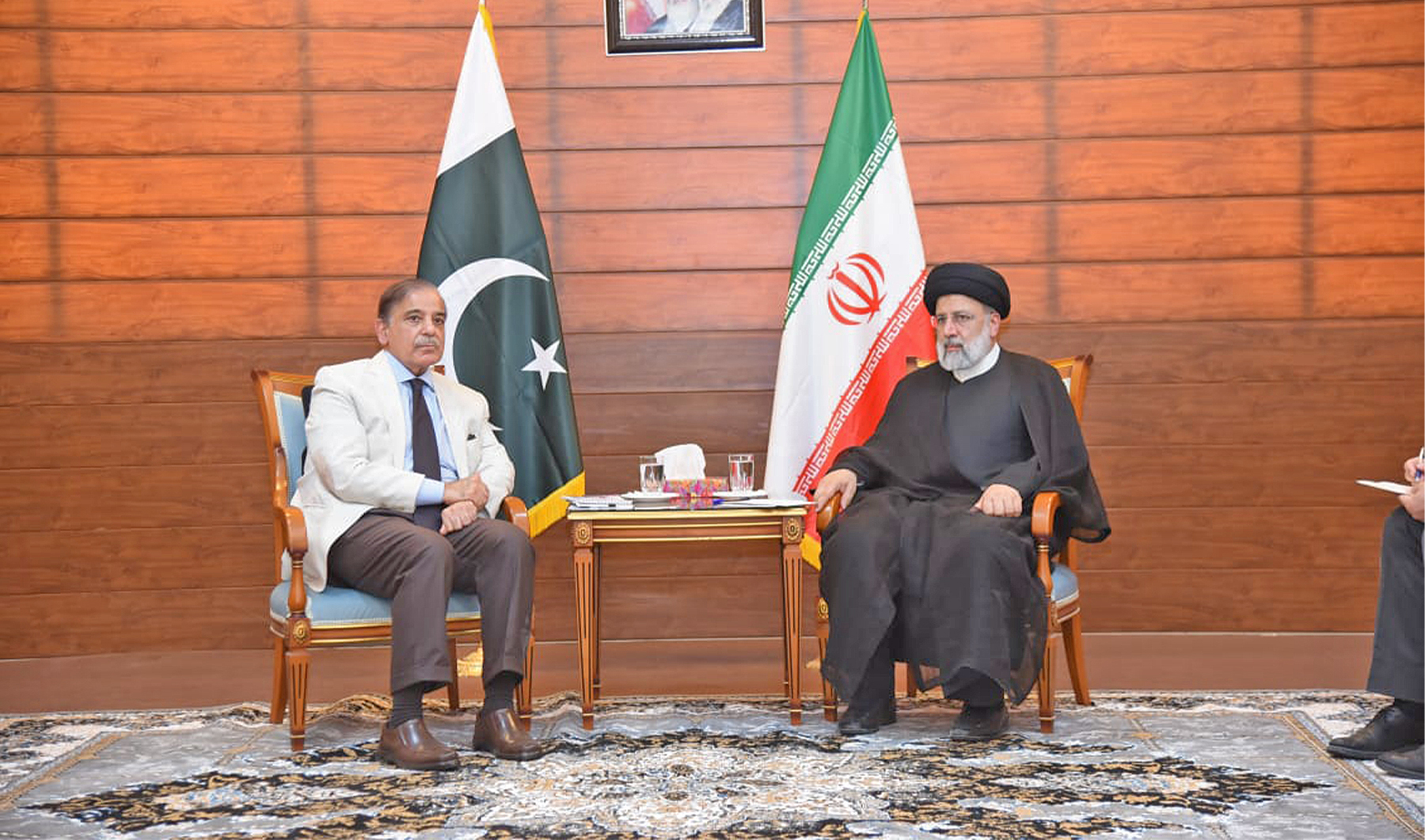


Pakistan Prime Minister Shehbaz Sharif (left) meets Iranian President Seyed Ebrahim Raisi at a border crossing between the two neighboring countries on May 18, 2023. (Government of Pakistan)

The foreign office informed the electricity transmission line had been developed under an agreement signed between the two countries last year in July.

Earlier this month, Vahid Jalalzadeh, chairman of the Commission of National Security and Foreign Policy of Iran, met Pakistani Commerce Minister Syed Naveed Qamar and discussed the opening of border markets.

Jalalzadeh had said the current trade volume of $2 billion with Pakistan was “insufficient” and called for solid steps to increase it to a multibillion-dollar level.

“Federal Minister for Commerce echoed this sentiment and emphasized the importance of opening new border markets and implementing a barter trade system to facilitate greater commercial exchange,” the commerce ministry said in a statement after the meeting. “These measures, he believed, would contribute to a significant surge in trade volume between Iran and Pakistan.”


Pakistan demands political dialogue, immediate ceasefire as Sudan conflict rages on

Updated 4 sec ago
Follow

Pakistan demands political dialogue, immediate ceasefire as Sudan conflict rages on

  • Sudan’s civil war since April 2023 has killed over 40,000 people, displaced over 14 million people
  • Pakistan urges Security Council to reject parallel government entities undermining state institutions

ISLAMABAD: Pakistan’s UN envoy has demanded a political dialogue and an immediate ceasefire in Sudan, where fierce fighting has raged on for months between the military and a powerful paramilitary force.

Sudan plunged into chaos in April 2023 when a power struggle between the military and the Rapid Support Forces exploded into open fighting, with widespread mass killings and rapes, and ethnically motivated violence. This has amounted to war crimes and crimes against humanity, according to the UN and international rights groups.

Sudan’s Prime Minister Kamal Idris, who heads its transitional civilian government, proposed a peace plan on Monday. Idris said his plan includes a ceasefire monitored by the United Nations, African Union and Arab League, and the withdrawal of paramilitary forces from all areas they occupy, their placement in supervised camps and their disarmament.

“There is no military solution to the conflict in Sudan,” Usman Jadoon, Pakistan’s deputy ambassador at the United Nations, said on Monday. “The only durable path forward lies in a political dialogue and reconciliation.”

Jadoon said Pakistan supports all genuine efforts and political processes aimed at achieving an immediate cessation of hostilities and ceasefire, protecting civilians and providing unfettered humanitarian access to civilians. 

He called on the UN Security Council to support all efforts to safeguard Sudan’s territorial integrity and sovereignty and reject “so-called parallel government or structures” that undermine state institutions and risk the country’s fragmentation. 

The Pakistani envoy called for maintaining “zero tolerance” for war crimes, including attacks against UN peacekeepers and humanitarian workers, with credible investigations and accountability of the perpetrators.

“The brotherly people of Sudan have suffered beyond measure,” Jadoon said. “The guns must be silenced; hopes for a brighter future rekindled; with peace and normalcy visible on the horizon.”

The devastating war in Sudan has killed more than 40,000 people according to UN figures, but aid groups say the true number could be many times higher. 

The conflict has created the world’s largest humanitarian crisis, with over 14 million people displaced, disease outbreaks and famine spreading in parts of the country.