

Yemen landmines kill 6 in Hodeidah in April, says Yemen mission

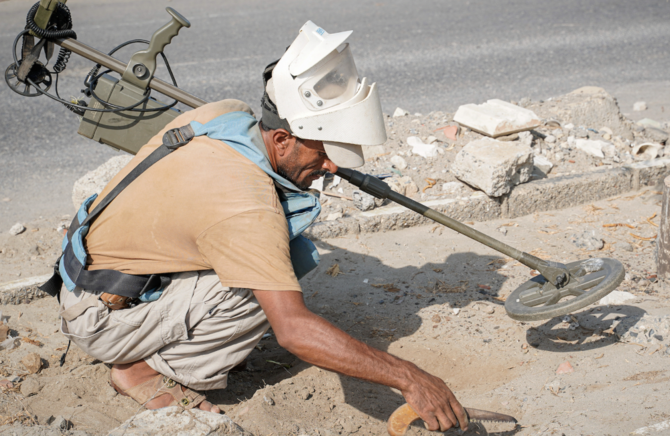
A deminer at work in Yemen. (UNMHA)
Short Url
Updated 15 May 2023
Follow

Yemen landmines kill 6 in Hodeidah in April, says Yemen mission

  • The UN has reported that six civilians were killed and seven injured by landmines and explosive remnants of war (ERW), in April, in Hodeidah
  • Third Yemenia Airways plane carrying 177 from Port Sudan lands in Aden

AL-MUKALLA: UN monitors in Yemen recorded 13 civilian casualties caused by landmines and explosive remnants of war (ERW) last month in Yemen’s western province of Hodeidah.

The UN Mission to Support the Hodeidah Agreement reported that six civilians were killed and seven others injured in April in explosions caused by landmines and other unexploded ordnance in various locations of the Red Sea Yemen province, bringing the total number of civilian deaths and injuries to 363 since January last year.

Last month’s civilian casualty figure is 13 percent lower than the same month last year and 24 percent lower than in March 2023.

“During the month of Ramadan (22 March to 21 April 2023), 22 casualties were recorded as a result of 10 incidents, in comparison to 15 casualties caused by nine incidents in the last Ramadan (2 April to 1 May 2022),” the UN mission said in a statement.

Even as the UN-brokered Stockholm Agreement, signed by Yemeni parties in late 2018, has brought relative calm to the province of Hodeidah over the last five years, thousands of landmines laid by the Iran-backed Houthis have continued to kill and maim hundreds of civilians while also preventing many internally displaced people from returning to their homes as well as farms, schools and workplaces.

The announcement of the UN mission comes as the Saudi-funded Masam demining program in Yemen prepares to record the removal of 400,000 landmines and other unexploded war remnants from the country.

Project Director Osama Al-Gosaibi said that Masam field deminers removed 398,110 landmines, unexploded ordnance and IEDs from 45,952,405 square meters of Yemeni land between mid-2018 and May 12 this year.

Masam also said that a health center in Hodeidah’s Bani Zuheir village had reopened and that patients were arriving in large numbers after deminers removed nine IEDs from the building and secured access roads.

Despite Masam’s extensive efforts, Hodeidah residents continue to report finding landmines exhumed by flooding.

Masam deminers discovered two fields containing landmines in the Hays district village of Bani Zuheir thanks to a tip from young shepherds who spotted the devices on the ground.

Yemen’s government, meanwhile, said on Monday that a third Yemenia Airways plane carrying 177 Yemenis from Sudan’s Port Sudan landed in the southern city of Aden, following the arrival of two planes carrying 360 Yemenis in Aden and Houthi-controlled Sanaa on Sunday.

A fourth plane transporting almost 180 Yemenis is scheduled to land in Sanaa on Monday evening.

The Yemeni government announced on Saturday the beginning of four emergency direct flights from Sudan to Yemen to evacuate about 700 Yemenis, primarily the ill, women, children, elderly and female students.

The government said that the remaining 1,300 Yemenis stranded in Port Sudan will have to wait until the arrangement of new flights or ship charters before they can be transported home.


Israel confirms ban on 37 NGOs in Gaza

A Palestinian woman carries wood for fire in the Nuseirat refugee camp in the central Gaza Strip on December 31, 2025. (AFP)
Updated 54 min 36 sec ago
Follow

Israel confirms ban on 37 NGOs in Gaza

  • UN has warned that this will exacerbate the humanitarian crisis in the war-ravaged Palestinian territory
  • Several NGOS have said the requirements contravene international humanitarian law or endanger their independence

JERUSALEM: Israel on Thursday said 37 humanitarian agencies supplying aid in Gaza had not met a deadline to meet “security and transparency standards,” and would be banned from the territory, despite an international outcry.
The international NGOs, which had been ordered to disclose detailed information on their Palestinian staff, will now be required to cease operations by March 1.
The United Nations has warned that this will exacerbate the humanitarian crisis in the war-ravaged Palestinian territory.
“Organizations that have failed to meet required security and transparency standards will have their licenses suspended,” Israel’s Ministry of Diaspora Affairs and Combating Antisemitism said in a statement.
Several NGOS have said the requirements contravene international humanitarian law or endanger their independence.
Israel says the new regulation aims to prevent bodies it accuses of supporting terrorism from operating in the Palestinian territories.
Prominent humanitarian organizations hit by the ban include Doctors Without Borders (MSF), the Norwegian Refugee Council (NRC), World Vision International and Oxfam, according to a ministry list.
In MSF’s case, Israel accused it of having two employees who were members of Palestinian militant groups Islamic Jihad and Hamas.
MSF said this week the request to share a list of its staff “may be in violation of Israel’s obligations under international humanitarian law” and said it “would never knowingly employ people engaging in military activity.”
‘Critical requirement’ 
NRC spokesperson Shaina Low told AFP its local staff are “exhausted” and international staff “bring them an extra layer of help and security. Their presence is a protection.”
Submitting the names of local staff is “not negotiable,” she said. “We offered alternatives, they refused,” hse said, of the Israeli regulators.
The ministry said Thursday: “The primary failure identified was the refusal to provide complete and verifiable information regarding their employees, a critical requirement designed to prevent the infiltration of terrorist operatives into humanitarian structures.”
In March, Israel gave NGOs 10 months to comply with the new rules, which demand the “full disclosure of personnel, funding sources, and operational structures.”
The deadline expired on Wednesday.
The 37 NGOs “were formally notified that their licenses would be revoked as of January 1, 2026, and that they must complete the cessation of their activities by March 1, 2026,” the ministry said Thursday.
A ministry spokesperson told AFP that following the revocation of their licenses, aid groups could no longer bring assistance into Gaza from Thursday.
However, they could have their licenses reinstated if they submitted the required documents before March 1.
Minister of Diaspora Affairs and Combating Antisemitism Amichai Chikli said “the message is clear: humanitarian assistance is welcome — the exploitation of humanitarian frameworks for terrorism is not.”
‘Weaponization of bureaucracy’
On Thursday, 18 Israel-based left-wing NGOs denounced the decision to ban their international peers, saying “the new registration framework violates core humanitarian principles of independence and neutrality.”
“This weaponization of bureaucracy institutionalizes barriers to aid and forces vital organizations to suspend operations,” they said.
UN Palestinian refugee agency chief Philippe Lazzarini had said the move sets a “dangerous precedent.”
“Failing to push back against attempts to control the work of aid organizations will further undermine the basic humanitarian principles of neutrality, independence, impartiality and humanity underpinning aid work across the world,” he said on X.
On Tuesday, the foreign ministers of 10 countries, including France and Britain, urged Israel to “guarantee access” to aid in the Gaza Strip, where they said the humanitarian situation remains “catastrophic.”
A fragile ceasefire has been in place since October, following a deadly war waged by Israel in response to Hamas’s unprecedented October 7, 2023 attack on Israel.
Nearly 80 percent of buildings in Gaza have been destroyed or damaged by the war, according to UN data.
About 1.5 million of Gaza’s more than two million residents have lost their homes, said Amjad Al-Shawa, director of the Palestinian NGO Network in Gaza.