RIYADH: When one first meets the victims of landmines and other explosive devices in Yemen, there are often smiles on their faces. But as one spends more time with them, and listens to their harrowing stories, it is hard to avoid the feeling that they have lost all hope.
As they recall the details of the life-changing incidents that caused often devastating injuries, and describe their daily struggles to overcome the disabilities they have been left with, the smiles disappear, replaced by tears for their own plight and that of their war-torn country.
Amal, a young women from Taiz, was preparing for her wedding when a chance encounter with an unexploded shell changed everything.
“I went to the city’s entrance to take care of some things for my wedding, as one of the neighborhood’s young men, who is an expat living outside Yemen, had asked for my hand in marriage,” she said.
“While I was out, I came across some children who had a suspicious object. It looked like something my father had been holding a while ago. He had warned us against touching these weird objects we might see in the streets.
“I was scared for the children’s safety and hurried to take it from them so it wouldn’t explode and hurt them. However, one of the playful children jumped and forcibly snatched it out of my hand, causing it to fall to the ground and explode. I no longer felt anything until I woke up at the hospital, where I realized that my arm and eye had been injured … I had to wear a prosthetic eye.”
Amal said the accident had a huge effect on her life.
“My fiance cut contact with us and my marriage never happened,” she said. “After a while, we heard that he got engaged to another girl.
“I decided to continue my university studies. However, in the beginning I faced a lot of bullying at university and on the streets. The questions I was asked were very difficult and I wanted to stop going to university, but my father supported me until I graduated from university and worked at a private school.
“This explosion affected my ability to deal with people, as I was afraid to talk to them. It destroyed my life.”
Jamila Qassem Maheeb, who is in a wheelchair, began to weep as soon as she started to share her story.
“I went out to bring back my sheep from an area close to my house,” she said. “I took the same road I always take. On my way back home, I stepped on a mine with my left leg. The mine exploded and threw me up in the air and I landed on a second mine that hit my right leg.
“I started shouting for people to help me and they took me to the hospital. I was not aware of where I was or what had happened to me until I discovered that I will not be able to walk ever again and that this wheelchair will stay with me forever.
“I used to comfortably walk around the area. Now, however, I am no longer comfortable as I am confined to this wheelchair. I used to walk and herd my sheep but now I cannot do that.
“This mine has dramatically affected me. I miss everything in this life. You feel like you are dead while alive. How can I be comfortable?”
Maheeb said the hostilities in Yemen “leave everyone, men and women, young and old, either injured or disabled. They are killing people in their houses, on their farms and at their workplaces. However, those who suffer the most are the children, women and civilians.”
After suffering his own traumatic experience, Omar Bashir Saeed, a child from Taiz governorate, now dreams helping others by becoming a doctor who specializes in landmine injuries.
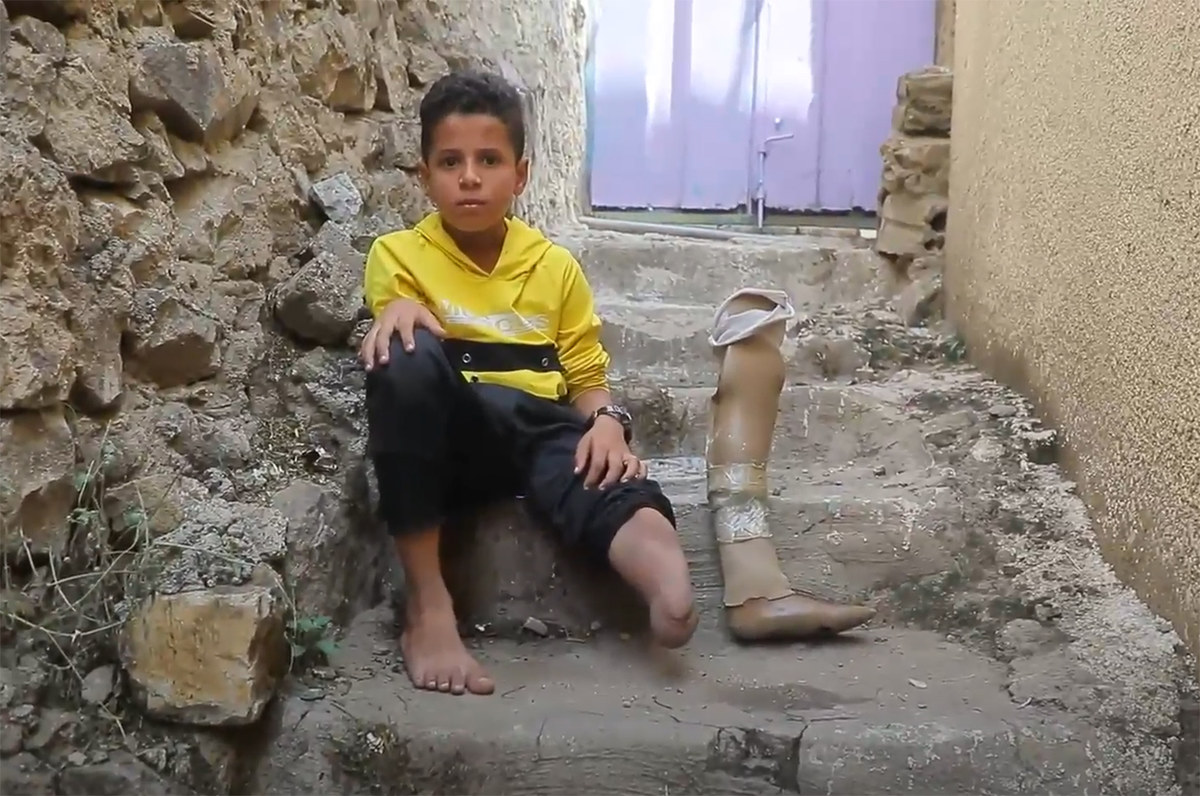
Omar Bashir Saeed, a child from Taiz governorate. (Supplied)
“I was playing on the street when a missile hit us,” he said. “I did not realize what happened and I still don’t know how we reached the hospital. I then discovered that my foot was amputated and I freaked out.
“However, I got used to my new situation, one day after another. I am no longer playing as much as I used to. Sometimes, playing with my friends might worsen the case of my foot, so I leave them to play without me.”
Yet brave Omar says that feels he got off relatively lightly compared with some of his friends who were with him at the time of the incident.
“I am doing much better than them, as some of them can no longer walk … while others are paralyzed,” he said. “My condition is better than theirs.
“I dream of becoming a doctor in the future to help those who are injured and lose limbs due to mines. I hope I excel in my school studies, and at university, so I can make my dream come true.”
Hamza Mohammed Ghaleb said that when combatants plant mines, the victims are always children, women, civilians and the elderly. He speaks from personal experience.
“We were gathered at my cousin’s house and upon exiting the house I was walking in front, and I suddenly felt that I was stepping on a mine planted in the road,” he said.
“I was taken to the hospital and when I woke up from the anesthesia I was told my foot had been amputated. The mine affected my studies as I couldn’t go to school, to the supermarket or do anything else.
“After I received the prosthesis, my life returned to normal and I went back to school and to my friends.”
Despite the adversity she has faced, Hadeel Mohammed Abdul Wase, from Al-Kedha, was perhaps the boldest and most self-confident all the people we met. She told how she was left in a coma after a missile strike hit her home at about 3.00 a.m. one night.
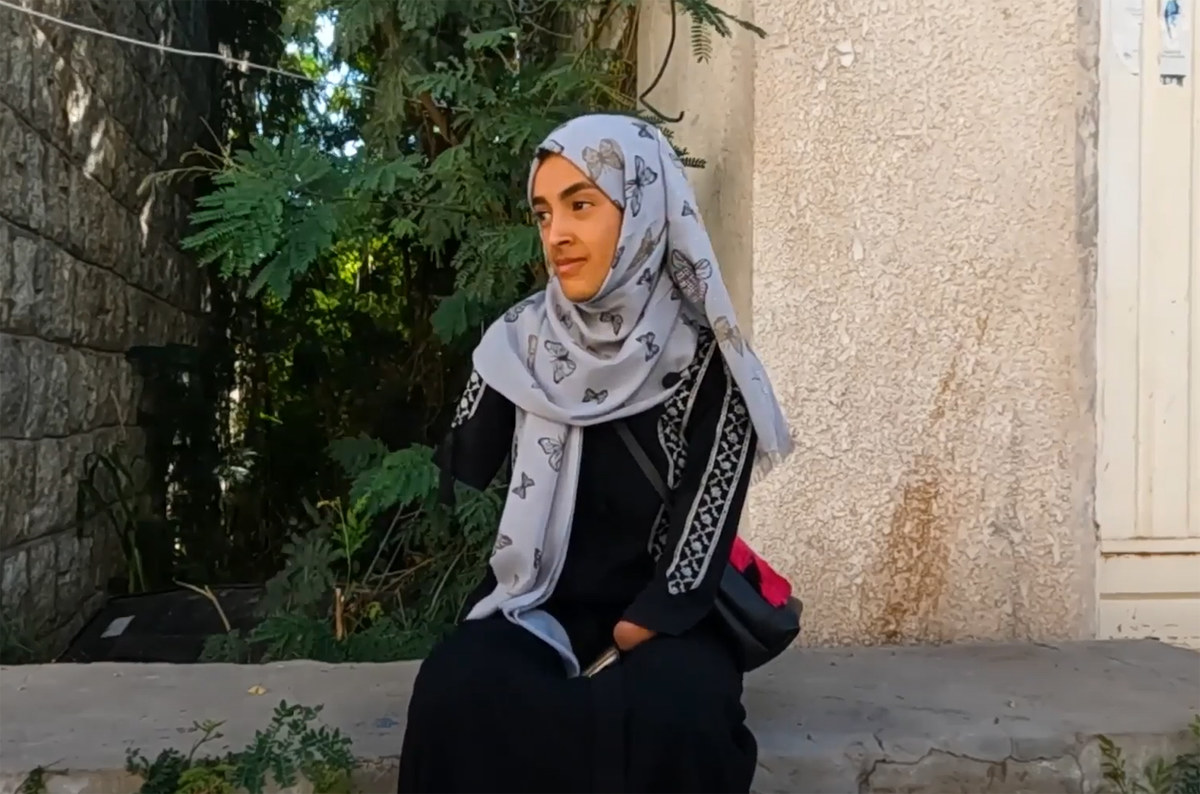
Hadeel Mohammed Abdul Wase, from Al-Kedha. (Supplied)
“My uncle and villagers took me to the hospital located in the nearest city,” she said. “Two days after the incident, I woke up from my coma to realize that both of my hands had been amputated.
“I asked my mom: ‘How will I ever be able to write again?’ I started imagining how I would face life and I couldn’t believe that I lost both hands to the missile.
“I finally managed to adapt to my new life after facing very challenging obstacles at first, as I couldn’t eat or drink. I used to rely on my mother until I finally managed to rely on myself.”
There is still some anger about what happened to her but Abdul Wase directs her rage toward the Houthis.
“Instead of planting seeds of hope in our land, they are planting seeds of obscenity and evil,” she said. “Our land is no longer safe. We are stepping on exploding mines. We have lost all forms of safety.
“The majority of the people have lost an arm or a leg, while others met death, lost sight or other parts of their bodies. The world is no longer a safe place.
“They select the paths people take as locations to plant chains of mines instead of a single exploding device. They are ruthless and cold-hearted. All they want is to raze the nation to the ground, including military personnel and citizens.”
Abdul Wase said she fears what the long-term effects of the violence will be on her country and its people.
“Mines leave no space for the future; with all these explosions, deaths, and wounds, is there really any future left in Yemen?” she asked.
“The seeds of failure are planted in our land. Plant hope and future seeds instead of these demolishing mines. There is no future in Yemen until mines are completely removed from our land.”
Mohamed Saleh Maraani, who lives in Moussa district, says: “The terrorist Houthi militia had reached us … and planted mines on roads and in houses, farms, schools, water wells and hospitals. We could not return to our homes, to our mosques, and to our schools. Our ways of life were destroyed.
“When the Masam (mine-clearance) teams arrived, they opened the roads and secured the schools so that the educational process can resume. They secured the houses and surveyed them; thus, we were able to return to our areas safely.”