

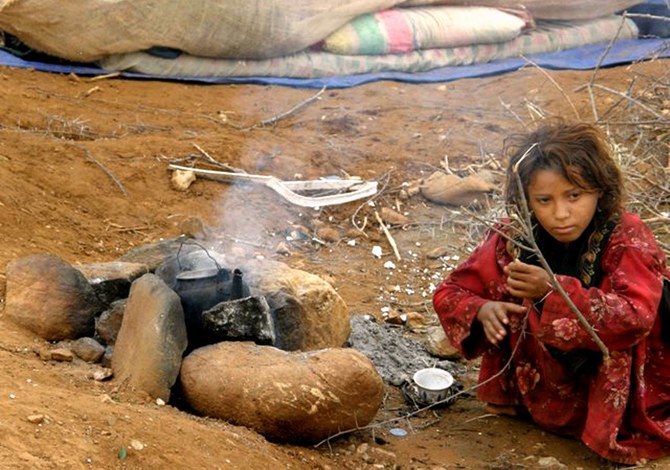

LONDON: Despite a truce taking hold in Yemen, civilians and children of the war-torn country continue to be at constant risk due to large swaths of land ridden with mines planted by the Houthi militants since the start of the war in 2015.
“Despite a decline in military operations, especially since the start of the UN-brokered truce in April 2022, landmines continue to claim civilian lives,” Fares Al-Hemyari, executive director of the Yemeni Landmine Records, which comprises a group of volunteers who document landmine casualties across the country, told Arab News.
During each month of the truce — which officially ended in October but is still largely observed — at least 40 civilians were killed by landmines, improvised explosive devices and unexploded ordnance, according to the US-based Center for Strategic and International Studies. Also affected are humanitarian organizations’ access to internally displaced persons, many of whom are unable to return to their homes.
This hindrance to humanitarian aid is not new. In April 2019, Human Rights Watch said in a report that Houthi-laid landmines have, since mid-2017, “prevented aid groups from reaching vulnerable communities.”
Cherry Franklin, humanitarian policy advisor for the Danish Refugee Council in Yemen, told Arab News: “Across Yemen, mines and other explosive ordnances are a deadly legacy of the conflict.
“Internally displaced people we speak to have told us that not only do they prevent them accessing vital services, for example water, but they are a barrier to them returning home and restarting their livelihoods,” she explained.
IDPs are “particularly vulnerable” to the threat of landmines, explosive ordnance and unexploded munition, stated a recent Save the Children report.
The report, titled “Watching Our Every Step,” revealed that “out of 194 child victims of EO supported by Save the Children between (Jan.) 2020 and (Nov.) 2022, nearly 1 in 4 were IDPs,” highlighting that “an estimated 80 percent of Yemen’s 4.5 million IDPs are women and children.”
It added that minors in Yemen were “facing the highest risk in five years of encountering landmines and unexploded ordnance,” emphasizing that in 2022 alone, more than half of the country’s overall child injuries and deaths were caused by landmines.
According to an eyewitness account that Arab News received, when the family of Zikra, 14, heard that battles in their village in Hays, south of Hodeidah, had ceased, they made their way home.
However, as soon as Zikra reached the doorstep, a mine detonated beneath her feet, severing both of them and injuring her arms.
Floods and sandstorms aggravate the threat of mines for Yemen’s displaced populations as these environmental hazards can cause a shift in the devices’ locations, explained Save the Children in its report.
“More than half of land mine and UXO casualties…since the start of 2018 have been in districts that host IDP sites assessed to be at high risk of flooding,” it stated.
The report, published late last month, highlighted that across all Yemeni governorates, 428 IDP sites hosting at least 68,000 families “have been identified as facing high risk of flooding.”
This calamity coincides with a shortage of appropriate funding for humanitarian organizations providing aid in Yemen. In an open letter calling for the renewal of the truce, 141 nongovernmental organizations expressed their shock “when less than one-third of the funds needed were pledged” during the February pledging event for the humanitarian crisis in Yemen.
Save the Children appealed in its report to donors to fully fund its humanitarian response plan of $4.3 billion, detailing that $225.7 million will be used to protect children, support child victims, and provide explosive ordnance risk education to the younger Yemeni population.
“Mines (in Yemen) cause civilian casualties almost on a daily basis, especially in parts highly contaminated by these explosive devices, such as Hodeidah on the Red Sea and other governorates, including Taiz, Al-Bayda, Marib, Shabwa, Jouf, and Hajjah,” Al-Hemyari, from Yemeni Landmine Records, said.
He added that during the first two months of 2023, “we recorded 43 civilian deaths and 78 injuries (by land mines), most of whom were children and women.”
Danish Refugee Council’s Franklin, however, stressed that “it is vital that across Yemen there is access to remove mines in line with international standards, and that the international community provides the support to ensure this happens quickly and effectively.
“Eight years of ongoing conflict has resulted in a deadly legacy of explosive ordnance, including landmines, across Yemen, which will take many years to clear,” said Franklin, highlighting that “even if the conflict in Yemen ends, without increased humanitarian mine action to clear contamination, the lives of people in Yemen will continue to be put at risk.
“Farmers will not be able to access their land, children will be forced to walk through minefields to get to school and many of those displaced by the conflict will be unable to return home or rebuild their lives.”


