- Arab News-YouGov survey respondents were asked to rank importance of policy priorities on 1-6 scale
- A significant 30 percent identified border control and internal security as their top priority for a future state
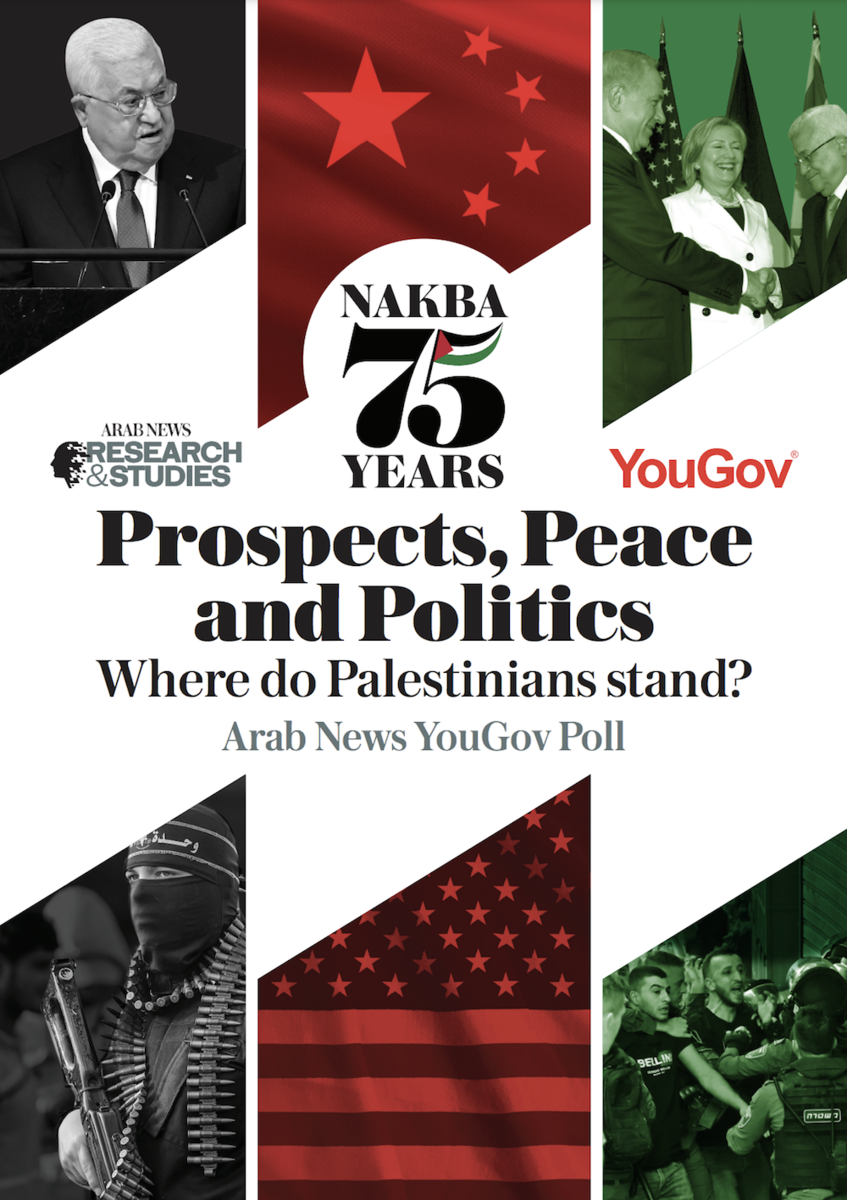
LONDON: An Arab News-YouGov poll - titled 'Prospect, Peace and Politics: Where do Palestinians stand?' - has revealed that there is little doubt in the minds of Palestinians about what should be the priority of any future independent Palestinian state — the economy.
Those polled were asked to rank six potential policy priorities on a scale of importance from 1 to 6, and a majority of 41 percent of respondents who gave an answer put economic development and the creation of jobs at the top of their to-do list.
Nearly 30 percent named border control and internal security as their top priority.
It is clear, however, that until the issue of growing the economy is addressed, Palestinian voters are unlikely to be focused on any of the other main functions of the government of a future Palestinian state.
Healthcare, for example, is seen as the number-one priority by just 5 percent of respondents, with barely any more enthusiasm expressed for infrastructure (7 percent), international relations (8 percent) and education (10 percent).
“I fully agree that economic development and job creation must be a top priority,” said Jason Greenblatt, former White House envoy to the Middle East under the Trump administration and author of the 2022 book “In the Path of Abraham: How Donald Trump Made Peace in the Middle East.”
However, he told Arab News, “I think the words ‘independent Palestinian State’ are one of the most-often glossed-over issues of the conflict.
“I don’t think that is realistically achievable for the foreseeable future, given the history of the conflict.”
On the other hand, he said, “I do think what we created under the Trump peace plan gives the Palestinians something they could develop into a huge success.”
That, he added, was why it was “a big mistake” for Palestinians to set themselves against the Abraham Accords.
The Arab News poll found that a majority (64 percent) remain opposed to the normalization of relations between Arab states and Israel before the Palestinian issue is resolved, despite the initiative’s focus on economic development.
“First of all, the Palestinians have been supported financially by the Gulf countries for decades,” Greenblatt said.
“They should be grateful for that and not criticize countries like the UAE and others.”
The UAE normalized relations with Israel in August 2020, followed by agreements with Sudan, Bahrain and Morocco, and in May 2022 Israel and the UAE signed a free-trade agreement, a historic first for any Arab country.
The Comprehensive Economic Partnership Agreement, which came into force on April 1 this year, establishes an “open and non-discriminatory environment for cross-border trade with Israel” and grants greater access to the Israeli market for UAE products and services.
Palestinians, Greenblatt said, “could be part of the economic success of the Abraham Accords without giving up their negotiating positions.
“Imagine how many Palestinian lives could be positively affected, even in the absence of peace with Israel, if Palestinians took part in this new Abraham Accords economy.”
This was, he added, “a historic, and yet another missed, opportunity for Palestinians.”
However, US-Palestinian journalist, author and media consultant Ramzy Baroud told Arab News that Palestinians “continue to overwhelmingly reject normalization because historically the Arab and Muslim world has served as Palestine’s strategic depth.
“Palestinians understand that this is not their fight alone but a fight for peace and justice in the entire region. They also understand that economic development without political and legal rights is pointless.
“Israel has tried this before, the so-called economic peace, and has failed miserably.”