- Respondents could choose English or Arabic as their preferred language at the start of the questionnaire
- Opinion poll, which took the pulse of Palestinians, was conducted over April 28-May 11 in West Bank and Gaza Strip
DUBAI: On the 75th anniversary of Palestine’s Nakba, Arab News partnered with YouGov to discover what Palestinians think of the current circumstances.
The survey, titled 'Prospect, Peace and Politics: Where do Palestinians stand?' delves into Palestinian’s thoughts and feelings about the conflict and a peace deal and ran between April 28 and May 11 in Palestine.
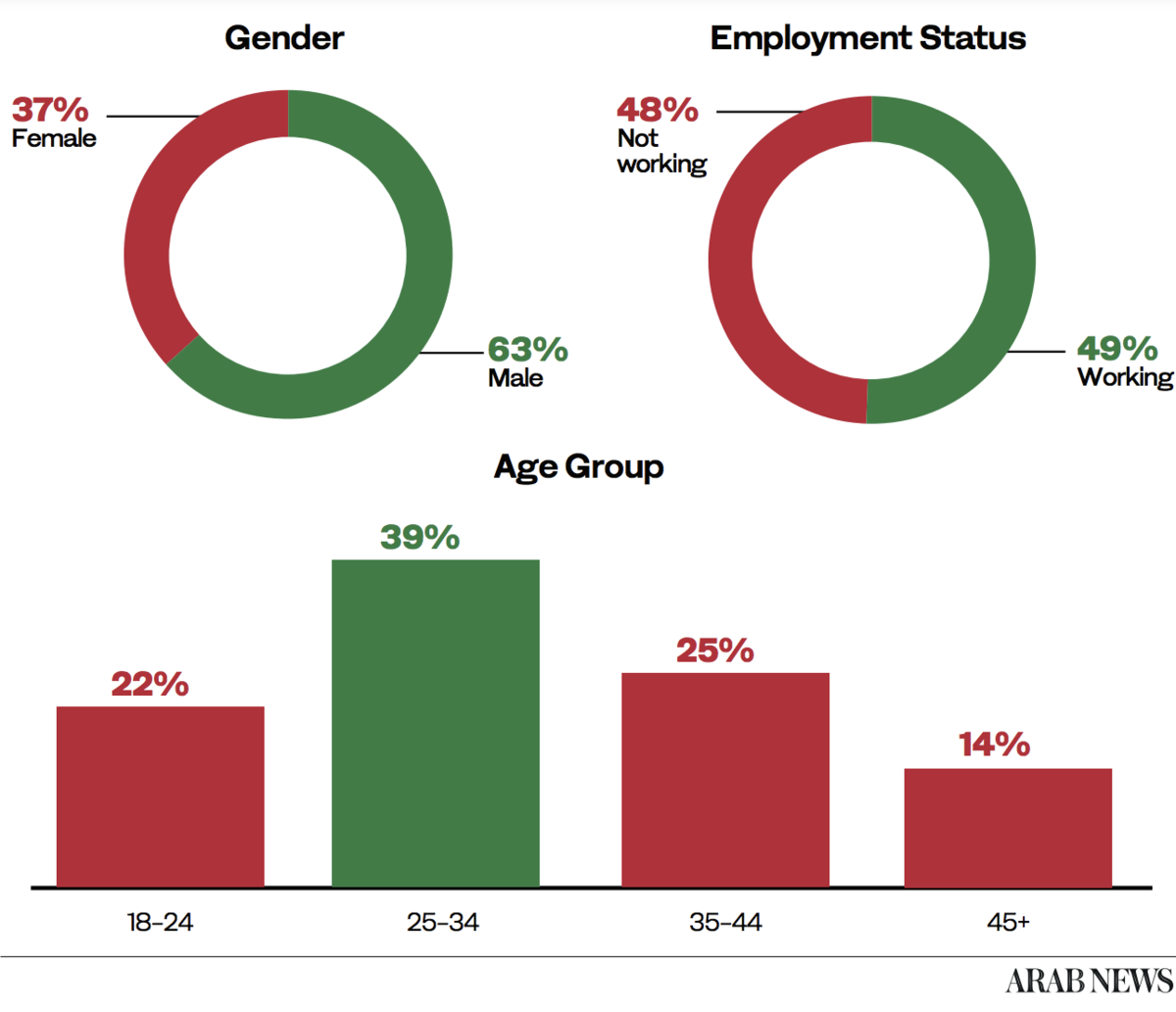
A total of 953 respondents were surveyed, including a weighted base of 467 men and 486 women.
Respondents from all age groups participated in the survey with a weighted base of 276, 300, 243 and 135 in the 18-24, 25-34, 35-44 and 45+ age groups respectively.
Survey respondents also included people from various income brackets and marital statuses. A total of 442 respondents were employed, while 511 were unemployed.
The survey was conducted online using a structured quantitative questionnaire, and respondents could choose English or Arabic as their preferred language at the start of the questionnaire.
The survey results were rebased, in line with accepted industry standards, to remove “don’t know” or “can’t say” answers to compare only relevant answers.
Among the highlights of the findings were that more than half (51 percent) said that they saw a two-state solution as the best one to resolve the conflict, followed by 21 percent considering a federal state as the ideal solution. Only 4 percent said that the best solution would be Gaza going to Egypt and the West Bank going to Jordan, with Palestinians carrying either Egyptian or Jordanian passports.
Perhaps surprisingly, 11 percent said that they would return to live under full Israeli occupation, but without Israeli citizenship or a Palestinian Authority. This number was significantly lower (5 percent) among those over the age of 40.
In the case of Israel refusing to give Jerusalem fully to the new Palestinian state, a suitable compromise would be to divide the city, with East Jerusalem as the capital of the Palestinian state and West Jerusalem as the capital of Israel, according to 42 percent of respondents.
Only 7 percent said that they would accept the Israelis keeping Jerusalem as a suitable compromise.
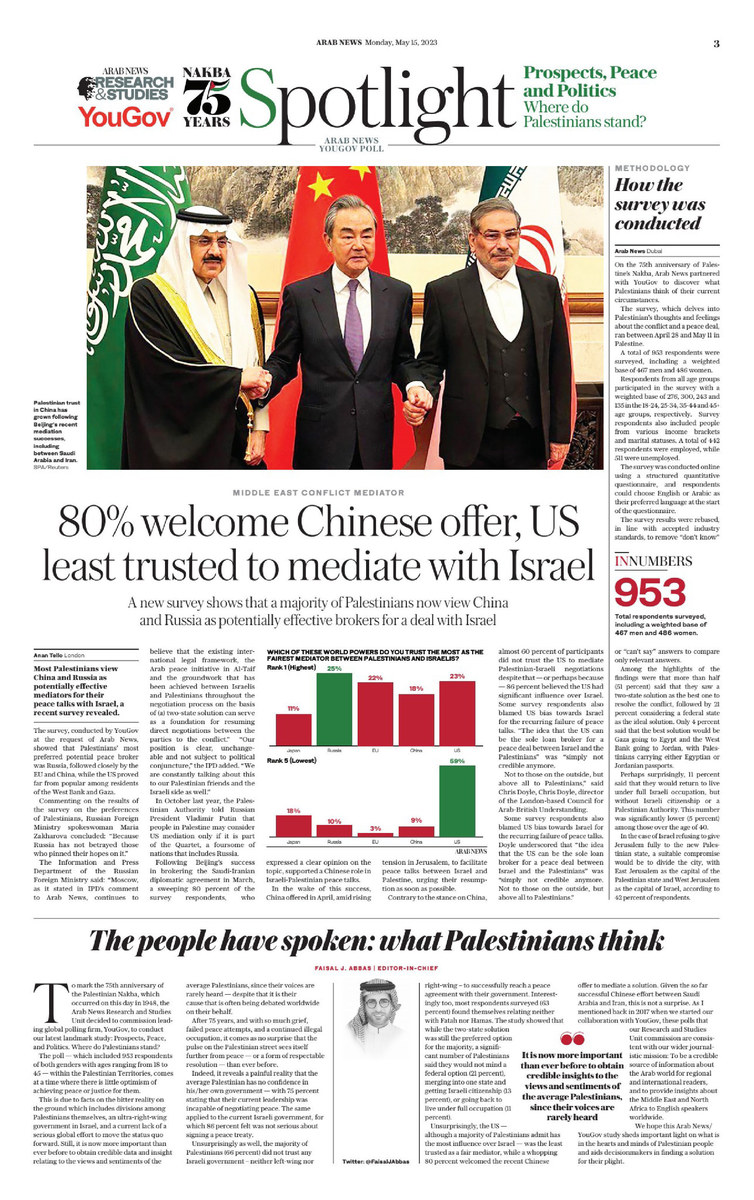
Despite China’s eagerness to broker Israel-Palestine peace talks, only 4 percent of those surveyed considered it to have any influence over Israel with the majority (86 percent) saying that the US was the most influential world power. However, a massive 80 percent said that they would support China’s offer given their mediation success between Saudi Arabia and Iran.
In the Arab world, respondents believed Egypt had the most influence over Israel with 29 percent ranking it first, followed by UAE (24 percent), Qatar (21 percent), Saudi Arabia (19 percent), and Jordan (7 percent).
In terms of trust, most respondents ranked Qatar (34 percent) the highest and UAE (7 percent) the lowest.
Despite Washington’ perceived influence over Israel, only 23 percent ranked the US first when asked who they trusted as the fairest mediator between the two countries, and the majority (59 percent) ranked it fifth.
The survey was commissioned by Arab News and conducted by YouGov as a part of an ongoing partnership between the two companies.