

Eurovision organizers ban Ukraine President Zelensky from addressing global audience

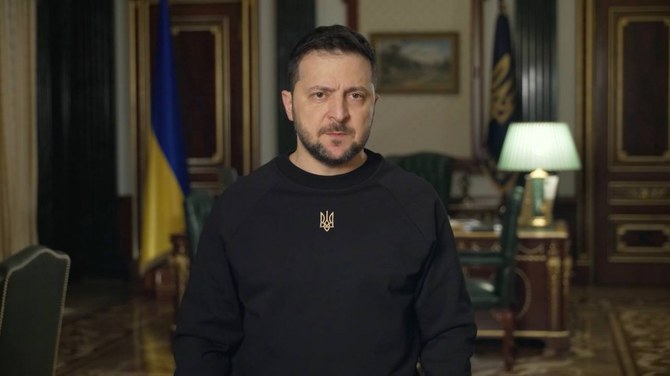
Zelensky's request to speak at Eurovision was turned down by the organizers, including the BBC. (Twitter/Sourced)
Short Url
Updated 13 May 2023
Follow

Eurovision organizers ban Ukraine President Zelensky from addressing global audience

  • International broadcasters, including the BBC, were concerned that Zelensky’s appearance may politicize the song contest
  • Eurovision this year has ‘featured strongly’ Ukrainian music and culture, says European Broadcasting Union

LONDON: Ukraine President Volodymyr Zelensky has been barred from making a surprise video appearance during the Eurovision final.

Zelensky had plans to address a global audience of some 160 million people to urge continued support for Ukraine against Russia’s invasion, but his request was rejected by the organizers of the annual song contest, The Times reported.

This came due to concerns over the politicization of the international song contest, said the European Broadcasting Union — EBU — an alliance of more than 100 public service media, including the BBC, which is hosting this year’s Eurovision.

“The Eurovision Song Contest is an international entertainment show and governed by strict rules and principles which have been established since its creation,” explained an EBU spokesperson, stressing that “one of the cornerstones of the contest is the non-political nature of the event.

“This principle prohibits the possibility of making political or similar statements as part of the contest,” the spokesperson said. “The request by Mr. Zelensky to address the audience at the Eurovision Song Contest, whilst made with laudable intentions, regrettably cannot be granted as it would be against the rules of the event.”

According to the spokesperson, the EBU has “featured strongly” Ukrainian music and culture through 11 Ukrainian artists, “including last year’s winner Kalush Orchestra.”

“Additionally, 37 locations around Ukraine will feature in the short film postcards that introduce each of the participating artists before they take to the stage,” the spokesperson said. “We believe that this is the best way to reflect and celebrate Ukraine’s Eurovision Song Contest win and show we are united by music during these hard times.”

Zelensky was also blocked from addressing other entertainment events, including the Oscars in March this year and in 2022, in line with the Toronto Film Festival in September.

Eurovision 2023 was supposed to be held in Ukraine. However, due to Russian aggression in the Eastern European country, the UK hosted the event, vowing to make it a celebration of Ukrainian creativity and culture.

Zelensky recently said that the song contest should not have been hosted by the UK on Ukraine’s behalf, but rather in a country that shares a border with Ukraine, such as Poland and Slovakia, so his people to travel easily, Metro News reported.


Foreign press group welcomes Israel court deadline on Gaza access

Updated 22 December 2025
Follow

Foreign press group welcomes Israel court deadline on Gaza access

  • Supreme Court set deadline for responding to petition filed by the Foreign Press Association to Jan. 4
  • Since the start of the Gaza war in October 2023, Israeli authorities have prevented foreign journalists from independently entering the Strip

JERUSALEM: The Foreign Press Association in Jerusalem on Sunday welcomed the Israeli Supreme Court’s decision to set January 4 as the deadline for Israel to respond to its petition seeking media access to Gaza.
Since the start of the Gaza war in October 2023, sparked by Palestinian militant group Hamas’s attack on Israel, Israeli authorities have prevented foreign journalists from independently entering the devastated territory.
Israel has instead allowed, on a case-by-case basis, a handful of reporters to accompany its troops into the blockaded Palestinian territory.
The Foreign Press Association (FPA), which represents hundreds of foreign journalists in Israel and the Palestinian territories, filed a petition to the supreme court last year, seeking immediate access for international journalists to the Gaza Strip.
On October 23, the court held a first hearing on the case, and decided to give Israeli authorities one month to develop a plan for granting access.
Since then the court has given several extensions to the Israeli authorities to come up with their plan, but on Saturday it set January 4 as a final deadline.
“If the respondents (Israeli authorities) do not inform us of their position by that date, a decision on the request for a conditional order will be made on the basis of the material in the case file,” the court said.
The FPA welcomed the court’s latest directive.
“After two years of the state’s delay tactics, we are pleased that the court’s patience has finally run out,” the association said in a statement.
“We renew our call for the state of Israel to immediately grant journalists free and unfettered access to the Gaza Strip.
“And should the government continue to obstruct press freedoms, we hope that the supreme court will recognize and uphold those freedoms,” it added.
An AFP journalist sits on the board of the FPA.