

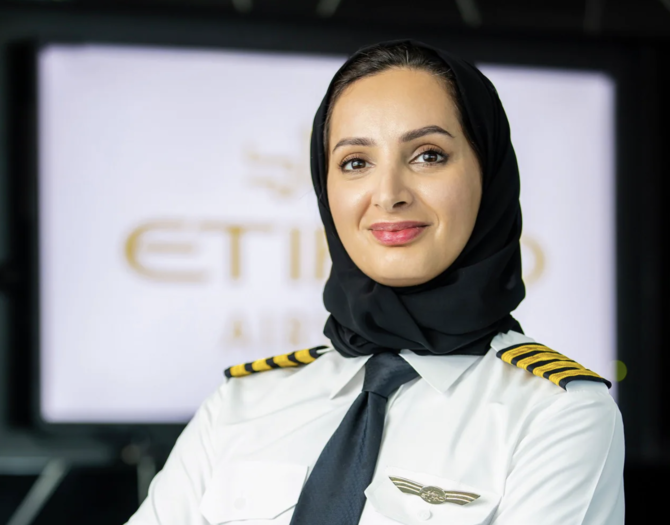
42 percent of workforce in UAE aviation sector are women, conference told

Aisha Al-Mansoori, the UAE’s first female captain at a commercial airline. (Etihad)
Short Url
Updated 11 May 2023
Follow

42 percent of workforce in UAE aviation sector are women, conference told

  • Despite advances the gender gap in the industry remains significant and an effective strategy is required to address the issue, Sheikha Mozah bint Marwan Al-Maktoum told delegates
  • The Women in Aviation Conference in Dubai heard there are many aviation career options for women other than pilot, and companies such as Boeing are working to advance gender equality

DUBAI: About 27,000 women now work in the UAE’s aviation sector, a figure that represents 42 percent of the workforce, the Emirates News Agency reported on Wednesday

Mervat Sultan, president of the Middle East Chapter of Women in Aviation, said the number of women working in the industry is increasing because of active and constructive engagement with women interested in a career in the field.

Speaking at Women in Aviation’s 10th Anniversary Conference in Dubai, Sultan said: “If you want to build your nation, you need to build a generation first. The empowerment of women is essential for betterment of the society.

“For this, women’s education and training are important. We need to educate parents and children as well about employment opportunities in aviation.”

Sultan noted that already, “women are in all areas of aviation, not only as pilots; there are more engineers, air traffic controllers, medical, technical and legal staff.”

Sheikha Mozah bint Marwan Al-Maktoum, a 1st Lt and pilot with Dubai Police Air Wing, told delegates that the gender gap in aviation remains significant and that an effective strategy is required to address the issue.

Delivering the keynote speech, she said that in 2019 she founded Shehana, an association to empower and support women in the aviation industry, and advance gender balance through local, regional and international partnerships and collaborations.

“Women in the UAE are not just heard and seen but respected and included,” said Sheikha Mozah. “To improve gender equality there is a need for collaboration of sponsors, government and organizations supporting women in aviation.”

Kuljit S. Ghata-Aura, the president of Boeing Middle East, Turkiye and Africa, said: “Boeing has taken steps to support gender equality in the workplace in the UAE.

“In December 2022, we joined 15 companies from the UAE’s private sector in signing a pledge to accelerate the advancement of gender equality in the UAE’s workforce by increasing the representation of women in leadership roles to 30 percent by 2025.

“This pledge was an important opportunity for us to reinforce our efforts and align them with the UAE’s gender-balance agenda.”

The proportion of women in the Boeing workforce has increased to 24.6 percent globally, Ghata-Aura said, as a result of improvements to hiring and retention efforts.

Among a number of successful and influential individuals who were honored during the conference for their achievements, the Innovative Leader Award in Women in Aviation was presented to Suzanne Al-Anani, CEO of Dubai Aviation Engineering Projects.


BYD Americas CEO hails Middle East as ‘homeland for innovation’

Updated 21 January 2026
Follow

BYD Americas CEO hails Middle East as ‘homeland for innovation’

  • In an interview on the sidelines of Davos, Stella Li highlighted the region’s openness to new technologies and opportunities for growth

DAVOS: BYD Americas CEO Stella Li described the Middle East as a “homeland for innovation” during an interview with Arab News on the sidelines of the World Economic Forum.

The executive of the Chinese electric vehicle giant highlighted the region’s openness to new technologies and opportunities for growth.

“The people (are) very open. And then from the government, from everybody there, they are open to enjoy the technology,” she said.

BYD has accelerated its expansion of battery electric vehicles and plug-in hybrids across the Middle East and North Africa region, with a strong focus on Gulf Cooperation Council countries like the UAE and Saudi Arabia.

GCC EV markets, led by the UAE and Saudi Arabia, rank among the world’s fastest-growing. Saudi Arabia’s Public Investment Fund has been aggressively investing in the EV sector, backing Lucid Motors, launching its brand Ceer, and supporting charging infrastructure development.

However, EVs still account for just over 1 percent of total car sales, as high costs, limited charging infrastructure, and extreme weather remain challenges.

In summer 2025, BYD announced it was aiming to triple its Saudi footprint following Tesla’s entry, targeting 5,000 EV sales and 10 showrooms by late 2026.

“We commit a lot of investment there (in the region),” Li noted, adding that the company is building a robust dealer network and introducing cutting-edge technology.

Discussing growth plans, she envisioned Saudi Arabia and the wider Middle East as a potential “dreamland” for innovation — what she described as a regional “Silicon Valley.” 

Talking about the EV ambitions of the Saudi government, she said: “If they set up (a) target, they will make (it) happen. Then they need a technology company like us to support their … 2030 Vision.”