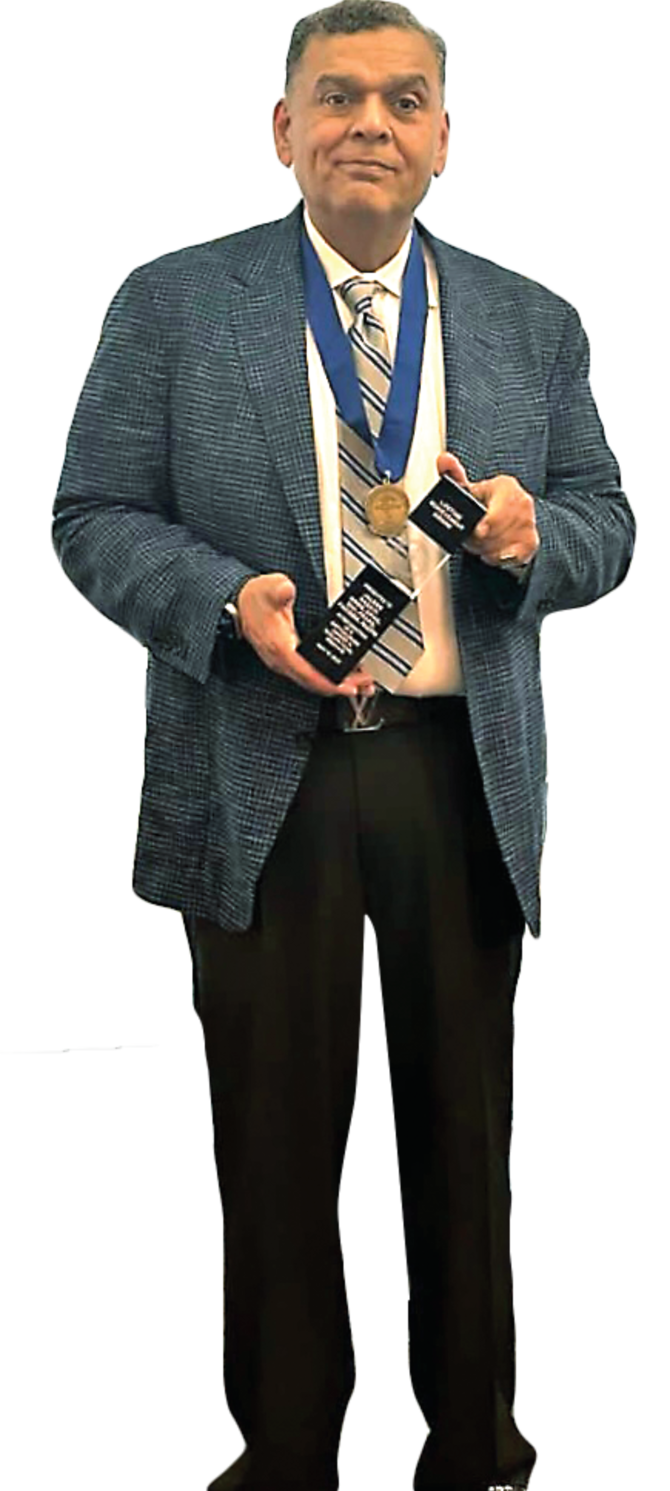

RIYADH: A Saudi doctor has been presented with the prestigious Lifetime Achievement in OEM Award by the American College of Occupational and Environmental Medicine.
Dr. Jalees Razavi is the first Saudi, and Arab, to have been honored with the prize and also the first person from outside North America.
The award, which was created in 1938 by William S. Knudsen, then president of General Motors, recognizes doctors who have made a distinguished contribution to occupational and environmental medicine.
“Never in my wildest dream did I think that I would ever be nominated, let alone win it, Razavi told Arab News.
“I Googled the award and was speechless, as the luminaries who have won this award in the past consist of the who’s who of the specialty, such as C. Everett Koop, the 13th surgeon general of the US, and the father of modern occupational medicine in Canada, Ernest Mastromatteo in 1987.”
Saudi Arabia has many world-class medical researchers. Many Saudis have already proven to the world that they are hardworking, capable, ethical and goal-oriented professionals. I hope that this award willinspire the next generations ofSaudi professionals to continue to workhardand aim higher.
Dr.Jalees Razavi, Saudi physician
Based in Canada, Razavi has been a pioneer in the field of occupational and environmental medicine in Saudi Arabia and across the Middle East, and has chaired many symposiums, conferences and technical workshops.
“I think (receiving the award) is the combination of my active clinical work, unyielding commitment to the health and safety of the workforce and teaching,” he said.
At the award ceremony, Razavi was praised for his work as head of occupational medicine and later as chief of preventive medicine at Saudi Aramco, where he led on a number of environmental health campaigns.
“During my work as the executive medical director for Imperial Oil Ltd., Canada and ExxonMobil I worked on the slogan I introduced: ‘Having a Healthy Career,’” he said.
Razavi said occupational and environmental medicine was the field that dealt with the relationship between work and people’s physical and mental health.
“Without enough physicians, the gap is filled by professionals who will not have the skill sets required to address worker health needs. This ultimately impacts the health of workers and even their safety, depending on their job. I don’t think that there is a global solution, nor is it something that can be solved alone.
“Instead, governments, industries, unions, workers, medical schools, regulatory bodies and others should come together to determine how to arrive at an adequate number of specialists to meet population needs and maintain worker health.”
He also suggested incorporating OEM courses in undergraduate medical education and postgraduate residency training in order to grow interest and awareness in the speciality.
“Over the past 20 or more years, planetary health, global warming, greenhouse effect and climate change became global challenges. The occupational medicine specialists were quick to recognize the need for addressing the environmental medicine need,” Razavi said.
“The postgraduate programs in occupational medicine at the Universities of Toronto, Alberta and Montreal, for example, over the last many years have expanded their training curriculum to include environmental medicine.
“I expanded my practice for heat- and cold-related diseases and injuries, migrant and remote workers heath, and I also consult on disaster responses, because what happens in one corner of the world can impact the rest within hours, such as with COVID-19 or catastrophes such as Fukushima or Chernobyl.”
Different from clinical medicine, OEM evaluates and addresses whether certain illnesses are caused by a specific workplace exposure and evaluates risk, toxicology, injuries management and prevention.
“For example, we may diagnose diabetes in the workplace during routine screening. We don’t actively treat the condition, but assess and manage the impact of the disease on the worker’s health at work, and his or her safety in the workplace,” Razavi said.
He said he was proud to be the first Saudi to win the award.
“Saudi Arabia has many world class medical researchers. Many Saudis have already proven to the world that they are hardworking, capable, ethical and goal-oriented professionals. I hope that this award will inspire the next generations of Saudi professionals to continue to work hard and aim higher.”