

Palestinian PM calls on UNESCO to prevent Israeli settlement in historic village

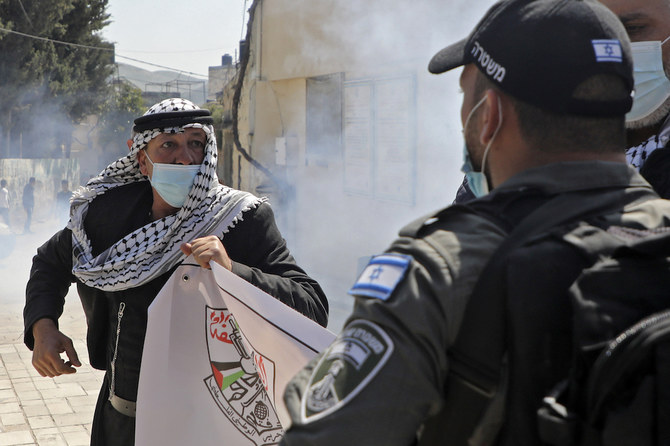
A Palestinian demonstrator rallies against settlers' visit to historical sites in the Palestinian village of Sebastia, Nablus. (File/AFP)
Short Url
Updated 08 May 2023
Follow

Palestinian PM calls on UNESCO to prevent Israeli settlement in historic village

  • Shtayyeh said settlement expansion was a continuation of the Nakba

RIYADH:  Palestinian Prime Minister Mohammad Shtayyeh called on UNESCO to place pressure on Israel to stop its development of a settlement near the historic village of Sebastia in Nablus, the Saudi Press Agency reported on Monday.  

During a weekly session convened by the Palestinian government, Shtayyeh warned of the consequences of the settlement plan on historical landmarks, including a building in Hebron.

Shtayyeh said that the settlement development is a continuation of the Nakba, or “Catastrophe,” which resulted in the mass displacement of Palestinians.  

This year marks the 75th anniversary of the Nakba, which will be commemorated for the first time by the UN at its headquarters in New York. 

The commemoration will witness the participation of Palestinian President Mahmoud Abbas, who expressed optimism that it would mark the start of an effective international response to the “ethnic cleansing” that the occupation is committing against the Palestinian people.


Jordan condemns Israel’s seizure of planning powers at Ibrahimi Mosque

Updated 9 sec ago
Follow

Jordan condemns Israel’s seizure of planning powers at Ibrahimi Mosque

  • Announcement on Wednesday by Israeli Civil Administration said it had transferred planning powers from Palestinian Authority-run Hebron Municipality to its own Supreme Planning Council

AMMAN: Jordan’s Ministry of Foreign and Expatriates Affairs on Friday strongly condemned Israel’s decision to revoke the planning and construction authorities of the Hebron Municipality at the Ibrahimi Mosque, the Jordan News Agency reported.

The ministry described the move as a blatant violation of international law and the historical and legal status quo at the holy site, JNA added.

The condemnation follows an announcement on Wednesday by the Israeli Civil Administration the body overseeing the occupied West Bank, that it had transferred planning powers from the Palestinian Authority-run Hebron Municipality to its own Supreme Planning Council.

The decision was accompanied by approval for a project to construct a roof over the mosque’s internal courtyard, a move that has drawn fierce Palestinian opposition.

The Hebron Municipality also condemned the Israeli decision, describing it as a “serious and illegal violation” and part of a systematic effort to alter the status quo at the mosque and weaken the authority of Palestinian institutions responsible for its management.

In a statement, the Jordanian ministry said Israel, as the occupying power, was acting unlawfully by unilaterally approving construction works at the Ibrahimi Mosque and stripping Palestinian authorities of their administrative powers, warning that the measures undermine the Islamic administration of the site.

The ministry’s official spokesperson, Fouad Al-Majali, affirmed Jordan’s “absolute rejection and severe condemnation” of Israel’s continued illegal unilateral measures in the occupied West Bank, most recently those targeting the Ibrahimi Mosque in Hebron.

Al-Majali added that the actions constituted clear violations of international law and international humanitarian law, including the 1954 Hague Convention for the Protection of Cultural Property in the Event of Armed Conflict, as well as relevant United Nations resolutions.

He also pointed to UNESCO’s 2017 decision to inscribe Hebron’s Old City and the Ibrahimi Mosque on the List of World Heritage in Danger.

He called on the international community to shoulder its “legal and moral responsibilities” by compelling Israel to halt its illegal measures in the occupied Palestinian territory, protect the cultural and religious heritage of the Ibrahimi Mosque, and preserve its outstanding universal value, which he said is under increasing threat due to Israeli actions.

Al-Majali further emphasized that achieving security and a just and comprehensive peace would remain impossible without fulfilling the legitimate rights of the Palestinian people to self-determination, including the establishment of an independent, sovereign Palestinian state on 1967 lines, with East Jerusalem as its capital.