



ISLAMABAD: In a veiled reference to India, Pakistani foreign minister Bilawal Bhutto-Zardari said on Friday states should not “weaponize terrorism for diplomatic point scoring.”
The foreign minister was speaking at the SCO Council of Foreign Ministers meeting in Goa during the first high-profile visit to India by a Pakistani top official in almost a decade. His comments followed those by his Indian counterpart, Subhrahmanyam Jaishankar, who said “cross-border terrorism must be stopped,” in what was perceived as a clear reference to Pakistan.
India and Pakistan have fought three wars since becoming separate nations in 1947, two of them over the Himalayan Muslim-region of Kashmir, which both claim in full but rule in part. New Delhi has for years accused Islamabad of backing separatists in the Indian-governed part of Kashmir. Pakistan denies the allegations.
“The collective security of our peoples is our joint responsibility,” Bhutto-Zardari said in his address at the SCO, a copy of which was released to the media by the foreign office.
“Terrorism continues to threaten global security, [so] let’s not get caught up in weaponizing terrorism for diplomatic point scoring.”
The foreign minister added that Pakistan, which had for decades suffered militant attacks and casualties, was ” firmly committed to being part of regional and global efforts for eradicating the menace of terrorism.”
“We must stop conflating non-state actors with state actors [and] condemn all forms of terrorism, including state-sponsored terrorism,” he said, calling on the SCO’s regional anti-terrorist structure (RATS) to be strengthened.
Earlier, the Indian foreign minister had said in a statement that “terrorism must be stopped in all its forms and manifestations including cross-border terrorism.”
“We must not allow anybody — individual or State — to hide behind non-State actors.”
Bhutto-Zardari also made a veiled reference to the disputed Kashmir region, saying “unilateral and illegal measures by States in violation of international law and Security Council resolutions run counter to the SCO objectives.”
He was widely perceived to be referring to New Delhi in 2019 stripping the special autonomy of the portion of the contested Kashmir region that it governs, after which Pakistan downgraded its diplomatic relations with India and suspended bilateral trade.
Earlier, in a widely shared photograph, Bhutto-Zardari was seen with Jaishankar ahead of the SCO meeting. However, there are no plans for the two leaders to meet separately and the Pakistani FM’s visit is not expected to lead to a breakthrough in strained Indian-Pakistani relations.
SCO foreign ministers began to gather in Goa on Thursday for Friday’s meetings on regional security matters, including adding Iran and Belarus to a union of nations seen as a counterweight to Western influence in Eurasia.
The foreign ministers, including Russia’s Sergei Lavrov and China’s Qin Gang, will prepare the ground for an SCO summit in India in July that Russian President Vladimir Putin and Chinese counterpart Xi Jinping are expected to attend in person.
The SCO is a political and security union of countries spanning much of Eurasia, including China, India, and Russia. Formed in 2001 by Russia, China, and ex-Soviet states in Central Asia, the body has been expanded to include India and Pakistan.
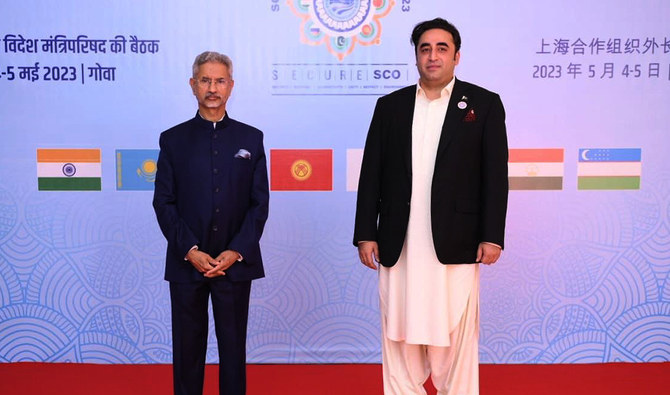
In this handout picture, taken and released by the Ministry of Foreign Affairs of Pakistan, Foreign Minister Bilawal Bhutto-Zardari (right) gestures with his Indian counterpart Subrahmanyam Jaishankar (left) ahead of Shanghai Cooperation Organization Council of Foreign Ministers meeting in Goa on May 5, 2023. (Photo courtesy: MOFA)




