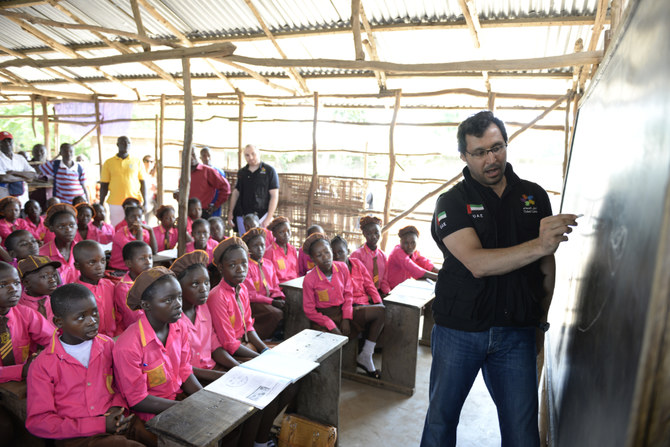

LONDON/GENEVA: The future of education will always be human despite the advances of artificial intelligence, Dubai Cares CEO and Vice Chairman Dr. Tariq Al Gurg said on Tuesday.
Al Gurg, who was speaking at the World Economic Forum’s Growth Summit in Geneva, said that AI will radically transform education systems and their human capital, but not replace them.
He told Arab News: “In my opinion, the future will always be human. And if we think otherwise, then it’s not a human-centric world.”
Dubai Cares, the philanthropic organization founded by UAE Prime Minister Mohammed bin Rashid Al-Maktoum in 2007, is dedicated to improving the lives of children and young people through quality education, while positioning it at the heart of human development.
Al Gurg said that the world was similarly concerned when computers became popular, but people still kept their jobs, and “everything went normal.”
He added: “Whether we were at clerks level or management level, we needed to (keep) upskilling ourselves.”
Some jobs would be lost and others created but, he said, “this is a cycle that will remain, and the future will remain human.”
He said that the traditional system of education needs to transform to meet challenges, starting with the roles of teachers and the way students learn. He added that we are moving away from a knowledge-based education and toward one that focuses on validating and checking the accuracy of information provided by tools like AI.
“Today, the technology has changed,” he said. “From books we moved to Google, and from Google we’re now moving to AI. I don’t see how a teacher’s role should be harmed in this transition.
“We have to adapt to AI. We have to build the capacities of teachers exactly how we build them toward computers.”
The CEO said that as AI becomes more advanced, students will move away from doing their own research and instead focus on validating the authenticity of information generated by AI systems.
He added: “Our role will change as well, and we have to make sure that the teachers are fully equipped with any fast-growing or accelerated technological advancement that we're going through.”
Al Gurg said that policymakers should focus on outlining a vision to transform the education system, as the risk of misuse of AI would be greater for a generation that lacks preparation in the use of the technologies.
He added: “That’s why the role of a teacher and education will play a very big role in whatever is upcoming when it comes to skilling and AI.”
He believes that if countries want to prepare a new global workforce, the international community should come together with the private sector to develop a framework to guide countries through the transformation that needs to be done. This should be designed to accommodate all the new changes, especially future jobs.
He said: “If we’re going to create that ecosystem, the private sector has to be involved because future jobs rely on the private sector. They are the ones who are going to reinvent their products so they will need future jobs and for these future jobs new skills are needed, so we need to upskill and reskill people today.
“But to do that we have to get the minister of education on board so they can change the curriculum.”
Dubai Cares has worked with a cohort of international partners over the years, including the World Economic Forum and the UN, to deliver over 250 programs across 60 countries, benefiting more than 21 million young people.
Recently it has partnered with UN agencies, academia, the private sector, teachers, and young people to draft a unified framework and promote policy papers with the goal of transforming the education system.
The philanthropic organization has also signed an exclusive partnership with COP28 to be its exclusive education partner.
As part of this partnership, Dubai Cares will host the second edition of the RewirEd Summit, which will focus on climate and education, green schools, and green jobs toward greener economies.
Al Gurg said: “We’re putting education at the center, at the heart of the conference and for the first time ever education is having a thematic day.
“What we hope to come out with from the summit is the youth’s role and the future of our planet, and how we can green our skills toward the jobs that are being created from the products that are being produced.
“And hopefully we come up with a full dossier of solutions as examples that can be used to help education become a main pillar of every future COP conference moving forward.”