

IMF says inflation to slow growth across Middle East, Pakistan this year

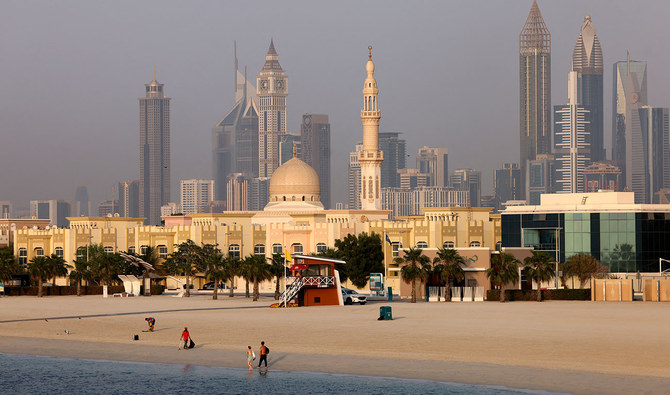
In this file photo taken on September 14, 2022 People gather at a beach in the Gulf emirate of Dubai. (AFP/File)
Short Url
Updated 03 May 2023
Follow

IMF says inflation to slow growth across Middle East, Pakistan this year

  • The international lending agency predicts regional growth to drop from 5.3 percent last year to 3.1 percent
  • Rising interest rates, used by central banks to stem inflation’s rise, are increasing the costs of borrowing money

DUBAI: Economies across the Middle East and Central Asia will likely slow this year as persistently high inflation and rising interest rates bite into their post-pandemic gains, the International Monetary Fund (IMF) said Wednesday.

The IMF’s Regional Economic Outlook blamed in part rising energy costs, as well as elevated food prices, for the estimated slower growth. The report said that while oil-dependent economies of the Gulf Arab states and others in the region have reaped the benefits of elevated crude prices, other countries — such as Pakistan — have seen growth collapse after an unprecedented flooding last summer or as economic woes worsened.

The regional slowdown also comes as an explosion of fighting in Sudan between two top rival generals — who only a year ago as allies orchestrated a military coup that upended the African country’s transition to democracy — threatens a nation where IMF and World Bank debt relief remains on hold.

Rising interest rates, used by central banks worldwide to try to stem inflation’s rise, increase the costs of borrowing money. That will affect nations carrying heavier debts, the IMF warned.

“This year we’re seeing inflation again being the most challenging issue for most of the countries,” Jihad Azour, the director of the Middle East and Central Asia Department at the IMF, told The Associated Press. “For those who have high level of debt, the challenge of increase in interest rate globally, as well as also the tightening of monetary policy, is affecting them.”

The IMF forecast predicts regional growth will drop from 5.3 percent last year to 3.1 percent this year. Overall, regional inflation is expected to be at 14.8 percent, unchanged from last year, as Russia’s war on Ukraine continues to pressure global food supplies and affect energy markets.

It will be even worse in Pakistan, where the IMF projected inflation to more than double, to about 27 percent. Pakistan and IMF officials have held repeated talks over the release of a stalled key tranche of a $6 billion bailout package loan to Islamabad.

The IMF warned that financial conditions worldwide will tighten this year, brought on in part by two bank failures in the United States in March. The sudden collapse of Credit Suisse before it was purchased by UBS also strained markets.

For Sudan, Azour acknowledged the challenge as the country faces a humanitarian crisis brought on by the weeks of fighting there. The violence has also worsened a debt crisis that has gripped the country for decades as it faced Western sanctions.

“We have worked with the government of Sudan, for the Sudanese people, in order to help them by achieving a debt operation that would allow Sudan to have a debt relief of more than $50 billion,” Azour said.

“But unfortunately, the recent developments ... put in a halt to all of those efforts,” he added.


Pakistan’s Punjab launches ‘Green Policing Unit’ with electric patrol fleet amid smog

Updated 7 sec ago
Follow

Pakistan’s Punjab launches ‘Green Policing Unit’ with electric patrol fleet amid smog

  • Unit to begin operations in Lahore, expand to other districts in phases
  • Chief minister says electric fleet will cut fuel costs and carbon emissions

ISLAMABAD: Pakistan’s eastern province of Punjab on Thursday launched the country’s first Green Policing Unit, according to an official statement, introducing electric patrol vehicles as authorities seek to curb fuel use and emissions amid worsening winter smog.

Large parts of Punjab, the country’s most populous province, are engulfed by dense smog every winter as cold, stagnant air traps pollution from vehicle emissions, construction dust , and agricultural fires.

The provincial capital, Lahore, frequently ranks among the world’s most polluted cities during the season. While authorities have previously relied on measures such as anti-smog guns and traffic restrictions, these have offered only temporary relief, leaving residents exposed to hazardous air quality.

“Green policing reflects the vision of clean air and good governance,” Chief Minister Maryam Nawaz Sharif said after inaugurating the unit.

“The use of electric vehicles will lead to a reduction in fuel costs and result in zero carbon emissions,” she added.

The chief minister inspected the electric patrol vehicles and drove one herself, according to the official statement.

Officials said the Green Policing Unit would initially operate in Lahore, using modern electric vehicles for traffic patrolling.

The vehicles, manufactured by Chinese automaker BYD, have a driving range of about 410 kilometers per charge and can be fast-charged from 30 percent to 80 percent in around 30 minutes, according to a briefing given to the chief minister.

All the electric patrol vehicles are fitted with surveillance systems, public address equipment, police lights, 360-degree cameras, and speed-detection tools.

Officials said conventional police patrol vehicles currently deployed in Lahore consume around 28,000 liters of fuel per month, costing about Rs7.42 million rupees ($26,600).

By contrast, each electric vehicle is expected to save roughly 4,500 liters of fuel annually, lower operational costs and eliminate carbon emissions.

The chief minister directed authorities to gradually expand the number of electric vehicles assigned to the Green Policing Unit and ordered steps to roll out the initiative to other districts of Punjab in phases, the statement added.