

Pakistan to announce new policy promoting electric vehicles ‘soon’— minister 

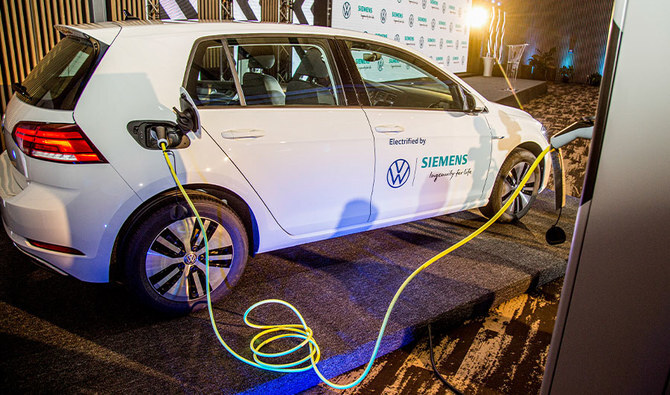
Volkswagen's first imported electric vehicle "e-Golf" is displayed during its launching ceremony in Kigali, Rwanda, on October 29, 2019. (AFP)
Short Url
Updated 25 September 2024
Follow

Pakistan to announce new policy promoting electric vehicles ‘soon’— minister 

  • Minister says policy to accelerate sale of two-wheelers and three-wheelers in country
  • Pakistan’s urban areas exhibit some of the world’s highest levels of air pollution

ISLAMABAD: Pakistan’s government plans to introduce a new policy “soon” to promote electric vehicles in the country, Power Minister Sardar Awais Ahmed Khan Laghari said on Wednesday, as Islamabad seeks to cut its expensive fuel import bill and shore up its foreign exchange reserves. 

Pakistan approved an ambitious National Electric Vehicles Policy (NEVP) in 2019 with the goal that electric vehicles would comprise 30 percent of all passenger vehicles and heavy-duty truck sales by 2030. It set an even more ambitious target of electric vehicles comprising 90 percent of all vehicle sales by 2040. 

Pakistan’s urban areas exhibit some of the world’s highest levels of air pollution, primarily due to sub-2.5 μm particulate emissions. This issue significantly impairs both the country’s economy and the quality of life of its residents. Road transport is a significant contributor to air pollution as around 23 percent of Pakistan’s greenhouse gas emissions originate from vehicles.

“The minister highlighted that a policy that encourages the adoption of electric vehicles will be announced soon, which will accelerate the adoption of electric vehicles in the country, particularly two-wheelers, and three-wheelers,” Pakistan’s power ministry said in a statement. 

Leghari was speaking at an event titled, “Pakistan Power Reforms Project” at the Institute of Business Administration in Karachi. The minister spoke about a roadmap for reforms that needed to catalyze industrial and economic growth in the country. 

“Such an intervention will not just increase electricity demand, but also reduce household expenditure on transport, as well as significantly reducing import bill associated with fuel imports,” Leghari said. 

In August, Warren Buffett-backed Chinese electric vehicle giant BYD announced its entry into the country, saying that up to 50 percent of all vehicles bought in Pakistan by 2030 will be electrified in some form in line with global targets. 

Investment company ADM Group also announced in August it would invest up to $250 million for the manufacturing of electric vehicles in Pakistan in a move likely to boost technological advancements in the country’s automobile industry and curtail pollution.

Speaking about the government’s reforms, Leghari said that the country’s power division was working toward improving the governance standards of distribution companies “while pushing for a radical transformation of transmission infrastructure to improve efficiency and reduce losses.”

Talking about surplus generation capacity, Leghari said plans were in place to “stimulate industrial demand” to accelerate industrial and economic growth.

The minister highlighted that Pakistan has one of the cleaner energy mixes in the world, with more than 55 percent of electricity generated from clean hydel, nuclear and renewable sources. 

“More importantly, the same would exceed 70 percent within a few years,” he concluded. “Similarly, almost 75 percent of electricity generated in the country is through indigenous sources, and the same is expected to increase to more than 90 percent over the next few years.”


Uzbekistan president arrives in Pakistan to increase trade, defense, energy cooperation

Updated 5 sec ago
Follow

Uzbekistan president arrives in Pakistan to increase trade, defense, energy cooperation

  • Uzbek President Shavkat Mirziyoyev leads high-level delegation of ministers, business leaders on Feb. 5-6 visit, says state media 
  • Visit takes place days after Pakistan, Uzbekistan reaffirmed $2 billion trade target during intergovernmental commission meeting

ISLAMABAD: Uzbekistan President Shavkat Mirziyoyev arrived in Pakistan’s capital Islamabad on Thursday, with a high-level delegation to identify new avenues for bilateral cooperation in trade, defense, energy and other avenues, state-run media reported. 

The visit takes place after the 10th session of the Pakistan–Uzbekistan Intergovernmental Commission (IGC) on Trade, Economic and Scientific-Technical Cooperation was held in Islamabad on Feb. 2. Both sides reaffirmed their $2 billion trade target and agreed to push for regional connectivity, develop trade routes and accelerate cooperation in several sectors. 

Mirziyoyev was given a red-carpet welcome when his aircraft landed at the Nur Khan Airbase, the state-run Associated Press of Pakistan (APP) said. He was welcomed by President Asif Ali Zardari, Prime Minister Shehbaz Sharif and senior members of the cabinet. 

“Discussions will focus on reviewing the entire gamut of bilateral relations and identifying new avenues to further deepen cooperation in diverse sectors, including trade, energy, defense, education, people-to-people exchange and regional connectivity,” APP reported. 

The Uzbek president will meet President Zardari, hold delegation-level talks with Prime Minister Sharif, and address the Pakistan-Uzbekistan Business Forum during his visit. 

Mirziyoyev’s visit takes place two days after Kazakhstan President Kassym-Jomart Tokayev arrived in Islamabad to hold talks on trade, business and connectivity. 

Pakistan and Kazakhstan signed 37 memoranda of understanding (MoUs) and set a target of raising bilateral trade to $1 billion within a year during Tokayev’s visit. 

Pakistan and Uzbekistan have steadily increased economic ties in recent years as Islamabad seeks greater access to landlocked Central Asian markets, aiming to position itself as a regional transit and trade hub linking South Asia with Central Asia.

Pakistan was the first Central Asian partner with which Uzbekistan signed a bilateral Transit Trade Agreement, along with a Preferential Trade Agreement in March 2022, covering 17 items, which became operational in 2023.

Pakistan’s finance ministry said last month that Azerbaijan’s state energy company SOCAR was set to finalize an investment in the country’s oil and gas sector following high-level engagements at the World Economic Forum in Davos.