Fitch affirms Pakistan’s ‘B-’ rating, flags debt risks

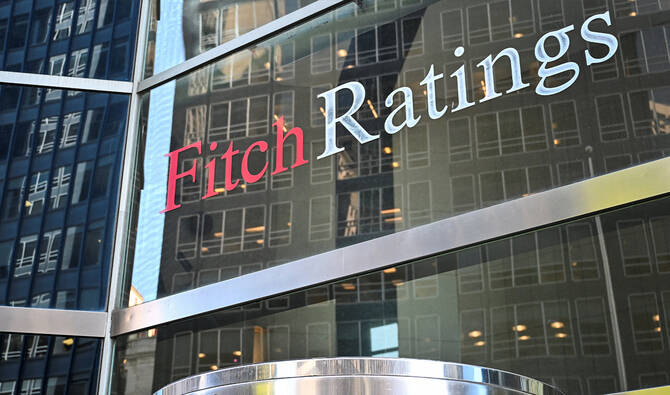
The Fitch Ratings Inc. logo is seen at its headquarters in New York's financial district on March 18, 2025. (AFP/File)
Short Url
Updated 22 January 2026
Follow

Fitch affirms Pakistan’s ‘B-’ rating, flags debt risks

  • Rating agency assigns ‘RR4’ recovery score under new criteria
  • Future rating moves tied to debt reduction and reserve recovery

ISLAMABAD: Fitch Ratings on Wednesday affirmed Pakistan’s long-term sovereign debt rating at “B-,” keeping the country in high-risk territory but signaling no immediate default threat, and assigned a “RR4” recovery rating, a measure of how much investors might recover if the country were to default, following a review under its updated sovereign rating criteria.

Fitch is one of the world’s three major credit rating agencies and its sovereign ratings are closely watched by investors because they affect a country’s access to international capital markets and the cost of borrowing.

Pakistan’s rating was last upgraded in April 2025 to “B-” from “CCC+,” reflecting improved macroeconomic stability after a period of severe financial stress.

“Fitch Ratings has affirmed Pakistan’s long-term debt ratings at ‘B-’ and assigned a Recovery Rating of ‘RR4,’” the agency said in a statement.

It said the action reflects the application of its new Sovereign Rating Criteria, effective September 2025, and the inclusion of recovery assumptions in sovereign debt ratings for the first time.

A “B-” rating means the country remains vulnerable to economic shocks but is currently meeting its debt obligations. The “RR4” recovery rating suggests “average recovery prospects” for holders of Pakistan’s bonds and sukuk if the country were to default.

The agency warned Pakistan’s rating could be downgraded if public debt and debt-servicing costs fail to remain on “a firm downward path,” or if external liquidity weakens.

On the positive side, it said an upgrade could be supported by “significant declines in government debt and debt-servicing burdens,” structural improvements in tax revenue collection, and a “sustained recovery in foreign-currency reserves” beyond current forecasts.

Pakistan is implementing structural economic reforms under a $7 billion International Monetary Fund (IMF) loan program agreed after prolonged political and economic turmoil.
While the country has faced high inflation, currency pressure and weak growth in recent years, authorities say tighter fiscal policy and external support have helped improve key macroeconomic indicators.


Pakistan’s president defends ongoing strikes in Afghanistan, urges Kabul to dismantle militants

Updated 7 sec ago
Follow

Pakistan’s president defends ongoing strikes in Afghanistan, urges Kabul to dismantle militants

  • Afghanistan on Thursday launched attacks in retaliation for Pakistani airstrikes the previous Sunday
  • Pakistan’s military says it is only targeting Afghan military installations to avoid civilian casualties

ISLAMABAD: Pakistan’s president on Monday defended his country’s ongoing military strikes in neighboring Afghanistan, saying Islamabad tried all forms of diplomacy before targeting militants operating from Afghan territory, and called on the Taliban government in Kabul to disarm groups responsible for attacks in Pakistan.

Pakistan earlier said it is in “open war” with Afghanistan, alarming the international community. The border area remains a stronghold for militant organizations including Al-Qaeda and the Daesh (Islamic State) group.

“(The Afghan Taliban) must choose to dismantle the terror groups that survive on conflict and its war economy,” Asif Ali Zardari said during a speech to lawmakers, adding that “no state accepts serial attacks on its soil.”

Afghanistan on Thursday launched attacks in retaliation for Pakistani airstrikes the previous Sunday. Since then, Pakistan has carried out operations along the border, with Information Minister Attaullah Tarar claiming the killing of 435 Afghan forces and the capture of 31 Afghan positions.

Kabul has denied such claims.

In Afghanistan, the deputy government spokesman Hamdullah Fitrat said Pakistan’s military fired mortar shells at a refugee camp in eastern Kunar province, killing three children and injuring three others.

Afghanistan’s defense ministry said Afghan forces carried out strikes targeting a Pakistani military facility near Paktia province, causing “substantial losses and heavy casualties.”

Pakistan’s military did not respond to questions. It has said Pakistan is only targeting Afghan military installations to avoid civilian casualties.

Pakistan has witnessed a surge of violence in recent months and blames it on the outlawed Pakistani Taliban, known as Tehreek-e-Taliban Pakistan or TTP. It operates both inside Pakistan and from Afghan territory.
Islamabad accuses Afghanistan’s Taliban government of providing safe havens for the TTP, which Kabul denies.

The latest cross-border fighting ended a ceasefire brokered by Qatar and Turkiye in October. The two sides failed to reach a permanent agreement during talks in Istanbul.

Zardari reiterated Pakistan’s call for talks, saying, “We have never walked away from dialogue.”

The Pakistani leader again accused Afghanistan of acting as a proxy for India by sheltering militant groups.

“Stop being used by another country as a battlefield for their ambitions,” he said.

Zardari cited a recent report from the United Nations Security Council’s monitoring team that described the presence of militant groups in Afghanistan as an extra-regional threat.