

Pakistan on high alert as heavy rain, storms expected through this week

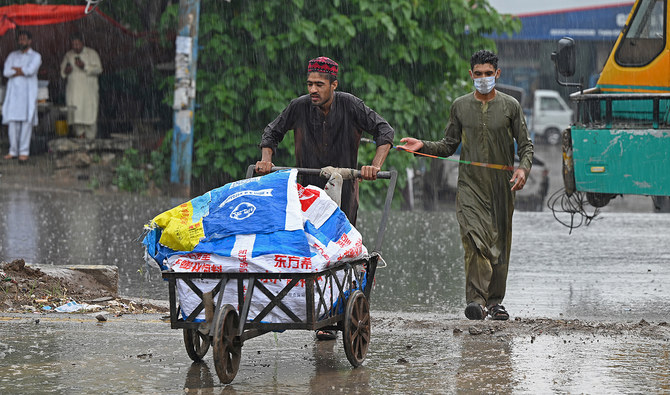
A man pushes a handcart along a street as it rains in Rawalpindi on May 1, 2023. (AFP)
Short Url
Updated 01 May 2023
Follow

Pakistan on high alert as heavy rain, storms expected through this week

  • Record monsoon rains and floods last year displaced some 8 million people, killed at least 1,700 in Pakistan
  • On Sunday, at least eight people died after torrential rains hit different parts of southwestern Balochistan province

ISLAMABAD: Pakistani Prime Minister Shehbaz Sharif on Monday directed federal and provincial authorities to be on high alert and utilize all resources to aid citizens as the Met Office forecast heavy rains and thunderstorms from April 26 and through the first week of May.

Record monsoon rains and melting glaciers last September displaced some 8 million people and killed at least 1,700 in a catastrophe blamed on climate change.

On Sunday, officials in the southwestern Balochistan province said at least eight people had died and over a dozen were injured after torrential rains followed by hail storms hit different parts of the province in the last 24 hours.

“Federal institutions should work in cooperation with provincial governments and departments,” the PM was quoted as saying in a statement released after he met senior disaster management officials. “Where necessary, to provide for the protection and assistance of the public. Wherever necessary, people should be shifted to safe areas immediately.”

Sharif directed the National Highway Authority and other relevant institutions to monitor inter-provincial national highways and ordered “effective arrangements for traffic flow and public convenience” on the Quetta-Karachi highway in Lasbela and Quetta-Sabi highway in Bolan.

“People should be alerted in various highways and affected areas. Protection of life and property of the people is the first priority,” the statement said. “All civic services departments should be alert in the rainy situation, work with national spirit and sense of responsibility. The people are also requested to take precautionary measures in the situation of severe weather and cooperate with the government institutions.”

The UN has urged international financial institutions like the World Bank and top leaders to reform policies that govern debt relief and concessional loan decisions so as to help middle-income countries like Pakistan focus on rebuilding rather than repayment.

Agreement at the COP27 climate talks last year to set up a “loss and damage” fund marked a milestone in the long fight to get help for poor communities on the frontlines of global warming. The two-week talks in the Egyptian resort town of Sharm el-Sheikh in November ended with a deal to establish a new fund to help vulnerable countries pay their rising costs of climate damage from wilder weather and rising seas.

A group of 134 African, Asian and Latin American states and small island nations, led by flood-battered Pakistan, presented a united front to push through the controversial fund.


Pakistan highlights economic reforms at Davos, eyes cooperation in AI, IT and minerals

Updated 21 January 2026
Follow

Pakistan highlights economic reforms at Davos, eyes cooperation in AI, IT and minerals

  • Prime Minister Shehbaz Sharif speaks at breakfast event in Davos at sidelines of World Economic Forum summit
  • Pakistan, rich in gold, copper reserves, has sought cooperation with China, US, Gulf countries in its mineral sector

ISLAMABAD: Prime Minister Shehbaz Sharif highlighted Pakistan’s recent economic reforms during the sidelines of the ongoing World Economic Forum (WEF) summit in Davos on Wednesday, saying that his country was eyeing greater cooperation in mines and minerals, information technology, cryptocurrency and artificial intelligence with other states. 

The Pakistani prime minister was speaking at the Pakistan Pavilion in Davos on the sidelines of the WEF summit at a breakfast event. Sharif arrived in Switzerland on Tuesday to attend the 56th annual meeting of the WEF, which brings together global business leaders, policymakers and politicians to speak on social, economic and political challenges. 

Pakistan has recently undertaken several economic reforms, which include removing subsidies on energy and food, privatization of loss-making state-owned enterprises and expanding its tax base. Islamabad took the measures as part of reforms it agreed with the International Monetary Fund (IMF) in exchange for a financial bailout package. 

“We are now into mines and minerals business in a big way,” Sharif said at the event. “We have signed agreements with American companies and Chinese companies.”

Islamabad has sought to attract foreign investment in its critical minerals sector in recent months. In April 2025, Pakistan hosted an international minerals summit where top companies and government officials from the US, Saudi Arabia, China, Türkiye, the UK, Azerbaijan, and other nations attended.

Pakistan is rich in gold, copper and lithium reserves as well as other minerals, yet its mineral sector contributes only 3.2 percent to the countrys GDP and 0.1 percent to global exports, according to official figures.

Sharif said Pakistan has been blessed with infinite natural resources which are buried in its mountains in the northern Gilgit-Baltistan, Khyber Pakhtunkhwa, Azad Kashmir and southwestern Balochistan regions. 

“But we have now decided to go forward at lightning speed,” he said. “And we are also moving speedily in the field of crypto, AI, IT.”

He said the government’s fiscal and economic measures have reduced inflation from nearly 30 percent a few years ago to single-digit figures, adding that its tax-to-GDP ratio had also increased from 9 to 10.5 percent. 

The prime minister admitted Pakistan’s exports face different kinds of challenges collectively, saying the country’s social indicators needed to improve. 

“But the way forward is very clear: that Pakistan has to have an export-led growth,” he said. 

SHARIF MEETS IMF MANAGING DIRECTOR

Separately, Sharif met IMF Managing Director Kristalina Georgieva on improvements in Pakistan’s macroeconomic indicators, efforts toward stability and progress on institutional reforms, a statement from Sharif’s office said.

He emphasized Pakistan’s commitment to fiscal discipline, revenue mobilization and sustainable development, it added. 

The IMF managing director acknowledged and appreciated Pakistan’s reform efforts, the Prime Minister’s Office (PMO) said.

“Both sides exchanged views on the global economic outlook, challenges facing emerging economies, and the importance of multilateral cooperation in safeguarding economic stability,” the PMO said.