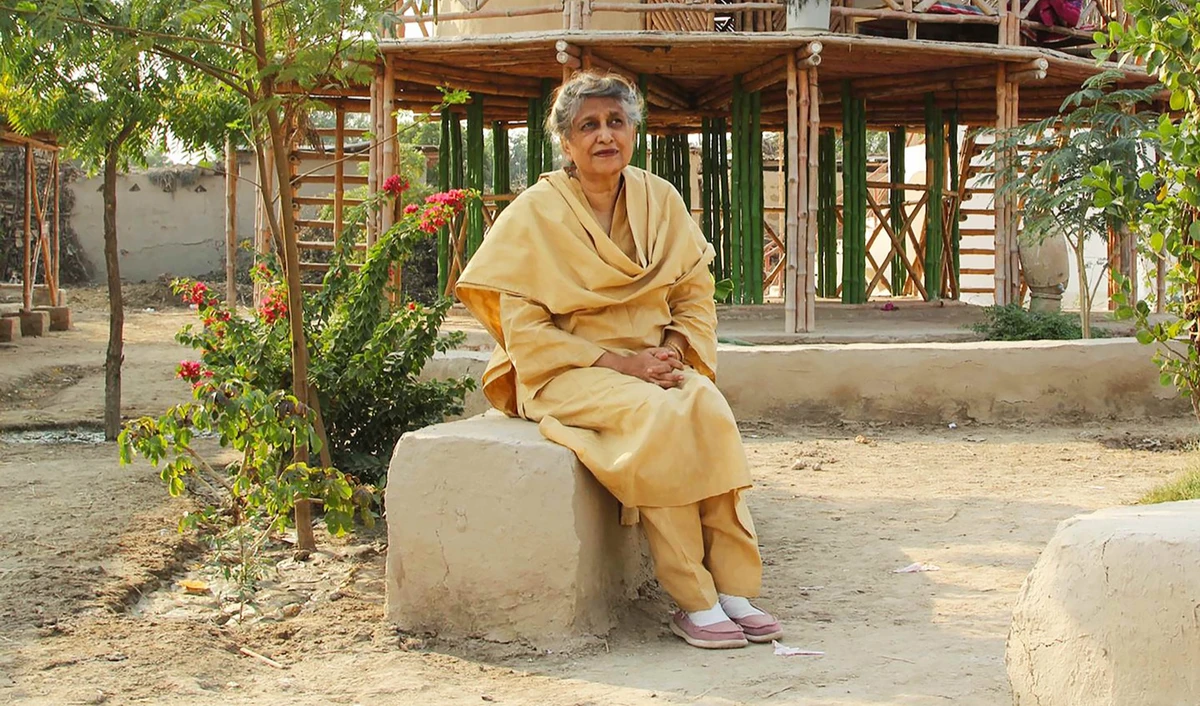
Yasmeen Lari, Pakistan's first woman architect, bags Royal Gold Medal from King Charles

An undated file photo of Pakistani architect Yasmeen Lari. (Photo courtesy: social media)
Short Url
Updated 27 April 2023
Follow

Yasmeen Lari, Pakistan's first woman architect, bags Royal Gold Medal from King Charles

  • She is recognized for her work related to zero-carbon, self-build houses for displaced populations
  • Awarded since 1848, Royal Gold Medal is counted among the world's highest awards for architecture

ISLAMABAD: Pakistan's first woman architect Yasmeen Lari, who this week bagged the prestigious British Gold Medal, said on Thursday that she was surprised and delighted on receiving the award since only "iconic" architects from across the globe have won it previously.

The award was presented to Lari, 81, by the Royal Institute of British Architects (RIBA), which is given in recognition of a lifetime’s work. According to RIBA, the monarch personally approves the medal for individuals or groups of people who have had a “significant influence either directly or indirectly on the advancement of architecture”.

Lari received the medal for her work related to zero-carbon self-built houses for displaced populations. Homes designed and conceived by Lari are becoming models around the world for climate resistant housing. 

“Well, it’s a great honor, there is no doubt about it and it’s something that I had not expected,” Lari told Arab News over the phone on Thursday.

Lari said since it is the first time that a woman architect from Pakistan was awarded the highest of honors in the field of architecture, it came as a “total surprise” to her.

“That’s because most of the architects who have been given this particular medal have been really, very well-known, iconic kind of architects, so it's a kind of total deviation from what’s been done in the past, and of course, I am very grateful,” she added.

Awarded since 1848, the medal has previously been given to renowned architects from across the world, including Sir David Adjaye OBE, Grafton Architects, Sir Nicholas Grimshaw, Neave Brown, Dame Zaha Hadid, Frank Gehry, Sir Norman Foster, Frank Lloyd Wright, and Sir George Gilbert Scott.

Graduating from the Oxford School of Architecture (now the Oxford Brookes University), Lari began her career in the 1960s and has since worked on several architectural projects across Pakistan. She also co-founded the Heritage Foundation in 1980 to safeguard the South Asian country’s cultural heritage. She was elected to the Royal Institute of British Architects (RIBA) in 1969 and as per Heritage Foundation's website, has worked on the conservation of several historic monuments in the World Heritage Sites of Makli and Lahore Fort, and other heritage sites across Pakistan.

In Pakistan's southern port city of Karachi, she designed several buildings which are considered as landmarks, such as the FTC building, the Pakistan State Oil House and ABN Amro Bank head office.

"An inspirational figure, she moved from a large practice centered on the needs of international clients to focusing solely on humanitarian causes," RIBA President Simon Allford said in a statement, adding that Lari's work championing zero carbon and zero waste construction is "exemplary."


"Her way of working also sets out to address the physical and psychological damage caused by major natural disasters – disaster that sadly inevitably will be ever more prevalent in our densely populated and climate challenged planet," he added.
IMF board to approve Pakistan reviews today ‘if all goes well,’ say officials

Updated 4 sec ago
Follow

IMF board to approve Pakistan reviews today ‘if all goes well,’ say officials

  • IMF’s executive board is scheduled to meet today to discuss the disbursement of $1.2 billion
  • Economists say the money will boost Pakistan’s forex reserves, send positive signals to investors

KARACHI: The International Monetary Fund’s (IMF) executive board is scheduled to meet today, Monday, to approve the release of about $1.2 billion for Pakistan under the lender’s two loan facilities, said IMF officials who requested not to be named.

The IMF officials confirmed the executive board was going to decide on the Fund’s second review under the $7 billion Extended Fund Facility (EFF) and first review under the $1.4 billion Resilience and Sustainability Facility (RSF), a financing tool that provides long-term, low-cost loans to help countries address climate risks.

“The board meeting will be taking place as planned,” an IMF official told Arab News.

“The board is on today yes as per the calendar,” said another.

A well-placed official at Pakistan’s finance ministry also confirmed the board meeting was scheduled today to discuss the next tranche for Pakistan.

The IMF executive board’s meeting comes nearly two months after a staff-level agreement (SLA) was signed between the two sides in October.

Procedurally, the SLAs are subject to approval by the executive board, though it is largely viewed as a formality.

“If all goes well, the reviews should pass,” said the second IMF official.

On approval, Pakistan will have access to about $1 billion under the EFF and about $200 million under the RSF, the IMF said in a statement in October after the SLA.

The fresh transfer will bring total disbursements under the two arrangements to about $3.3 billion, it added.

Experts see smooth sailing for Pakistan in terms of the passing of the two reviews, saying the IMF disbursements will help the cash-strapped nation to strengthen its balance of payments position.

Samiullah Tariq, group head of research at Pakistan Kuwait Investment Company Limited, said the IMF board’s approval will show that Pakistan’s economy is on the right path.

“It obviously will help strengthen [the country’s] external sector, the balance of payments,” he told Arab News.

Until recently, Pakistan grappled with a macroeconomic crisis that drained its financial resources and triggered a balance of payments crisis.

Pakistan has reported financial gains since 2022, recording current account surpluses and taming inflation that touched unprecedented levels in mid-2023.

Economists also viewed the IMF’s bailout packages as crucial for cash-strapped Pakistan, which has relied heavily on financing from bilateral partners such as Saudi Arabia, China and the United Arab Emirates, as well as multilateral lenders.

Saudi Arabia, through the Saudi Fund for Development, last week extended the term of its $3 billion deposit for another year to help Pakistan boost its foreign exchange reserves, which stood at $14.5 billion as of November 28, according to State Bank of Pakistan statements.

“In our view this [IMF tranche] will be approved,” said Shankar Talreja, head of research at Karachi-based brokerage Topline Securities Limited.

“This will help strengthen reserves and will eventually help a rating upgrade going forward,” he said.

The IMF board’s nod, Talreja said, would also send a signal to the international and local investors regarding the continuation of the reform agenda by Pakistan’s government.