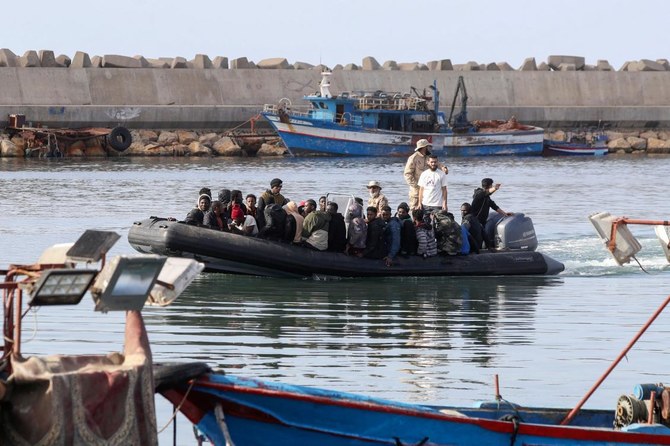
CAIRO: A rubber boat carrying dozens of Europe-bound migrants sank off the coast of Libya and at least 55 people drowned, including women and children, the UN migration agency said Wednesday. It was the latest tragedy in this part of the Mediterranean Sea, a key route for migrants.
The International Organization for Migration said the disaster took place on Tuesday. The boat was carrying at least 60 migrants and had set off from the coastal town of Garabouli, east of Libya’s capital, Tripoli.
The agency said five migrants survived the shipwreck and were brought back to shore by the Libyan coast guard. It was not immediately clear what happened to the vessel.
Safa Msehli, an IOM spokesperson, said the boat capsized a short while after leaving Garabouli. She said the Libyan coast guard has so far retrieved the bodies of nine men and a child.
The five survivors include four men — three Pakistanis and one Egyptian — and a Syrian child, Msehli told The Associated Press.
The was the latest tragedy in the central Mediterranean Sea, a key route for migrants. The IOM said at least 537 people have drowned or gone missing in migrant disasters in the Mediterranean off Libya so far this year, while over 4,300 have been intercepted and returned to shore.
Earlier this month, the IOM’s Missing Migrants Project said that the first quarter of this year was the deadliest in the Central Mediterranean since 2017, with at least 441 documented deaths.
That number, however, is likely “an undercount of the true number of lives lost,” the agency said, adding that it was still investigating several other unreported shipwrecks where the fate of more than 300 people onboard remain unclear.
In 2022, at least 529 migrants were reported dead and 848 people were missing off Libya, while over 24,680 were intercepted and returned to the chaos-hit North African country, according to the IOM.
Libya has in recent years emerged as the dominant transit point for migrants from Africa and the Middle East trying to make it to Europe. The oil-rich country plunged into chaos following a NATO-backed uprising that toppled and killed longtime autocrat Muammar Qaddafi in 2011.
Human traffickers in recent years have benefited from the chaos in Libya, smuggling in migrants across the country’s lengthy borders with six nations. The migrants are crowded into ill-equipped vessels, including rubber boats, and set off on risky sea voyages.
Those who are intercepted and returned to Libya are held in government-run detention centers rife with abuses, including forced labor, beatings, rapes and torture — practices that amount to crimes against humanity, according to UN-commissioned investigators.
The abuse often accompanies efforts to extort money from families of those held, before the migrants are allowed to leave Libya on traffickers’ boats.


![]()

UN says at least 55 migrants drowned in shipwreck off Libya
Short Url
https://arab.news/54gbh
UN says at least 55 migrants drowned in shipwreck off Libya
- Boat was carrying at least 60 Europe-bound migrants and had set off from the town of Garabouli
- Human traffickers in recent years have benefited from the chaos in Libya


Latest updates






© 2026 SAUDI RESEARCH & PUBLISHING COMPANY, All Rights Reserved And subject to Terms of Use Agreement.