

ICESCO launches Girls, Women and Society Chair at Omar Bongo University in Gabon

1 / 2
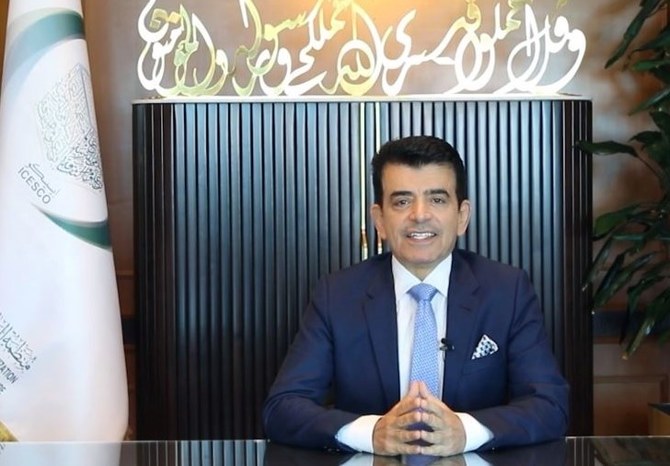
ICESCO Director-General Dr. Salem bin Mohammed Al-Malik said that the chair will contribute to dismantling stereotypes. (ICESCO)
2 / 2
An ICESCO delegation and Gabonese officials discuss plans for joint programs and projects. (ICESCO)
Short Url
Updated 25 April 2023
Follow

ICESCO launches Girls, Women and Society Chair at Omar Bongo University in Gabon

  • Aim to consolidate and promote gender equality in African nation
  • Other programs from 2023-2027 include Arabic, science, technology

RIYADH: The Islamic World Educational, Scientific and Cultural Organization, or ICESCO, a specialized organization under the aegis of the Organization of Islamic Cooperation launched a Girls, Women and Society Chair at Omar Bongo University in Libreville, Gabon, on Monday.

The chair aims to promote scientific and educational research on gender issues and women’s rights, contribute to building the capacities of women and girls, and enhance peace-building efforts by developing multidisciplinary study programs, ICESCO stated.

This forms part of a cooperation program between ICESCO and Gabon for 2023-2027.

Dr. Salem bin Mohammed Al-Malik, ICESCO’s director-general, in a recorded speech delivered at the launch ceremony, praised Gabon’s efforts to consolidate and promote the rights of women and girls.

Al-Malik said the national strategy for promoting women’s rights and achieving gender equality launched in 2020 has contributed to significant progress.

He affirmed ICESCO’s support for this cause, adding that the chair would contribute to dismantling stereotypes, in order to bring about the desired change and build a just and equitable society for present and future generations.

Patrick Mouguiama-Daouda, the minister of higher education and president of the Gabonese National Commission for Education, Science and Culture, said that the launch of the chair comes on the occasion of National Women’s Day in Gabon.

He said the Gabonese government remains committed to improving living and working conditions for girls and women in society.

Dean of Omar Bongo University, Mesmin-Noel Soumaho, said the chair would serve as a center for studying and evaluating government measures aimed at combating gender inequality.

On March 31, the ICESCO delegation and Gabonese officials held sessions on the implementation of plans for joint programs and projects in this regard.

The ICESCO/Gabon 2023-2027 Action Plan is aimed at implementing a set of programs and projects in the areas of culture, education, science, technology and the Arabic language.

It prioritizes the development of human capital by building the capacities of women and girls, supporting their issues and concerns, and promoting dialogue for peace.

The action plan aims to elevate the value of tangible and intangible cultural heritage, integrate technology into educational systems, and train teachers of Arabic for non-speakers in Gabon.


In Ethiopia, Tigrayans fear return to ‘full-scale war’

Updated 44 min 10 sec ago
Follow

In Ethiopia, Tigrayans fear return to ‘full-scale war’

  • Flights have been suspended into Tigray since Thursday and local authorities reported drone strikes on goods lorries
  • The international community fears the fighting could turn into an international conflict between Ethiopia and Eritrea

ADDIS ABABA: Tigrayans in northern Ethiopia fear a return to all-out war amid reports that clashes were continuing between local and federal forces on Monday, barely three years after the last devastating conflict in the region.
The civil war of 2020-2022 between the Ethiopian government and Tigray forces killed more than 600,000 people and a peace deal known as the Pretoria Agreement has never fully resolved the tensions.
Fighting broke out again last week in a disputed area of western Tigray called Tselemt and the Afar region to the east of Tigray.
Abel, 38, a teacher in Tigray’s second city Adigrat, said he still hadn’t recovered from the trauma of the last war and had now “entered into another round of high anxiety.”
“If war breaks out now... it could lead to an endless conflict that can even be dangerous to the larger east African region,” added Abel, whose name has been changed along with other interviewees to protect their identity.
Flights have been suspended into Tigray since Thursday and local authorities reported drone strikes on goods lorries on Saturday that killed at least one driver.
In Afar, a humanitarian worker, speaking to AFP on condition of anonymity, said there had been air strikes on Tigrayan forces and that clashes were ongoing on Monday, with tens of thousands of people displaced.
AFP could not independently verify the claims and the government has yet to give any comment on the clashes.
In the regional capital Mekele, Nahom, 35, said many people were booking bus tickets this weekend to leave, fearing that land transport would also be restricted soon.
“My greatest fear is the latest clashes turning into full-scale war and complete siege like what happened before,” he told AFP by phone, adding that he, too, would leave if he could afford it.
Gebremedhin, a 40-year-old civil servant in the city of Axum, said banks had stopped distributing cash and there were shortages in grocery stores.
“This isn’t only a problem of lack of supplies but also hoarding by traders who fear return of conflict and siege,” he said.
The region was placed under a strict lockdown during the last war, with flights suspended, and banking and communications cut off.
The international community fears the fighting could turn into an international conflict between Ethiopia and Eritrea, whose relations have been increasingly tense in recent months.
The Ethiopian government accuses the Tigrayan authorities and Eritrea of forging closer ties.
United Nations Secretary-General Antonio Guterres is “deeply concerned about... the risk of a return to a wider conflict in a region still working to rebuild and recover,” his spokesman said.
The EU said that an “immediate de-escalation is imperative to prevent a renewed conflict.”