Israeli troops kill Palestinian during raid in West Bank

1 / 2
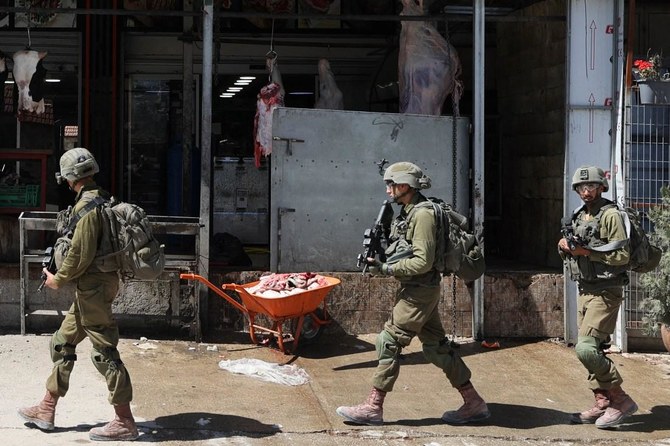
The Israeli military said it was operating in the area when two suspects were spotted fleeing. (AFP)
2 / 2
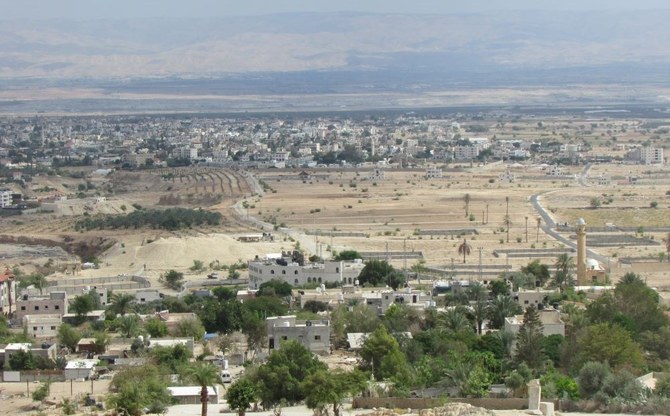
Aqabat Jaber with Jericho in the background, Oct. 10 2017. (Wikimedia Commons)
Short Url
Updated 24 April 2023
Follow

Israeli troops kill Palestinian during raid in West Bank

  • The governor of Jericho said the body of 20-year-old Suleiman Awad, who dies at the Aqabat Jaber camp, was being held by the Israeli military
  • The Israeli army also closed off the West Bank and Gaza Strip from Monday night until midnight on Wednesday, which marks the 75th anniversary of the founding of Israel

RAMALLAH: Israeli forces killed a Palestinian man on Monday during a raid in the occupied West Bank. Suleiman Awad, 20, was “killed by the (Israeli) occupation bullets, in Aqabat Jaber camp,” near the city of Jericho, according to the Palestinian Health Ministry.

Jihad Abu Al-Assal, the governor of Jericho, said Awad’s body was being held by the Israeli military. Three other people were wounded during the raid, sources said.

The Fatah movement, to which Awad belonged, said the “occupation’s continued crimes against our people indicate an Israeli tendency to escalate violence against the Palestinians.”

The head of the Palestinian National Council, Rawhi Fattouh, said the crime of “field execution” committed by the Israeli army was the result of instructions from “the political echelons of the right-wing criminal government.”

He added that the killings, assaults on religious sites, daily incursions into Palestinian areas, arrests, and the operation of military checkpoints during the Eid holiday to restrict the freedom of movement of Palestinian citizens amounted to a “racist and fascist method that will only increase our people’s insistence on steadfastness and resistance to thwart the occupation’s racist plans.”

The Palestinian Foreign Ministry condemned the Israeli military blockade of the entrances to cities and restrictions on the movement of Palestinians, describing it as a “collective punishment against citizens, including children, women, the sick and the elderly.”

An Israeli siege of Jericho, in the eastern West Bank, and its camps continued for a third day on Monday. The Foreign Ministry accused Israeli authorities of turning “holidays and events into tragedies for Palestinian citizens.” It added that the human rights of Palestinians were being violated so that Israelis could enjoy their time, security and freedoms.

At least 99 Palestinians have been killed by the Israeli army in the Occupied Territories since the beginning of the year.

During the raids on Monday, the Israeli army arrested six men from Nablus, two from Bethlehem, five from Hebron, three from Jericho and four from Jenin in the northern West Bank, according to Palestinian sources.

Also on Monday, dozens of Israeli settlers stormed the courtyards of Al-Aqsa Mosque under the protection of Israeli police after a hiatus of 10 days. Israeli police attacked the Gate of Mercy chapel at the mosque and cut its electrical lines, preventing Al-Aqsa guards from entering. Fans, lights, cables and loudspeakers were seized. Last Saturday, Israeli police entered Bab Al-Rahma chapel and vandalized it the same way.

The Council of Waqf, Islamic Affairs and Holy Sites in Jerusalem condemned the attacks and what it described as deliberate Israeli sabotage of maintenance and restoration work at Al-Aqsa. Bab Al-Rahma chapel reopened in February 2019, 16 years after it was closed and prayers inside it were halted by Israeli military authorities.

Palestinian officials expressed anger after groups of extremist settlers raised Israeli flags on the roof and walls of the Ibrahimi Mosque, south of Jerusalem. Palestinians have for many years accused Israelis of trying to Judaize the holy site and warn it could provoke a dangerous escalation that might plunge the region into a spiral of violence.

Meanwhile, the Israeli army announced the West Bank and Gaza Strip would be completely closed off from Monday evening until midnight on Wednesday, April 26, which marks the 75th anniversary of the founding of Israel.

Palestinian political analyst Riyad Qadriya told Arab News that the massive provocations by the Israeli military could result in a violent Palestinian reaction.

“There is intense competition between the ministers of the extreme right-wing Israeli government as to who will be the most radical in front of his party by abusing the Palestinians,” Qadriya told Arab News.

Elsewhere, three people were hit by a car that ran into a crowd in Jerusalem, police said. One of them, a 50-year-old, was unconscious and in serious condition, officials said. They described the driver of the vehicle as a “suspect” who was “neutralized on the spot.”


Qatari minister reaffirms support for Lebanon, calls stability a regional priority

Updated 5 sec ago
Follow

Qatari minister reaffirms support for Lebanon, calls stability a regional priority

  • Mohammed bin Abdulaziz Al-Khulaifi said Lebanon remains key foreign policy priority, reveals economic, development and humanitarian measures
  • US ambassadors to Lebanon, Israel meet in Jordan to discuss peace efforts amid latest escalations

BEIRUT: Qatar’s Minister of State Mohammed bin Abdulaziz Al-Khulaifi on Monday reaffirmed Doha’s support for Lebanon during a meeting with President Joseph Aoun.

In a press conference he said that “Lebanon’s stability is a fundamental pillar for the stability of the entire region” and announced a package of economic, development and humanitarian measures.

The Qatari minister’s visit to Beirut coincided with Israeli military escalation in southern Lebanon, including the assassination of Hezbollah members by drones, incursions into the border area, and the demolition of more residences.

While the date for the meeting of the Ceasefire Monitoring Committee (Mechanism) agreement has yet to be confirmed, the US Embassy in Lebanon said in a press release on Monday that Washingt’s ambassadors to Beirut and Israel met in Jordan to discuss peace efforts through diplomacy and dialogue.

The meeting, hosted by the US Embassy in Amman last weekend, focused on the steps needed to achieve a more peaceful and prosperous region.

The visit by Qatar’s minister to Lebanon was made “upon the instructions of Emir Tamim bin Hamad Al-Thani,” according to Aoun’s media office.

“It is crucial to involve Lebanon in regional discussions, and Qatar is keen on this matter, as well as on following the situation in the country, especially the internal developments, Israeli attacks, the work of the committee, the dialogue, and efforts to find the necessary solutions,” Al-Khulaifi said.

Aoun expressed his thanks and appreciation to the Qatari minister for the visit and initiatives.

He said that the Lebanese military is carrying out its duties south of the Litani River in full, while Israeli attacks on southern villages and towns continue, destroying residential areas and displacing residents, at times extending to villages in the Bekaa Valley.

“Israel has not responded to repeated calls to abide by the agreement announced in November 2024 and implement Resolution 1701. This Israeli stance prevents the return of security and safety to the south, in addition to its repercussions on all levels,” he stated.

Aoun revealed that “contacts are ongoing before the meeting of the Mechanism committee scheduled for next month to reach practical results that will expedite the restoration of stability to the south, the withdrawal of Israeli forces, the return of prisoners, and enable the army to deploy to the internationally recognized southern border.”

He stressed that “pressuring Israel to facilitate the work of the Mechanism committee is essential to achieving the full implementation of Resolution 1701 in all its aspects.”

Aoun also spoke about the Lebanese military’s “need for equipment, vehicles, and supplies that would enable it to carry out its required tasks not only in the south but throughout all Lebanese territory.”

Regarding relations with Syria, Aoun affirmed that the situation on the Lebanese-Syrian border is better than before, and that negotiations are ongoing between the two countries to address several issues, particularly the return of Syrian refugees.

He added that Lebanon welcomes any Arab support in general, and Qatari support in particular, to help facilitate this return.

Al-Khulaifi also met with Parliament Speaker Nabih Berri and Prime Minister Nawaf Salam, and in a joint press conference stressed “the necessity for all parties to adhere to UN Security Council Resolution 1701 and respect the full sovereignty of the Lebanese Republic over its territory.

“We reiterate our complete condemnation of the Israeli attacks on Lebanese territory, which constitute an infringement on the sovereignty of our sister nation, Lebanon, and we emphasize the need for the Security Council to assume its responsibilities to stop these violations and to preserve Lebanon’s stability,” he said.

The minister announced a Qatar Fund for Development package — coordinated with Lebanese authorities within legal frameworks — including a $40 million grant and $360 million economic project to bolster Lebanon’s electricity sector, benefiting 1.5 million people nationwide.

Other measures include 185 scholarships over three years for Lebanese youth, the Sports for Development and Peace initiative to protect 4,400 children and young people in conflict areas, and reconstruction of Beirut’s Karantina Hospital, destroyed in the port explosion, with further health projects under review.

Qatar will also fund a $20 million first phase, in partnership with the International Organization for Migration, to support the voluntary return of 100,000 Syrian refugees. It guarantees housing upon return, plus three months of food and medicine to ensure stability and social reintegration.

“We thank the Syrian government for its constructive cooperation in facilitating the implementation of this humanitarian and development project,” the minister said.

Elsewhere on Monday, the Syrian Internal Security Directorate said it thwarted an attempt to smuggle missiles and ammunition through the Syrian town of Breij into Lebanon, according to SANA.

Breij, located east of Talkalakh on the border with Lebanon’s Akkar region, is considered a smuggling hub, according to a Lebanese security source.