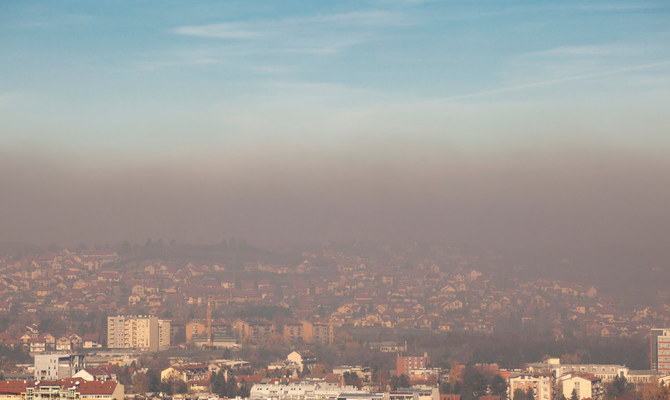
COPENHAGEN: Air pollution still causes more than 1,200 premature deaths a year in under 18’s across Europe and increases the risk of chronic disease later in life, the EU environmental agency said Monday.
Despite recent improvements, “the level of key air pollutants in many European countries remain stubbornly above World Health Organization” (WHO) guidelines, particularly in central-eastern Europe and Italy, said the EEA after a study in over 30 countries, including the 27 members of the European Union.
The report did not cover the major industrial nations of Russia, Ukraine and the United Kingdom, suggesting the overall death tolls for the continent could be higher.
The EEA announced last November that 238,000 people died prematurely because of air pollution in 2020 in the EU, plus Iceland, Liechtenstein, Norway, Switzerland and Turkiye.
“Air pollution causes over 1,200 premature deaths per year in people under the age of 18 in Europe and significantly increases the risk of disease later in life,” the agency said.
The study was the agency’s first to focus specifically on children.
“Although the number of premature deaths in this age group is low relative to the total for the European population estimated by EEA each year, deaths early in life represent a loss of future potential and come with a significant burden of chronic illness, both in childhood and later in life,” the agency said.
It urged authorities to focus on improving air quality around schools and nurseries as well as sports facilities and mass transport hubs.
“After birth, ambient air pollution increases the risk of several health problems, including asthma, reduced lung function, respiratory infections and allergies,” the report noted.
Poor air quality can also “aggravate chronic conditions like asthma, which afflicts nine percent of children and adolescents in Europe, as well as increasing the risk of some chronic diseases later in adulthood.”
Ninety-seven percent of the urban population were in 2021 exposed to air that did not meet WHO recommendations, according to figures released Monday.
The EEA had last year underlined that the EU was on track to meet its target of reducing premature deaths by 50 percent by 2030 compared with 2005.
In the early 1990s, fine particulates caused nearly a million premature deaths a year in the 27 EU nations. That fell to 431,000 in 2005.
The situation in Europe looks better than for much of the planet, says the WHO, which blames air pollution for seven million deaths globally each year, almost as many as for cigarette smoking or bad diets.
Several hundred thousand of the deaths concern children under 15.
It took until September 2021 to reach agreement to tighten limits set for major pollutants back in 2005.
In Thailand alone, where toxic smog chokes parts of the country, health officials said last week that 2.4 million people had sought hospital treatment for medical problems linked to air pollution since the start of the year.
Fine particulate matter, primarily from cars and trucks and which can penetrate deeply into the lungs, is considered the worst air pollutant, followed by nitrogen dioxide and ozone.

Air pollution kills 1,200 children a year: EU agency
https://arab.news/whe9f
Air pollution kills 1,200 children a year: EU agency
- The study was the agency’s first to focus specifically on children
Trump says Greenland will ‘work out’ after Denmark fails to bridge gap
- Trump has appeared emboldened on Greenland — which he views as in the US backyard — since ordering a deadly January 3 attack in Venezuela that removed president Nicolas Maduro
WASHINGTON, United States: US President Donald Trump held open the possibility Wednesday for a resolution on his designs over Greenland after Denmark’s top diplomat said he failed to change the administration’s mind on wanting to conquer the island.
The foreign ministers of Denmark and Greenland, an autonomous territory under Copenhagen’s sovereignty, met at the White House with Vice President JD Vance and Secretary of State Marco Rubio in a meeting the visitors had requested to clear up “misunderstandings” after Trump’s bellicose language toward the fellow NATO member.
Trump, speaking after the meeting which he did not attend, for the first time sounded conciliatory on Greenland, acknowledging Denmark’s interests even if he again said he was not ruling out any options.
“I have a very good relationship with Denmark, and we’ll see how it all works out. I think something will work out,” Trump said without explaining further.
He again said Denmark was powerless if Russia or China wanted to occupy Greenland, but added: “There’s everything we can do.”
Danish Foreign Minister Lars Lokke Rasmussen, speaking after leaving the White House, said a US takeover of Greenland was “absolutely not necessary.”
“We didn’t manage to change the American position. It’s clear that the president has this wish of conquering over Greenland,” Lokke told reporters.
“We therefore still have a fundamental disagreement, but we also agree to disagree.”
He said the issue was “very emotional” for the people of Greenland and Denmark, a steadfast US ally whose troops died alongside Americans in Afghanistan and, controversially, Iraq.
“Ideas that would not respect territorial integrity of the Kingdom of Denmark and the right of self-determination of the Greenlandic people are, of course, totally unacceptable,” Lokke said.
He nonetheless said the tone was “constructive” and said the sides would form a committee that would meet within weeks to see if there was possible headway.
Referring to the British prime minister who trumpeted his diplomacy with Hitler, Lokke said, “I am not a Chamberlain to say “Peace for our time,” but we must seize the opportunities that present themselves.”
Mocking tone
While the talks were underway, the White House posted on X: “Which way, Greenland man?“
The post included a drawing of two dogsleds — one heading toward the White House and a huge US flag, and the other toward Chinese and Russian flags over a lightning-bathed Kremlin and Great Wall of China.
Neither country has claimed Greenland, and Lokke said no Chinese ship had been spotted there in a decade and that there were no major Chinese investments.
Denmark promised ahead of the meeting to ramp up its military presence further in the vast, sparsely populated and strategically located island.
Trump has derided recent Danish efforts to increase security for Greenland as amounting to “two dogsleds.” Denmark says it has invested almost $14 billion in Arctic security.
Denmark also announced immediate military exercises that will include aircraft, vessels and soldiers, with Sweden also participating.
In another show of solidarity with Denmark following Trump’s threats, Germany and France both said Wednesday they will send troops to Greenland. German’s defense ministry said it would send a 13-person team.
Signs of relief
On the quiet streets of the capital Nuuk, red and white Greenlandic flags flew in shop windows, on apartment balconies, and on cars and buses, in a show of national unity during the talks.
Ivaana Egede Larsen, 43, said she felt relief that the meeting appeared to be cordial.
“I am more calm now, and I feel more safe. I had felt very much unsafe lately,” she said.
In Copenhagen, Thomas Fallesen, 56, voiced similar sentiments.
“They are now at least talking together instead of talking through the press. I think it’s a very positive thing,” he said.
Vance, who slammed Denmark as a “bad ally” during an uninvited visit to Greenland last year, is known for a hard edge, which was on display when he publicly berated Ukrainian President Volodymyr Zelensky in the Oval Office last February.
Wednesday’s meeting, however, was closed to the press, meaning there was no on-camera confrontation.
Trump has appeared emboldened on Greenland — which he views as in the US backyard — since ordering a deadly January 3 attack in Venezuela that removed president Nicolas Maduro.


