

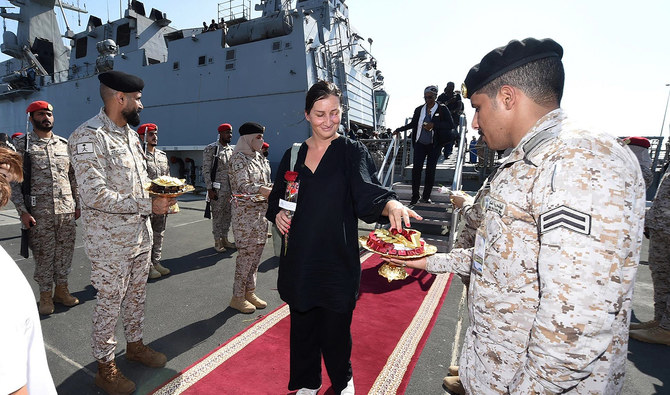

JEDDAH: More than 150 people from various nations reached the safety of Saudi Arabia on Saturday in the first announced evacuation of civilians from Sudan, where fighting between the army and paramilitaries entered a second week following a brief lull.
Foreign nations have said they are preparing for the potential evacuation of thousands more of their nationals, even though Sudan’s main airport remains closed.
As the Kingdom’s naval forces transported the civilians, including diplomats and international officials, across the Red Sea from Port Sudan to Jeddah, fighting resumed in Sudan’s capital Khartoum after a temporary truce saw gunfire momentarily die down on Friday, the first day of Eid Al-Fitr.
Fighting has left hundreds dead and thousands wounded while survivors cope with shortages of electricity and food.
Saudi Arabia’s Foreign Ministry announced the “safe arrival” of 91 of its citizens along with nationals from Kuwait, Qatar, the UAE, Egypt, Tunisia, Pakistan, India, Bulgaria, Bangladesh, the Philippines, Canada and Burkina Faso.
It added that diplomats and international officials were among those who arrived in the evacuation operation carried out by the Royal Saudi Navy with the support of various branches of the armed forces.
US President Joe Biden thanked the Kingdom, Djibouti and Ethiopia for facilitating the plan to get US personnel out of Khartoum.
“I thank Djibouti, Ethiopia, and Saudi Arabia, which were critical to the success of our operation,” he said in a statement on Saturday, calling for a ceasefire to allow “unhindered humanitarian access, and respect the will of the people of Sudan”.
The Saudi ministry said in a statement: “The Kingdom worked to provide all the basic needs of foreign nationals in preparation for their departure to their countries.
“The first evacuation vessel from Sudan has arrived, carrying 50 (Saudi) citizens and a number of nationals from friendly countries,” the official Al-Ekhbariyah television said.
The first boat docked at the Red Sea port of Jeddah where the four other ships carrying 108 people from 11 different countries was expected to arrive later from Sudan, the broadcaster said.
Al-Ekhbariyah carried footage of large vessels arriving in Jeddah’s port. It also released a video showing women and children carrying Saudi flags on board one of the ships.
Those who have arrived in Jeddah include the crew of a Saudi passenger plane that was hit by gunfire while preparing to take off from Khartoum at the start of the fighting on April 15, according to Saudi state TV.
A convoy of vehicles carried the evacuees to Port Sudan from where they boarded ships to Jeddah, according to the Saudi broadcaster.
Saudi Arabia’s Deputy Foreign Minister Waleed Al-Khuraiji received the first batch of citizens and foreign nationals, upon their arrival today at King Faisal Naval Base in the Western Fleet in Jeddah on board the His Majesty King Jubail ship.
He said the journey was long, starting from Khartoum, passing through a number of regions in Sudan until reaching Port Sudan, and was done in cooperation with government agencies in the Kingdom, praising the role of the Ministry of Defense that implemented the plan.
“We all celebrate the return of our sons and the sons of brotherly and friendly countries to the Kingdom Saudi Arabia, which coincided with the celebration of Eid Al-Fitr,” he said.
Those evacuated expressed their thanks and appreciation to the Saudi government and the concerned authorities in the Kingdom for their efforts to secure their transportation and facilitate their arrival procedures to the Kingdom.
Earlier on Saturday, the Kingdom’s Foreign Ministry announced that Saudi Arabia will start arranging the evacuation of its citizens and several nationals from other “brotherly and friendly” countries from Sudan as clashes intensify despite an Eid truce.
In a statement, the Saudi foreign ministry said the evacuated people will be flown to Saudi Arabia.
The decision comes “in the implementation of the directives” of Saudi Arabia’s King Salman and Crown Prince Mohammed bin Salman “to oversee the care and wellbeing of citizens of the Kingdom in the Republic of Sudan,” the foreign ministry said.
Kuwait’s Foreign Minister Sheikh Salem Abdullah Al-Jaber Al-Sabah said his country carried out an emergency operation to evacuate Kuwaiti citizens stranded in Sudan.
Sheikh Salem confirmed that all citizens wishing to return to the country had arrived safely in Jeddah, and that work was currently underway to secure their transfer to Kuwait.
The minister praised the efforts of Kuwait’s Ambassador to Sudan Dr. Fahd Mashari Al-Dhafiri, all members of the embassy in Khartoum and also extended his sincere thanks and gratitude to the Saudi authorities for coordinating and providing all the facilities for the transfer and evacuation of citizens to Jeddah.
He also thanked the Sudanese authorities and everyone who contributed to securing the safety of Kuwaiti citizens and enabling them to communicate with their families to ensure their safe return to their country.
Saturday’s evacuations mark the first major civilian rescue since violence in Sudan broke out on April 15.
Eid this year in Sudan is being marked by fear, grief and hunger.Eid is meant to be spent “with sweets and pastries, with happy children, and people greeting relatives,” Khartoum resident Sami Al-Nour said. Instead, there has been “gunfire and the stench of blood all around us.”
The Sudanese army said it was coordinating efforts to evacuate diplomats from the United States, Britain, China and France out of the country on military airplanes, as fighting persisted in the capital, including at its main airport.
The military said that army chief Gen. Abdel Fattah Burhan had spoken to leaders of various countries requesting safe evacuations of their citizens and diplomats from Sudan.
Foreign countries have struggled in vain to repatriate their citizens, a task deemed far too risky as clashes between the Sudanese army and a rival powerful paramilitary group have raged in and around Khartoum, including in residential areas.
The main international airport near the center of the capital has been the target of heavy shelling as the paramilitary group, known as the Rapid Support Forces, has tried to take control of the complex, complicating evacuation plans. With Sudan’s airspace closed, foreign countries have ordered their citizens to simply shelter in place until they can figure out evacuation plans.
The country has been roiled by bloody fighting for the past week that has killed over 400 people so far, according to the World Health Organization.
- With additional input from AFP and AP


