Sri Lankan protesters demand justice for 2019 Easter Sunday attacks

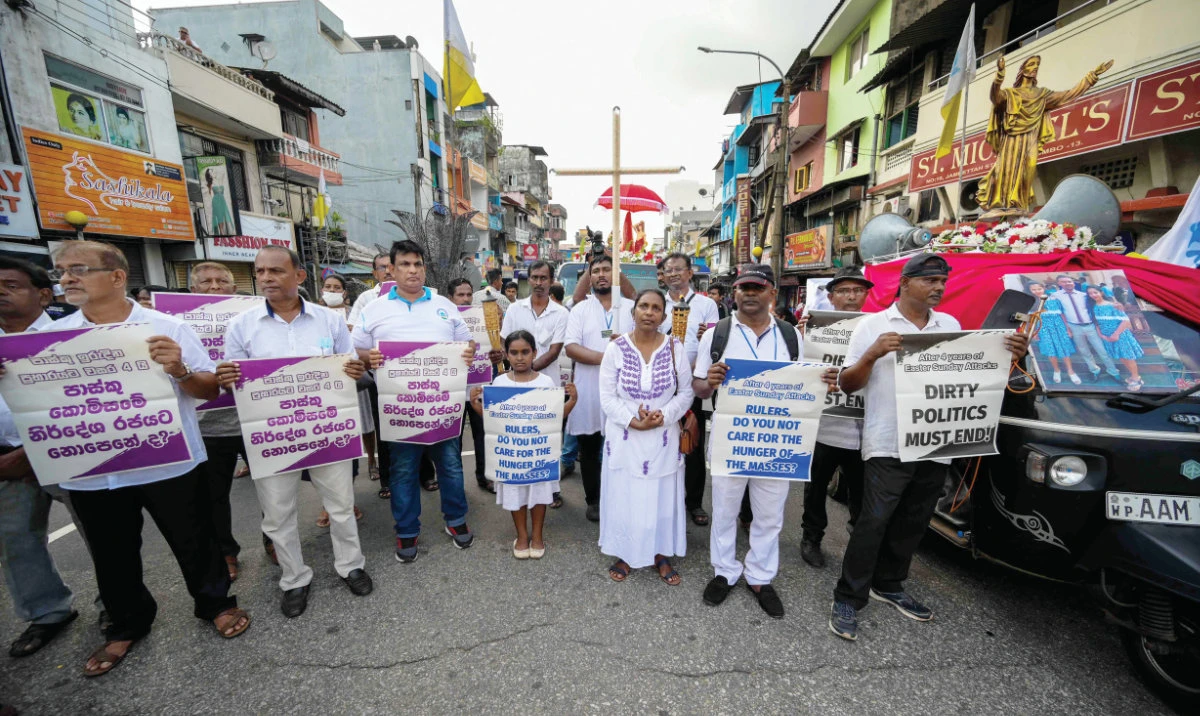
Sri Lankans demonstrate on the fourth anniversary of the Easter Sunday bombings, outside St. Anthony’s church in Colombo on Friday. (AFP)
Short Url
Updated 22 April 2023
Follow

Sri Lankan protesters demand justice for 2019 Easter Sunday attacks

  • The protesters, dressed in white and black, held one another’s hands, forming a human chain

COLOMBO: Thousands of Sri Lankans held a protest in the capital on Friday, demanding justice for the victims of the 2019 Easter Sunday bomb attacks that killed nearly 270 people.

The protesters demanded that the government uncover who they said were the real conspirators behind the attacks on three churches — two Catholic and one Protestant — that included simultaneous suicide bombings during Easter celebrations on April 21, 2019. Three tourist hotels were also targeted, killing 42 foreigners from 14 countries.

Thousands of people including Catholic clergy on Friday lined up for a silent protest on both sides of the main road connecting the capital, Colombo, with the country’s international airport. They blamed the government for not taking adequate measures to deliver justice for the victims of the bombings and punish those responsible.

The protesters, dressed in white and black, held one another’s hands, forming a human chain. They displayed placards and banners that read “Until justice is meted out, we are watching,” “No justice delivered to victims so far” and “Where is the mastermind behind the Easter Sunday attack?”

Two local Muslim groups that had pledged allegiance to the Daesh group were accused of carrying out six near-simultaneous suicide bomb attacks, targeting worshippers at Easter services in three churches and tourists having breakfast at three popular hotels. The attacks killed 269 people and wounded some 500 more.

Officials have charged dozens of people who allegedly received weapons training and participated in indoctrination classes from the two local Islamic extremist groups accused of carrying out the attacks. But no one has yet been convicted or sentenced.

“Four years have gone, still no one has been punished for this brutal attack. It is really disgusting. We need to know who are the real culprits and their motives,” said Ruwan Fernando, 47, who protested on Friday.

To mark the four-year anniversary of the blasts, prayer services were also held at churches across Sri Lanka on Friday, with the main ceremony held at one of the churches attacked by the bombers in Colombo.

At that ceremony, Archbishop of Colombo Cardinal Malcolm Ranjith lamented the failure of successive governments to identify the conspirators in the attacks. 

He urged the authorities to probe alleged links between some of the attackers and members of state intelligence.

He called on the government to conduct a full-scale investigation into the blasts, saying: “Until justice is done, we will be watching.”

The Catholic Church in Sri Lanka has been critical of the investigation into the bombings. The church’s leaders have repeatedly criticized the previous and present governments for their failure to bring the culprits to justice.

A breakdown in communication caused by a rift between then-President Maithripala Sirisena and then-Prime Minister Ranil Wickremesinghe was blamed for the failure of authorities to act on near-specific foreign intelligence received prior to the attacks. The duo belonged to different political parties.

In January, Sri Lanka’s top court ruled that inaction by Sirisena and four others led to the bomb attacks and ordered them to pay compensation for violating the basic rights of the victims and their families.
UN slams world’s ‘apathy’ in launching aid appeal for 2026

Updated 24 min 34 sec ago
Follow

UN slams world’s ‘apathy’ in launching aid appeal for 2026

  • ‘Prioritized’ plan to raise at least $23 billion to help 87 million people in the world’s most dangerous places such as Gaza and Ukraine

UNITED NATIONS, United States:  The United Nations on Monday hit out at global “apathy” over widespread suffering as it launched its 2026 appeal for humanitarian assistance, which is limited in scope as aid operations confront major funding cuts.

“This is a time of brutality, impunity and indifference,” UN humanitarian chief Tom Fletcher told reporters, condemning “the ferocity and the intensity of the killing, the complete disregard for international law, horrific levels of sexual violence” he had seen on the ground in 2025.

“This is a time when the rules are in retreat, when the scaffolding of coexistence is under sustained attack, when our survival antennae have been numbed by distraction and corroded by apathy,” he said.

He said it was also a time “when politicians boast of cutting aid,” as he unveiled a streamlined plan to raise at least $23 billion to help 87 million people in the world’s most dangerous places such as Gaza, Ukraine, Sudan, Haiti and Myanmar.

The United Nations would like to ultimately raise $33 billion to help 135 million people in 2026 — but is painfully aware that its overall goal may be difficult to reach, given US President Donald Trump’s slashing of foreign aid.

Fletcher said the “highly prioritized appeal” was “based on excruciating life-and-death choices,” adding that he hoped Washington would see the choices made, and the reforms undertaken to improve aid efficiency, and choose to “renew that commitment” to help.

The world body estimates that 240 million people in conflict zones, suffering from epidemics, or victims of natural disasters and climate change are in need of emergency aid.

‘Lowest in a decade’

In 2025, the UN’s appeal for more than $45 billion was only funded to the $12 billion mark — the lowest in a decade, the world body said.

That only allowed it to help 98 million people, 25 million fewer than the year before.

According to UN data, the United States remains the top humanitarian aid donor in the world, but that amount fell dramatically in 2025 to $2.7 billion, down from $11 billion in 2024.

Atop the list of priorities for 2026 are Gaza and the West Bank.

The UN is asking for $4.1 billion for the occupied Palestinian territories, in order to provide assistance to three million people.

Another country with urgent need is Sudan, where deadly conflict has displaced millions: the UN is hoping to collect $2.9 billion to help 20 million people.

In Tawila, where residents of Sudan’s western city of El-Fasher fled ethnically targeted violence, Fletcher said he met a young mother who saw her husband and child murdered.

She fled, with the malnourished baby of her slain neighbors along what he called “the most dangerous road in the world” to Tawila.

Men “attacked her, raped her, broke her leg, and yet something kept her going through the horror and the brutality,” he said.

“Does anyone, wherever you come from, whatever you believe, however you vote, not think that we should be there for her?”

The United Nations will ask member states top open their government coffers over the next 87 days — one day for each million people who need assistance.

And if the UN comes up short, Fletcher predicts it will widen the campaign, appealing to civil society, the corporate world and everyday people who he says are drowning in disinformation suggesting their tax dollars are all going abroad.

“We’re asking for only just over one percent of what the world is spending on arms and defense right now,” Fletcher said.

“I’m not asking people to choose between a hospital in Brooklyn and a hospital in Kandahar — I’m asking the world to spend less on defense and more on humanitarian support.”