

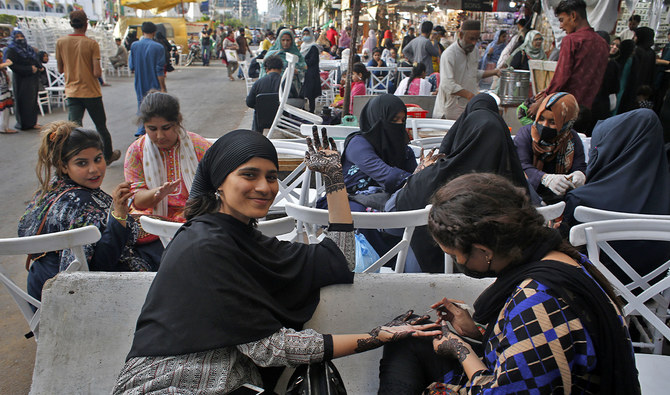

KARACHI: For many South Asian women, Eid and mehndi, or henna, are inseparable.
In Karachi too, as Chand Raat, or the night before Eid, draws close, thousands of women head to Gulf Market in the port city’s Clifton neighborhood to get intricate designs of henna embelished on their hands and feet.
Women in Karachi would traditionally go to beauty salons for mehndi application or ask a family member to apply it at home. In the last two decades or so, however, thousands of chairs are set up in the city’s Gulf Market each Eid, with hundreds of artists setting up shop a full 24 hours before Eid morning and continuing to apply mehndi well after Eid prayers have taken place on the morning of the festival.
Mehndi, a finely ground, green powder that yields a reddish-brown hue when mixed with water, is derived from crushed henna plant leaves. The use of henna can be traced back 9,000 years to ancient Egypt during the reign of the pharaohs and it is believed that Cleopatra, the final queen of the Ptolemaic Kingdom from 51 to 30 BC, enhanced her beauty by adorning her body with henna.
“Mehndi on Chand Raat is a must, Eid isn’t complete if mehndi isn’t painted,” Dr. Ubaida Fatima told Arab News on Thursday evening as two artists decorated her hands with designs at Gulf Market.
“Every Eid I definitely either come to [Karachi’s] Tariq Road or Gulf Market so I can get good and beautiful designs of mehndi. The fun of Chand Raat is in sitting in the market and getting mehndi with everyone around and among the hustle and bustle.”

An artist applies a 'henna' design on a customer's hand in the Gulf Market ahead of the Eid al-Fitr festival, which marks the end of the holy fasting month of Ramadan, in Karachi, Pakistan, on April 20, 2023. (AN photo)
Muhammad Shahid, who is the chairman of the market, said his union had been setting up the henna stalls for nearly two decades but the number of artists and customers had grown exponentially in the last six to seven years.
“We set up around 2500 to 3000 chairs. Those wanting to get mehndi are countless, but the girls who apply it, they are around 1200 to 1400,” Shahid told Arab News.
“We begin at around 9 to 10am on Chand Raat and the next [Eid] day, women are still coming after the prayers, it’s very difficult to make them stop.”

Artists apply henna designs on customers' hands in the Gulf Market ahead of the Eid al-Fitr festival, which marks the end of the holy fasting month of Ramadan, in Karachi, Pakistan, on April 20, 2023. (AN photo)
While experienced mehndi artists rely on years of skill and expertise, younger artists follow online designs chosen by customers.
Kulsoom, a student who only gave her first name, said she had selected a design she found on the Internet and showed it to a henna artist at Gulf Market.
“I told her make that design and she did it,” the student said.

A girl shows her 'henna' design in the Gulf Market ahead of the Eid al-Fitr festival, which marks the end of the holy fasting month of Ramadan, in Karachi, Pakistan, on April 20, 2023. (AN photo)
Skillful artists like Uzma Tehseen, who runs a beauty parlor in Meena Bazaar, a women’s only market, however, said experienced artists did not need to follow sample designs.
“I am experienced and it has been long since I have been doing this, that’s why I don’t need to look at designs from the cell phone,” she said, adding that intricate, subtle designs from her childhood were back in fashion, with new variations.
“Kids get peacocks and crescents made, they like to get ‘Eid Mubarak’ written on their hands also,” Zarmina Fazal, a graduate in criminology who applies henna as a hobby, said.
“The aroma of mehndi I think smells good and the designs are very attractive.”

An artist applies a 'henna' design on a customer's hand in the Gulf Market ahead of the Eid al-Fitr festival, which marks the end of the holy fasting month of Ramadan, in Karachi, Pakistan, on April 20, 2023. (AN photo)
For many artists, Eid is also a chance to make a quick buck.
“There are so many needy girls [henna artists] here, and Mashallah, I can see so many people are sitting here [waiting to get henna], and thank god, these artists will get a good income and then Eid becomes joyful for everyone,” Tehseen the salon owner said.
“Artists from all backgrounds have come here and everyone gets a good share of work.”


