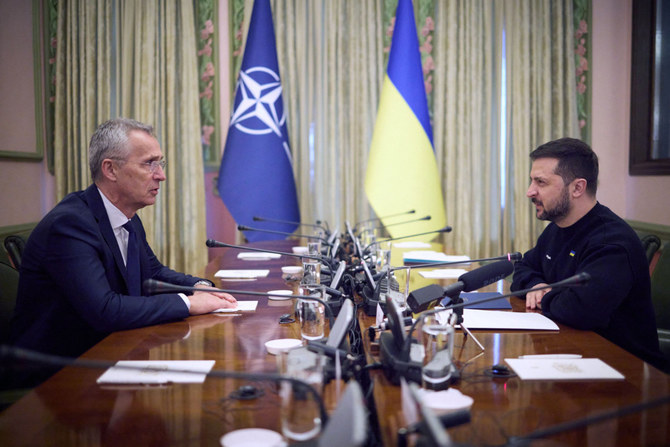
KYIV, Ukraine: NATO chief Jens Stoltenberg defiantly declared Thursday that Ukraine’s “rightful place” is in the military alliance and pledged more support for the country on his first visit to Kyiv since Russia’s invasion just over a year ago.
Ukrainian President Volodymyr Zelensky urged Stoltenberg, who has been instrumental in marshaling support from NATO members, to push for even more from them, including warplanes, artillery and armored equipment.
The Kremlin has given various justifications for going to war, but repeated Thursday that preventing Ukraine from joining NATO is still a key goal of its invasion, arguing that Kyiv’s membership in the alliance would pose an existential threat to Russia.
NATO leaders said in 2008 that Ukraine would join the alliance one day, and Stoltenberg has repeated that promise throughout the war, though the organization has established no pathway or timetable for membership.
“Let me be clear, Ukraine’s rightful place is in the Euro-Atlantic family,” Stoltenberg told a news conference. “Ukraine’s rightful place is in NATO.”
Zelensky said he was grateful for an invitation to a NATO summit in July in Vilnius, Lithuania, but said his country needs a roadmap for becoming a member.
“The time has come for the (alliance’s) leaders to define the prospects of Ukraine’s acquisition of NATO membership, to define the algorithm of Ukraine’s movement toward this goal, and to define security guarantees for our state for the period of such movement — that is, for the period before NATO membership,” he said.
Stoltenberg said he and Zelensky discussed a NATO support program for Ukraine.
“This will help you transition from Soviet-era equipment and doctrines to NATO standards and ensure full interoperability with the alliance,” Stoltenberg said. “NATO stands with you today, tomorrow and for as long as it takes.”
He noted an announcement Thursday by Denmark and the Netherlands that they plan to provide Ukraine with at least another 14 refurbished Leopard 2 battle tanks by early 2024.
He added that he expected countries to “make new announcements of concrete military support to Ukraine” at a meeting Friday in Germany.
In other developments, a large explosion hit the Russian city of Belgorod late Thursday, and the Defense Ministry said one of its Su-34 warplanes accidentally discharged ammunition over the city about 25 kilometers (15 miles) from the Ukrainian border. The government gave no further details.
Belgorod regional Gov. Vyacheslav Gladkov said the blast injured at least two people, damaged homes and left a crater about 20 meters (65 feet) across.
The fighting in recent months has become a war of attrition, with neither side able to gain momentum. But Ukraine has recently received sophisticated weapons from its Western allies and is expected to launch a counteroffensive in coming weeks.
Russian President Vladimir Putin has warned that Moscow could use “all means available” — a phrase some see as a threat to use nuclear weapons — in response to an attack on its territory if Ukraine attempts to recapture Moscow-occupied areas.
NATO has no official presence in Ukraine and provides only nonlethal support to Kyiv, but Stoltenberg has been the strong voice of the alliance throughout the war.
A procession of international leaders has made the journey to Kyiv over the last year, and the former Norwegian prime minister is one of the last major Western figures to do so.
NATO, formed to counter the Soviet Union, has long feared being dragged into a wide war with nuclear-armed Russia. But as the West has moved from hesitantly providing helmets and uniforms to tanks, warplanes and advanced missile systems, high-level visits have become routine.
Kremlin spokesman Dmitry Peskov said Thursday that preventing Ukraine from joining NATO remains one of the goals of what Moscow calls its “special military operation.” Speaking in a conference call with reporters, Peskov said that Ukraine’s accession would pose a “serious, significant threat to our country, to our country’s security.”
Earlier this month, Finland joined the alliance, setting aside decades of neutrality in a historic realignment of Europe’s post-Cold War security landscape. While NATO says it poses no threat to Russia, the Nordic country’s accession dealt a major political blow to Putin.
Finland’s membership doubles Russia’s border with the world’s biggest security alliance. Neighboring Sweden is expected to join too, possibly by the time US President Joe Biden and his NATO counterparts meet in Vilnius in July.
The alliance has focused on bolstering defenses on its own territory to dissuade Putin from attacking any member country. Under NATO’s collective security guarantee, an attack on one member country is considered an attack on all of them.
On Friday, Stoltenberg will attend a meeting of the Ukraine Defense Contact Group at Ramstein Air Base in Germany with US Defense Secretary Lloyd Austin. The group is the main international forum for drumming up military support for Ukraine.
Meanwhile, the Ukraine Space Agency said Thursday that a bright flash of light in the night sky over the country the previous day was probably a meteor entering the atmosphere. Residents of the capital and several cities in Belarus saw the flash of light, which lingered for a couple of seconds, and an explosion was heard in the Kyiv region. It triggered an air raid alarm in Kyiv.

NATO chief: Ukraine’s ‘rightful place’ is in the alliance
Short Url
https://arab.news/9y8gn
NATO chief: Ukraine’s ‘rightful place’ is in the alliance
- Zelensky said he was grateful for an invitation to a NATO summit in July in Vilnius, Lithuania, but said his country needs a roadmap for becoming a member
Greenland should hold talks with the US without Denmark, opposition leader says
COPENHAGEN: Greenland should hold direct talks with the US government without Denmark, a Greenlandic opposition leader told Reuters, as the Arctic island weighs how to respond to President Donald Trump’s renewed push to bring it under US control.
Trump has recently stepped up threats to take over Greenland, reviving an idea he first floated in 2019 during his first term in office.
Greenland is strategically located between Europe and North America, making it a critical site for the US ballistic missile defense system. Its rich mineral resources also fit Washington’s goal of reducing dependence on China.
The island is an autonomous territory of the Kingdom of Denmark. It has its own parliament and government, but Copenhagen retains authority over foreign affairs and defense.
“We encourage our current (Greenlandic) government actually to have a dialogue with the US government without Denmark,” said Pele Broberg, the leader of Naleraq, the largest opposition party and the most prominent political voice for Greenland’s independence.
“Because Denmark is antagonizing both Greenland and the US with their mediation.”
Naleraq, which strongly advocates a rapid move to full independence, doubled its seats to eight in last year’s election, winning 25 percent of the vote in the nation of just 57,000.
Although excluded from the governing coalition, the party has said it wants a defense agreement with Washington and could pursue a “free association” arrangement — under which Greenland would receive US support and protection in exchange for military rights, without becoming a US territory.
All Greenlandic parties want independence but differ on how, and when, to achieve it.
GOVERNMENT SAYS DIRECT TALKS NOT POSSIBLE
Greenlandic Foreign Minister Vivian Motzfeldt said Greenland could not conduct direct talks with the US without Denmark because it is not legally allowed to do so.
“We must respect the law, and we have rules for how to resolve issues in the Kingdom,” she told Sermitsiaq daily late on Wednesday.
The Danish and Greenlandic governments did not immediately reply to requests for comment on Broberg’s remarks.
The comments come ahead of a planned meeting between the Danish and Greenlandic foreign ministers and US Secretary of State Marco Rubio next week to address tensions between NATO allies.
Motzfeldt said it was important to set Greenland’s relationship with Washington on a steady course.
“My greatest hope is that the meeting will lead to a normalization of our relationship,” she told Sermitsiaq.
Rubio appears not to favor a military operation, according to France’s foreign minister. But others in the Trump administration say the option is on the table.
“We are going to make sure we defend America’s interests,” US Vice President JD Vance told Fox News in an interview aired late on Wednesday. “And I think the president is willing to go as far as he has to make sure he does that.”
(Reporting by Tom Little and Stine Jacobsen in Copenhagen; additional reporting by Soren Jeppesen; writing by Gwladys Fouche; Editing by Ros Russell)
Trump has recently stepped up threats to take over Greenland, reviving an idea he first floated in 2019 during his first term in office.
Greenland is strategically located between Europe and North America, making it a critical site for the US ballistic missile defense system. Its rich mineral resources also fit Washington’s goal of reducing dependence on China.
The island is an autonomous territory of the Kingdom of Denmark. It has its own parliament and government, but Copenhagen retains authority over foreign affairs and defense.
“We encourage our current (Greenlandic) government actually to have a dialogue with the US government without Denmark,” said Pele Broberg, the leader of Naleraq, the largest opposition party and the most prominent political voice for Greenland’s independence.
“Because Denmark is antagonizing both Greenland and the US with their mediation.”
Naleraq, which strongly advocates a rapid move to full independence, doubled its seats to eight in last year’s election, winning 25 percent of the vote in the nation of just 57,000.
Although excluded from the governing coalition, the party has said it wants a defense agreement with Washington and could pursue a “free association” arrangement — under which Greenland would receive US support and protection in exchange for military rights, without becoming a US territory.
All Greenlandic parties want independence but differ on how, and when, to achieve it.
GOVERNMENT SAYS DIRECT TALKS NOT POSSIBLE
Greenlandic Foreign Minister Vivian Motzfeldt said Greenland could not conduct direct talks with the US without Denmark because it is not legally allowed to do so.
“We must respect the law, and we have rules for how to resolve issues in the Kingdom,” she told Sermitsiaq daily late on Wednesday.
The Danish and Greenlandic governments did not immediately reply to requests for comment on Broberg’s remarks.
The comments come ahead of a planned meeting between the Danish and Greenlandic foreign ministers and US Secretary of State Marco Rubio next week to address tensions between NATO allies.
Motzfeldt said it was important to set Greenland’s relationship with Washington on a steady course.
“My greatest hope is that the meeting will lead to a normalization of our relationship,” she told Sermitsiaq.
Rubio appears not to favor a military operation, according to France’s foreign minister. But others in the Trump administration say the option is on the table.
“We are going to make sure we defend America’s interests,” US Vice President JD Vance told Fox News in an interview aired late on Wednesday. “And I think the president is willing to go as far as he has to make sure he does that.”
(Reporting by Tom Little and Stine Jacobsen in Copenhagen; additional reporting by Soren Jeppesen; writing by Gwladys Fouche; Editing by Ros Russell)
© 2026 SAUDI RESEARCH & PUBLISHING COMPANY, All Rights Reserved And subject to Terms of Use Agreement.


