

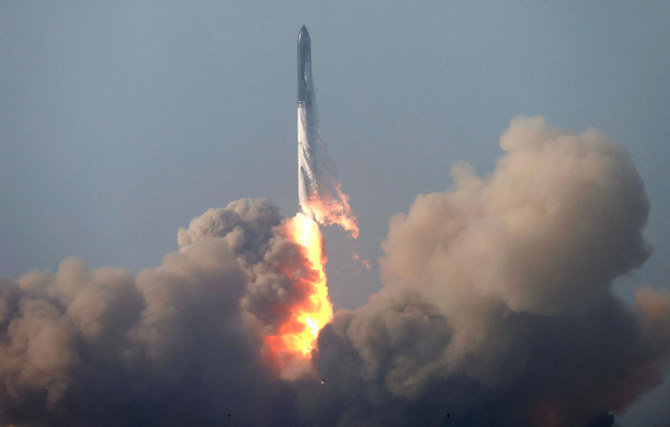
SpaceX giant rocket explodes minutes after launch from Texas

SpaceX's next-generation Starship spacecraft atop its powerful Super Heavy rocket lifts off from the company's Boca Chica launchpad on a brief uncrewed test flight near Brownsville, Texas, US April 20, 2023. (REUTERS)
Short Url
Updated 21 April 2023
Follow

SpaceX giant rocket explodes minutes after launch from Texas

  • Musk, in a tweet, called it “an exciting test launch of Starship! Learned a lot for next test launch in a few months.” SpaceX termed it a “rapid unscheduled disassembly”

SOUTH PADRE ISLAND, Texas: SpaceX’s giant new rocket exploded minutes after blasting off on its first test flight Thursday and crashed into the Gulf of Mexico.
Elon Musk’s company was aiming to send the biggest and most powerful rocket ever built on a round-the-world trip from the southern tip of Texas, near the Mexican border. The nearly 400-foot (120-meter) Starship carried no people or satellites.
SpaceX later said multiple engines on the 33-engine booster were not firing as the rocket ascended, causing it to lose altitude and begin to tumble. The rocket was intentionally destroyed by its self-destruct system, exploding and plummeting into the water.
Instead of a best-case-scenario 1 1/2-hour flight with the spacecraft on top peeling away and taking a lap around the world, the whole thing lasted four minutes. The rocket reached a maximum speed of about 1,300 mph (2,100 kph) and as high as 24 miles (39 kilometers), before going sideways and dropping.
Throngs of spectators watched from South Padre Island, several miles away from the Boca Chica Beach launch site, which was off-limits. As Starship lifted off with a thunderous roar, the crowd screamed: “Go, baby, go!”
Musk, in a tweet, called it “an exciting test launch of Starship! Learned a lot for next test launch in a few months.” SpaceX termed it a “rapid unscheduled disassembly.”
In the weeks leading up to the flight, Musk gave 50-50 odds that the spacecraft would reach orbit. He stressed that clearing the launch tower and not blowing up the pad would be a win.
“You never know exactly what’s going to happen,” said SpaceX livestream commentator and engineer John Insprucker. “But as we promised, excitement is guaranteed and Starship gave us a rather spectacular end.”
At liftoff, the rocket kicked up huge plumes of sand and dust around the pad. In Port Isabel, about 10 miles (6 kilometers) away, particles covered cars and other surfaces. The only other report, said John Sandoval, assistant to the city manager, was a shattered window at a local business. “Yes, it shook, rattled and rolled,” he said of the rocket.
The Federal Aviation Administration said it would oversee the accident investigation, noting that no injuries or public property damage were reported. The agency also said that until it determines that there is no threat to public safety, Starships are grounded.
SpaceX intends to use Starship to send people and cargo to the moon and, eventually, Mars. NASA has reserved a Starship for its next moonwalking team, and rich tourists are already booking lunar flybys.
Despite the abbreviated flight, congratulations poured in from NASA chief Bill Nelson and others in the space industry. Retired Canadian astronaut Chris Hadfield tweeted, “Huge accomplishment, huge lessons, onwards to the next attempt.”
“It fell somewhere between a small step and their hoped-for giant leap, but it still represents significant progress toward a reusable super-heavy lift rocket,” University of Chicago’s Jordan Bimm, a space historian, said in an email.
At 394 feet and nearly 17 million pounds of thrust, Starship easily surpasses NASA’s moon rockets — past, present and future. NASA successfully launched its new 322-foot (98-meter) moon rocket last November on a test flight, sending the empty Orion capsule around the moon.
The stainless steel Starship rocket is designed to be fully reusable with fast turnaround, dramatically lowering costs, similar to what SpaceX’s smaller Falcon rockets have done soaring from Cape Canaveral, Florida. Nothing was to be saved from this test flight, with the spacecraft — if all had gone well — aiming for a watery grave in the Pacific near Hawaii.
The futuristic spacecraft flew several miles into the air during testing a few years ago, landing successfully only once. But this was the inaugural launch of the first-stage booster with 33 methane-fueled engines.
SpaceX has more boosters and spacecraft lined up for more test flight; the next set is almost ready to go. Musk wants to fire them off in quick succession, so he can start using Starships to launch satellites into low-Earth orbit and then put people on board.
It was the second launch attempt. Monday’s try was scrapped by a frozen booster valve.
Jason and Lisa Flores drove down from Corpus Christi to watch the launch with their daughter, and noticed something was amiss.
Lisa Flores cried seeing the liftoff and then realized, “It’s not working out the way it was supposed to.”
Elizabeth Trujillo, 13, wearing a “Star Wars” shirt and carrying toy binoculars, skipped school to see the launch from the beach with her mother and other relatives. The crowd cheered when Starship cleared the tower.
Despite the failed attempt, “it was worth it,” said Jessica Trujillo, Elizabeth’s mother. “Just hearing and seeing the view, the excitement of the crowd, it was priceless.”
“Practice makes perfect. They just got to practice some more,” she added.


Eating snow cones or snow cream can be a winter delight, if done safely

Updated 28 January 2026
Follow

Eating snow cones or snow cream can be a winter delight, if done safely

  • As the storm recedes, residents of lesser-affected areas might be tempted to whip up bowls of “snow cream”
  • Fassnacht said he tried “snow cream” for the first time last year when some students made him some

WASHINGTON: Take two snowballs and call me in the morning?
Dr. Sarah Crockett, who specializes in emergency and wilderness medicine, doesn’t explicitly tell her patients at New Hampshire’s Dartmouth-Hitchcock Medical Center to swallow snow, but she often prescribes more time outside. If that time includes eating a handful of ice crystals straight or adding ingredients to make snow cones and other frozen treats, she’s all for it.
“To stop and just be present and want to catch a snowflake on your tongue, or scoop up some fresh, white, untouched snow that’s collected during something as exciting as a snowstorm, I think that there’s space in our world to enjoy that,” Crockett said. “And while we need to make good choices, I think these are simple things that can bring joy.”
Getting outdoors to enjoy simple pleasures is unlikely to be front of mind for people in a 1,300-mile (2,100-kilometer) stretch of the United States where a massive weekend storm brought deep snow and bitter cold. Freezing rain and ice brought down power lines and tree limbs, leaving hundreds of thousands of homes without power or heating in the South, while snow upended road and air travel from Arkansas to New England.
As the storm recedes, residents of lesser-affected areas might be tempted to whip up bowls of “snow cream” — snow combined with milk, sugar and vanilla — after seeing techniques demonstrated on TikTok. Others might want to try “sugar on snow,” a taffy-like confection made by pouring hot maple syrup onto a plate of snow.
Despite its pristine appearance, snow isn’t always clean enough to consume. Crockett and other experts shared advice for digging in safely while digging out.
The science of snow
Whether it’s rain or snow, precipitation cleans the atmosphere, picking up pollutants as it falls, said Steven Fassnacht, a professor of snow hydrology at Colorado State University. But snowflakes pick up more impurities because they fall more slowly and have more exposed surface areas than raindrops, he said.
That means snow that falls near coal plants or factories that emit particulates into the air contains more contaminants, said Fassnacht, who was in Shinjo, Japan, last week studying the salt content of snow. He said he wouldn’t have hesitated to take a taste there because there weren’t any big industrial complexes upwind.
“Snow can be eaten, but you want to think about the trajectory. Where did that snow come from?” he said.
Timing is another consideration, according to Crockett. The first wave of snow holds the most particulate matter, she said, so waiting until a storm is well underway before putting out a bowl to collect falling snow is one precaution to take.
Ground contamination is an additional factor, experts say. Avoiding yellow snow, which may be tainted by urine or tree bark, is conventional wisdom, but it’s also a good idea to stay away from any snow pushed by snowplows and packed with road salt, deicing chemicals and debris.
Snack versus survival
What about eating snow to survive? Crockett, who oversees the wilderness medicine program at Dartmouth College’s Geisel School of Medicine, says that’s a bad idea.
The energy it takes to melt snow in your mouth as you’re eating it essentially counteracts the hydration benefit, plus it decreases your core body temperature and increases the risk of hypothermia. While outdoor enthusiasts who plan to spend days in the mountains often melt and boil snow to purify it for drinking, it shouldn’t be viewed as an immediate hydration source, she said.
“If you are disoriented on a local hike, I would say your number one priority is to try to reach out for help in any way you can, ... not ‘Can I eat enough snow?’” Crockett said.
Focus on rewards, not risks
Fassnacht, who has studied snow for more than 30 years, said he tried “snow cream” for the first time last year when some students made him some. He described it as a fun experience that got him thinking about flavors and textures, not contaminants.
“It’s a whimsical thing,” he said. “It made me think about what are the characteristics of that freshly fallen snow, and how does that change the taste sensation?”
Crockett likewise is a fan of finding inspiration and wonder in nature. She worries that overprotective parenting has contributed to anxiety in some young people, and that excessive warnings about eating snow could add to that.
“We have to strike that right balance of making sure we’re avoiding danger while not being so protective that we encourage this ‘Everything is going to harm me’ mentality, particularly for children,” she said.
Crockett has four children, including a daughter she described as a “passionate snow eater.” As the recent winter storm got underway, she asked her why she liked eating snow so much and was told, “It makes me feel connected to the Earth.”
“That is actually something that’s really important to me, that we all have this connection to nature,” Crockett said.