

UK expected to ignore ECHR rulings on migrant deportations

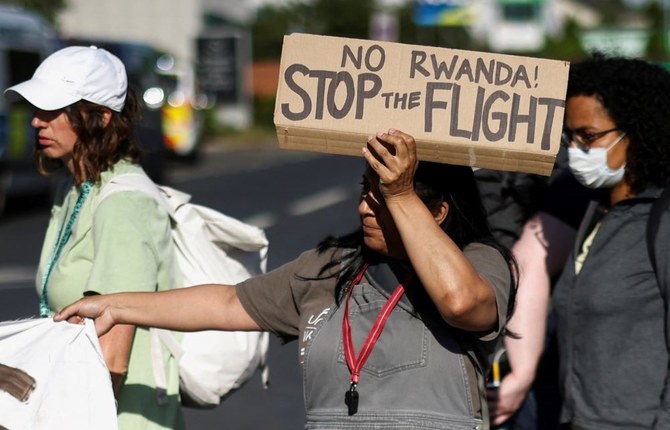
Activists protest against the British government’s plan to deport asylum seekers to Rwanda, near Heathrow airport in London, June 14, 2022. (Reuters)
Short Url
Updated 21 April 2023
Follow

UK expected to ignore ECHR rulings on migrant deportations

  • Amendment to illegal migration bill would allow home secretary to ‘disregard’ interim rule 39 orders
  • Former lord chief justice says move would likely amount to ‘symbolic breach of the rule of law’

LONDON: The UK home secretary is expected to be allowed to ignore rulings from the European Court of Human Rights on migrant deportations, government sources told The Guardian on Thursday.

Hard-right MPs have urged Prime Minister Rishi Sunak to toughen the illegal migration bill so that ministers can disregard ECHR rulings.

The law would include provisions that will prevent anyone who enters the UK illegally from seeking asylum, and will allow them to be held and deported.

According to government sources, an amendment to the bill will enable the home secretary to “disregard” interim rule 39 orders.

The ECHR granted 12 of 161 interim measures applications against the UK government between 2020 and 2022, The Guardian reported.

One of the Strasbourg court’s rule 39 injunctions last year prevented the government from deporting asylum applicants to Rwanda.

Another planned amendment to the new law will make it clear that the only option to prevent the deportation of refused asylum-seekers or criminals is to convince a British judge that doing so would cause “serious and irreversible harm,” sources told The Guardian.

The prime minister was believed to have initially resisted agreeing to ignore rulings from the ECHR, prompting the Rwanda removal plan to be postponed.

But according to government sources, Sunak told them he had “skin in the game, too” and that his premiership had vowed to halt the boats.

Although some Conservative MPs are pushing for the UK to leave the ECHR, they have taken a “tactical retreat” from prompting the government to do so before the next election, The Guardian reported

Removing the UK from the ECHR, whose rights were enshrined into UK law in 1998 with the Human Rights Act, is seen as problematic because the court was critical to the Good Friday Agreement, which secured peace in Northern Ireland.

John Thomas, the former lord chief justice of England and Wales, said the new amendments would likely amount to a “symbolic breach of the rule of law”.

He told The Guardian: “Many people would say having the power to ignore a court order is something [that], unless the circumstances were quite extraordinary, [that] this is a step a government should never take because it is symbolic of a breach of the rule of law.”


Myanmar arrests hundreds under new election law ahead of December vote

Updated 1 sec ago
Follow

Myanmar arrests hundreds under new election law ahead of December vote

Myanmar’s junta said this week it had arrested more than 200 people under a new law against undermining ​elections, drawing criticism from a monitoring group that the legislation is being used to block criticism of the regime and prevent scrutiny. The military government is set to begin a general election on December 28, the first since a 2021 coup overthrew the civilian administration.
The Asian Network for Free Elections (ANFREL), which served as an accredited international observer during the 2015 and 2020 polls, said in an assessment that the election protection law enacted by the junta in July is a major concern.
Myanmar authorities ‌have charged ‌at least 229 people under the law for attempting ‌to ⁠sabotage ​the election ‌process, the junta-run Global New Light of Myanmar newspaper reported this week.
It did not provide details on those charged or exactly what punishment they faced. Myanmar junta spokesman Zaw Min Tun did not respond to calls seeking comment.
The law prohibits actions aimed at disrupting the election as well as staging protests, including criticism on social media. Those convicted of breaking the law can face punishments ranging from three years in prison to the death ⁠penalty.
The law has been used against young people putting up boycott stickers, film directors and artists who ‌posted reactions on social media, and to charge journalists, according to ‍ANFREL.
“Rather than ensuring peaceful, competitive elections, ‍the Election Protection Law is being deployed to silence dissent, deter protests, and block ‍independent scrutiny – turning any form of election monitoring into a criminal risk,” the group said.

ELECTION AMID CIVIL WAR
Several countries, the United Nations, and rights groups have described the upcoming multi-phase elections as a sham designed to keep Myanmar’s ruling generals in power through proxies, although the junta ​insists the polls have public support. Over 100 townships, including the commercial capital of Yangon, will vote in the first phase of the elections ⁠in late December, followed by another 100 in the second phase on January 11. The details of a possible third phase are yet to be announced. The elections will be held amidst a raging civil war, triggered by the 2021 coup in which the military ousted an elected civilian government led by Nobel laureate Aung San Suu Kyi and her National League for Democracy. Her party remains dissolved under the junta’s directions and several other political groups are also boycotting the polls, drawing international criticism over the credibility of the elections. The junta, however, has defended its plan to go ahead with the polls.
“The election is being conducted for the people of Myanmar, not for the international community,” junta ‌spokesman Zaw Min Tun said at a press conference in Yangon last week, according to the state-run newspaper.
“Whether the international community is satisfied or not, is irrelevant.”