MOSCOW: A leading Russian military expert has accused the Czech Republic of state racketeering.
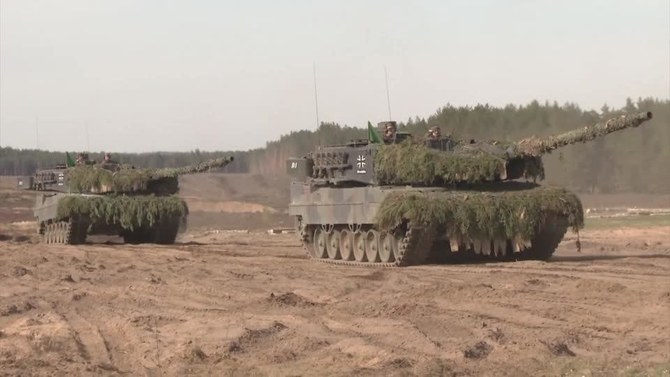
Konstantin Sivkov, vice president of the Russian Academy of Rocket and Artillery Sciences and a captain of the first rank, said Prague had violated international law by sending tanks belonging to Morocco to Ukraine.
Rabat did not give consent for its tanks to be delivered to Kyiv for use in the conflict against Russia, he said. Instead, they were transferred by authorities in the Czech Republic, where they had been sent for repairs and modernization.
Sivkov described the Czech decision to send the tanks, which Morocco purchased from Belarus, to Ukraine as “a blatant act of state racketeering, if not an act of state terrorism.”
He told Arab News: “These tanks were transferred to a third party without the consent of Morocco, which paid for their repair and modernization.
“In essence, these tanks were reexported to Ukraine without the consent of the seller — that is, Belarus — which would never agree to transfer them to a belligerent country.”
Morocco purchased 148 T-72B tanks in 1999 and 2000. In the past two years it sent 130 to a Czech company for modernization but less than half have been returned and at least 20 of the 74 that remained in the Czech Republic were reportedly handed over to Ukraine by Czech authorities in violation of contractual agreements.
“We consider this egregious case as further evidence of the hostile anti-Russian course pursued by the Czech authorities, within the framework of which Prague does not hesitate to violate the basic norms of international law regulating the arms trade, and seize another’s property,” said Maria Zakharova, the director of the Information and Press Department of the Russian Ministry of Foreign Affairs.
“The sad experience of the Second World War is being repeated, when Czech enterprises, being part of the military-industrial complex of Nazi Germany, tirelessly supplied the Third Reich with weapons for the war against the USSR.”
Zakharova said Czech authorities have learned nothing from history and have turned their country into a platform for the repair and modernization of equipment sent to Ukraine, and suggested such actions confirm the main goal of Kiev’s Western allies is to prolong the conflict as long as possible to cause maximum damage to Russia.
Morocco signed contracts in 2021 with Czech company Excalibur Army to repair and modernize 130 of the Soviet-built T-72B tanks. Only 56 have been returned and Czech authorities have been accused of appropriating the remaining 74.
In January this year, the website MENA Defense reported that the Czech Republic had sent at least 20 of the tanks to Ukraine as military assistance. The report said the decision had been made by Morocco under pressure from Western countries during a NATO summit at America’s Ramstein Air Base in Germany on April 26, 2022.
However, some African-related news organizations on the Telegram messenger app reported that it was Czech and not Moroccan authorities that had transferred tanks to Ukraine, in violation of the terms of the contract between the countries
MENA Defense later published photos of disassembled and upgraded T-72Bs at the Excalibur Army plant in the town of Sternberk, taken during a visit by Czech Prime Minister Peter Fiala on Jan. 9 this
year. In one of the pictures, he is signing a gun on a tank on which Czech and Ukrainian flags are visible.
“This egregious fact shows once again that Western countries cannot be trusted in any case, but the very transfer of these tanks confirms that Kiev’s Western patrons have already exhausted their capabilities to arm the Ukrainian army with modern weapons,” said Sivkov.
“And as for the T-72B tanks, these are combat vehicles of the mid-1980s, of the last century, and will not give Ukraine any advantage on the battlefield.”


![]()

Morocco did not consent to transfer of its tanks to Ukraine, says Russian military expert
Short Url
https://arab.news/chvws
Morocco did not consent to transfer of its tanks to Ukraine, says Russian military expert
- Konstantin Sivkov said authorities in the Czech Republic, where the tanks were being modernized, sent them to Kyiv in ‘a blatant act of state racketeering, if not an act of state terrorism’
- Morocco bought 148 T-72B tanks from Belarus two decades ago and recently sent 130 of them to a Czech company for modernization but less than half are said to have been returned


Latest updates


© 2026 SAUDI RESEARCH & PUBLISHING COMPANY, All Rights Reserved And subject to Terms of Use Agreement.