BEIRUT: Suleiman Franjieh, the candidate for the Lebanese presidency backed by Hezbollah, said on Tuesday that the “game has changed in the region, and this will be reflected in one way or another in Lebanon.”
He added that his goal “is not power, but to be a president who leaves his mark.”
Lebanon has had no head of state since former President Michel Aoun’s term ended at the end of October.
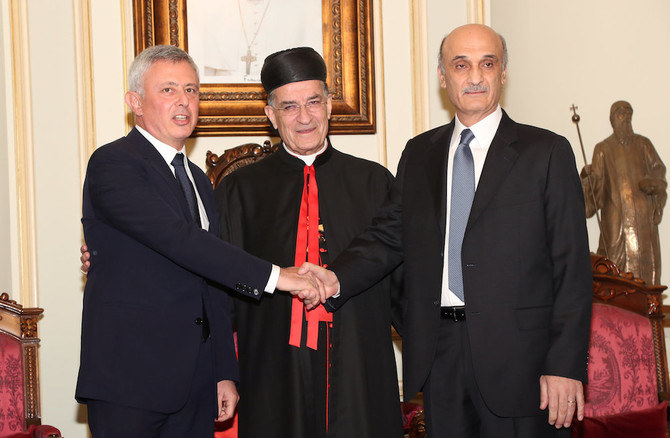
Franjieh made a surprise visit to Maronite Patriarch Bechara Boutros Al-Rahi at his headquarters in Bkerke, and made a statement for the first time following Hezbollah’s pledged support for his candidacy.
Franjieh — an ally of the Syrian regime and a friend of President Bashar Assad — described the meeting with Al-Rahi as “extremely frank and clear.”
He said that it was necessary to “join the settlement train in the region and not [be] outside it, unlike what happened in 1989-1990 when some [politicians] remained outside the settlement and the Christians paid the price.”
Franjieh said that he had visited France and met officials there who had played a mediating role in the Lebanese crisis.
He said his visit to France raised a number of questions and gave rise to discussions on several topics.
He added: “I was asked about supporting reforms and the relationship with the International Monetary Fund — and they are in contact with Saudi Arabia — and I confirmed that it is obvious that we proceed with reforms, support the agreement with the IMF and any government that has a reform program.”
Franjieh went on to say: “I heard the veto on my name from the Lebanese media, but I never heard it from Saudi Arabia or its friends and allies.
“I am ready for dialogue with everyone, and we must join the settlement train in the region.
“I call on all politicians to understand how things are moving. We only want the best for the Arabs and Saudi Arabia.
“I was born in a pan-Arab home, and I did not have any hostile view of any country that is friendly with Lebanon, especially Saudi Arabia.
“We want the best for the Arabs and we do not accept that anyone attacks the Arab countries.”
Franjieh said that his relationship with Assad and Hezbollah had been for the benefit of the country.
He added that the issue of Syrian refugees was being dealt with in a way that would lead to their return to Syria.
He added: “The obstruction of the return of the Syrian refugees was never Syrian, but European and Western.”
He pointed out that “President Assad was never against their return.”
Franjieh said: “We are in favor of discussing a defense strategy that is in the interests of Lebanon and removes everyone’s concerns.”
Franjieh heads the Marada Movement. He won a seat as a politician in 1991 and was then the youngest MP in parliament. He was subsequently elected for three successive terms in 1992, 1996 and 2000.
Franjieh, 57, has participated in the government more than once, and was minister of health in the Rafic Hariri Cabinet of 1996.
His grandfather is the late President Suleiman Franjieh, and his father is the former MP and minister, Tony Franjieh.


![]()

Hezbollah’s candidate for Lebanon’s presidency hails talks with Maronite patriarch after surprise visit to Bkerke
Short Url
https://arab.news/5fg44
Hezbollah’s candidate for Lebanon’s presidency hails talks with Maronite patriarch after surprise visit to Bkerke
- Suleiman Franjieh: ‘We only want the best for the Arabs and Saudi Arabia’
- Franjieh made a surprise visit to Maronite Patriarch Bechara Boutros Al-Rahi at his headquarters in Bkerke


Latest updates


© 2026 SAUDI RESEARCH & PUBLISHING COMPANY, All Rights Reserved And subject to Terms of Use Agreement.