



MIRPURKHAS: For Yasmeen Lari, an architect and a conservationist, climate change is a real threat and it is very important to use materials that do not tend to hurt the planet. Lari, 82, has been spearheading a push for a model architecture solution in southern Pakistan to address the risk of damage from torrential rains and floods.
Unprecedented rains and floods wreaked havoc in the southern Pakistani province of Sindh, which accounted for the most casualties out of more than 1,700 fatalities across the South Asian country. The deluges impacted 33 million Pakistanis and caused over $30 billion economic losses.
Aiming to reduce the likelihood of future damage from extreme weather conditions, Lari’s NGO, the Heritage Foundation of Pakistan, has been implementing a rain- and flood-resistant architecture solution by rebuilding the 1,000 homes that were affected by the last year’s floods in Sindh’s Mirpurkhas district.
The destruction of these homes was particularly difficult for women and children, who struggle to restart their lives, and the devastating floods highlighted the need for better preparedness in flood-prone regions like Sindh, according to Lari.
“The same was the story in the area of Pono cluster villages and Pono village in Mirpurkhas itself where there was just water everywhere,” she told Arab News.
“So, it was very important for us to take it up as at first I wanted to take it as a pilot to show how we could do it as a holistic model.”

On April 11, 2023, laborers pile up bamboo panels for rain-resistant Chanwara houses in Sindh's Pono village, Pakistan, on April 11, 2023. (AN photo by Zulfiqar Kunbhar)
To build these climate-resilient homes, the panels of the home structures, which have “collapsible” roofs made of bamboo, are firmly anchored into the foundation and plinth that are made of materials such as lime brick, lime mud brick, or lime concrete. Cement is not used at all as these structures are designed to be zero-carbon and zero-waste, according to the Heritage Foundation of Pakistan.
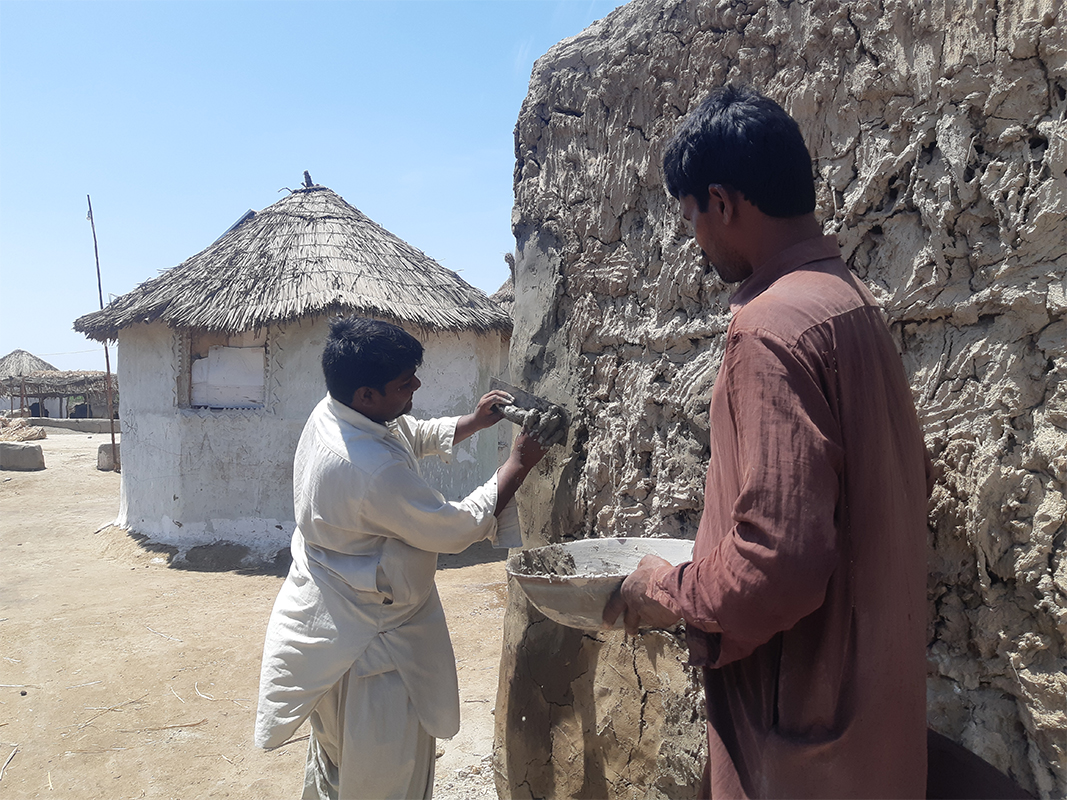
Ramesh Kolhi plasters his newly constructed Chanwara with mud and lime paste in Sindh's Pono village, Pakistan, on April 11, 2023. (AN photo by Zulfiqar Kunbhar)
The approach is both cost-effective and environment-friendly and provides rapid building and shelter solutions for those in need. Additionally, the participatory approach empowers individuals to construct these structures themselves.
Lari’s organization, which has been involved in disaster relief efforts in Pakistan since 2005, previously helped build rain-resistant Chanwara houses in the Pono village. The wood- and straw-made were not damaged by last year’s rain in the village.
“Pono village was able to provide shelter to many of its neighbors who had lost their homes for a period of one and a half months,” Ramesh Kolhi, a teacher and resident of Pono village, told Arab News.
“Neighbors also have started adopting this building style in their villages.”

Heritage Foundation of Pakistan is seen holding a meeting with the residents of Pono village in Pakistan's Sindh province on April 11, 2023. (AN photo by Zulfiqar Kunbhar)
Previously, Kohli said, there used to be a constant fear of old structures collapsing during rains and flooding. However, with the new structures that have proper drainage, there has been no risk of water entering the homes, he added.
The new structures are quick and economical to build, with collapsible roofs and panels anchored to foundations made of eco-friendly materials, according to Lari.
The cost of constructing a single room using this eco-friendly approach is less than Rs25,000 ($90), a fraction of the cost of traditional concrete structures that can cost up to Rs400,000.
The Heritage Foundation has also introduced washrooms in these new homes, providing relief to locals, particularly women, who previously had to defecate in the open.
Jaiti Kolhi, a 40-year-old housewife, said the new structures have brought “great relief” to them.
“The construction of washrooms has saved us from the inconvenience of going out. This has helped maintain our privacy,” Jaiti told Arab News.
“Similarly, the installation of hand pumps at the household level has saved us from the hardship of fetching water from distant areas.”


