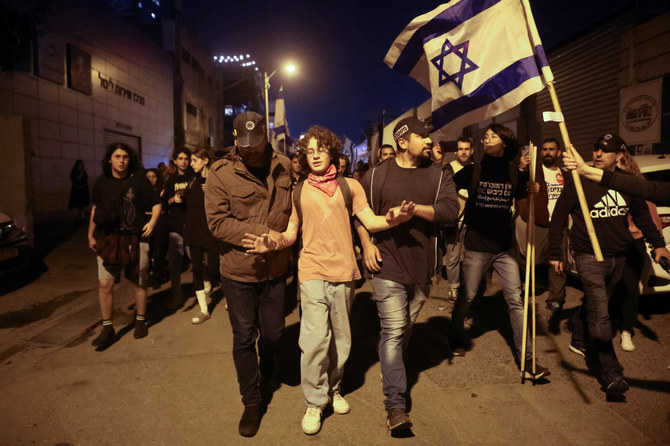
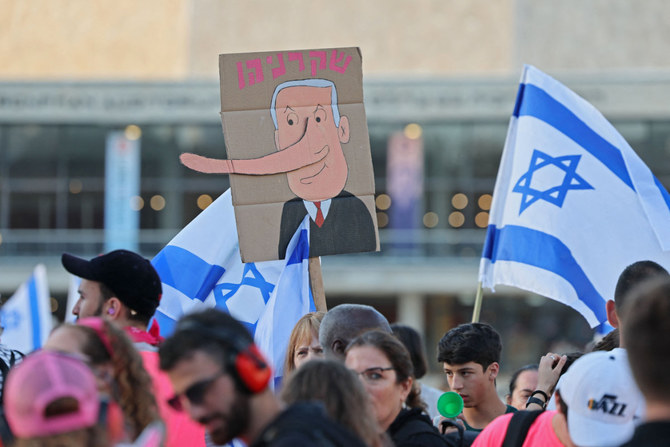
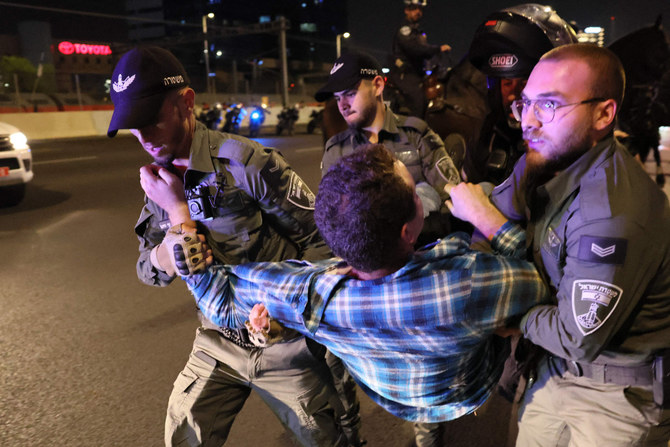
TEL AVIV: Thousands of Israelis again took to the streets of Tel Aviv late Saturday to protest government judicial reforms they view as an attack on democracy.
The 15th consecutive week of protest came after Prime Minister Benjamin Netanyahu on March 27 announced a “pause” to allow for dialogue on the reforms which were moving through parliament and split the nation.
“Let’s save democracy” read signs in a sea of Israeli flags waved by demonstrators. AFP journalists also reported smoke bombs and flares being set off.
Smaller protests also took place in the northern port of Haifa and outside the home of Justice Minister Yariv Levin in Modiin.
Israeli media reported tens of thousands had turned out, as occurred in some previous demonstrations.
“We are fighting for our democracy. We have no other country,” one demonstrator, Nadav Tamir, 61, told AFP.
Karen Baron, a 45-year-old Tel Aviv psychiatrist, said: “I didn’t want to come today but my sister told me, ‘We have no choice’, and it’s true. We have no choice — we can’t lower our guard. We have to defend our country.”
The proposals would curtail the authority of the Supreme Court and give politicians greater powers over the selection of judges.
Netanyahu’s government, a coalition between his Likud party and extreme-right and ultra-Orthodox Jewish allies, argues the changes are needed to rebalance powers between lawmakers and the judiciary.
Saturday’s demonstration came a day after US rating agency Moody’s announced it was lowering Israel’s outlook from “positive” to “stable.”
It said the change “reflects a deterioration of Israel’s governance, as illustrated by the recent events around the government’s proposal for overhauling the country’s judiciary.
“While mass protests have led the government to pause the legislation and seek dialogue with the opposition, the manner in which the government has attempted to implement a wide-ranging reform without seeking broad consensus points to a weakening of institutional strength and policy predictability,” Moody’s noted.


![]()
![]()
![]()

Israeli judicial protest movement again crowds Tel Aviv
Short Url
https://arab.news/2n7hq
Israeli judicial protest movement again crowds Tel Aviv
- The protests were sparked by PM Netanyahu's attempt to curtail the authority of the Supreme Court and give politicians greater powers over the selection of judges


Latest updates


© 2026 SAUDI RESEARCH & PUBLISHING COMPANY, All Rights Reserved And subject to Terms of Use Agreement.