

Sudan’s army pounds paramilitary bases with air strikes in power struggle

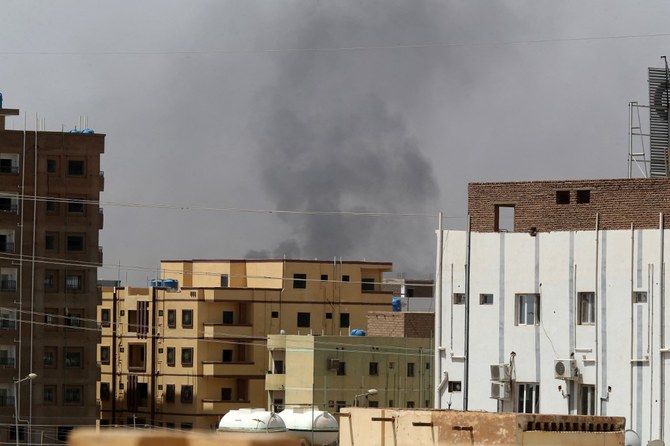
Sounds of heavy weaponry were heard in the vicinity of Sudan’s army command and paramilitary headquarters in central Khartoum. (FILE/AFP)
Short Url
Updated 17 April 2023
Follow

Sudan’s army pounds paramilitary bases with air strikes in power struggle

  • Sudan Doctor’s Syndicate says death toll could be far bigger
  • Army said it was fighting RSF at sites paramilitaries said they had taken

KHARTOUM: Sudan’s army appeared to gain the upper hand on Sunday in a bloody power struggle with rival paramilitary forces after blasting its bases with air strikes, witnesses said, and at least 59 civilians were killed including three UN workers.
The fighting erupted on Saturday between army units loyal to General Abdel Fattah Al-Burhan, head of Sudan’s transitional governing Sovereign Council, and the paramilitary Rapid Support Forces (RSF), led by General Mohamed Hamdan Dagalo, known as Hemedti, who is deputy head of the council.
It was the first such outbreak since both joined forces to oust veteran Islamist autocrat Omar Hassan Al-Bashir in 2019 and was sparked by a disagreement over the integration of the RSF into the military as part of a transition toward civilian rule.

The US, China, Russia, Egypt, Saudi Arabia, the UN Security Council, European Union and African Union have appealed for an quick end to the hostilities that threaten to worsen instability in an already volatile wider region.
Efforts by neighbors and regional bodies to end the violence intensified on Sunday. That included an offer by Egypt and South Sudan to mediate between the fighting parties, according to a statement by the Egyptian presidency.
The two rivals have been competing for power as political factions negotiate forming a transitional government after a 2021 military coup. Hemedti’s whereabouts were unknown on Sunday but Burhan was inside army headquarters in downtown Khartoum.
Witnesses and residents told Reuters that the army had carried out air strikes on RSF barracks and bases, including in Omdurman across the Nile river from the capital Khartoum, and managed to destroy most of their facilities.
They said the army had also wrested back control over much of Khartoum’s presidential palace from the RSF after both sides claimed to control it and other key installations in Khartoum, where heavy artillery and gunbattles raged into Sunday.
RSF members remained inside Khartoum international airport besieged by the army but it was holding back from striking them to avoid wreaking major damage, witnesses said.

“The hour of victory is near,” the army said in a statement on Sunday. “We pray for mercy for the innocent lives taken by this reckless adventure taken by the rebel Rapid Support militia ... We will have good news for our patient and proud people soon, God willing.”
But a major problem, witnesses and residents said, was posed by thousands of heavily armed RSF members deployed inside neighborhoods of the capital Khartoum and other cities, with no authority able to control them.
“We’re scared, we haven’t slept for 24 hours because of the noise and the house shaking. We’re worried about running out of water and food, and medicine for my diabetic father,” Huda, a young resident in southern Khartoum told Reuters.
“There’s so much false information and everyone is lying. We don’t know when this will end, how it will end,” she added.
Tagreed Abdin, an architect in Khartoum, said the power was out and people were trying to conserve phone batteries. “We can hear air strikes, shelling, and gunfire,” she said.
Doctors unions said it was difficult for medics and the sick to get to and from hospitals and called on the army and RSF to provide safe passage. Later on Sunday, the army approved a UN proposal to open safe passage for urgent humanitarian cases for three hours every day starting from 1600 local time (1400 GMT).
Sudan’s MTN telecommunications company blocked Internet services on the orders of the government telecommunications regulator, two company officials told Reuters on Sunday.

In Khartoum, several groups of people reported being stranded near the presidential palace and military headquarters.
Social media videos showed military jets flying low over the city, at least one appearing to fire a missile.
The Central Committee of Sudanese Doctors reported at least 56 civilians had been killed and 595 people including combatants had been wounded since the fighting erupted.
Scores of military personnel were killed, the doctors’ committee said, without giving a specific number due to a lack of first-hand information from hospitals.
Egypt called on the fighting parties to ensure the safety of all Egyptian interests in Sudan, the Egyptian representative in the Arab League told a meeting called on Sunday to discuss developments in Sudan, which is also a member of the League.
In a speech at the League, Sudan said the Sudanese should be allowed to reach a settlement internally, without interference from the international community.
The African Union’s Peace and Security Council also called an emergency session on Sunday to discuss political and security developments in Sudan.
The RSF claimed on Saturday to have seized the presidential palace, army chief’s residence, state television station and airports in Khartoum, the northern city of Merowe, El Fasher and West Darfur state. The army rejected those assertions.
The armed forces said it would not negotiate with the RSF unless the force dissolved. The army told soldiers seconded to the RSF to report to nearby army units, which could deplete RSF ranks if they obey.
RSF leader Hemedti, deputy head of state, called military chief Burhan a “criminal” and a “liar.”


Syrian military tells civilians to evacuate contested area east of Aleppo amid rising tensions

Updated 3 sec ago
Follow

Syrian military tells civilians to evacuate contested area east of Aleppo amid rising tensions

  • Syria’s military has announced it will open a “humanitarian corridor” for civilians to evacuate from an area in Aleppo province
  • This follows several days of intense clashes between government forces and the Kurdish-led Syrian Democratic Forces
DAMASCUS: Syria’s military said it would open a corridor Thursday for civilians to evacuate an area of Aleppo province that has seen a military buildup following intense clashes between government and Kurdish-led forces in Aleppo city.
The army’s announcement late Wednesday — which said civilians would be able to evacuate through the “humanitarian corridor” from 9 a.m. to 5 p.m. Thursday — appeared to signal plans for an offensive in the towns of Deir Hafer and Maskana and surrounding areas, about 60 kilometers (40 miles) east of Aleppo city.
The military called on the Kurdish-led Syrian Democratic Forces and other armed groups to withdraw to the other side of the the Euphrates River, to the east of the contested zone.
Syrian government troops have already sent troop reinforcements to the area after accusing the SDF of building up its own forces there, which the SDF denied. There have been limited exchanges of fire between the two sides, and the SDF has said that Turkish drones carried out strikes there.
The government has accused the SDF of launching drone strikes in Aleppo city, including one that hit the Aleppo governorate building on Saturday shortly after two Cabinet ministers and a local official held a news conference there.
The tensions in the Deir Hafer area come after several days of intense clashes last week in Aleppo city that ended with the evacuation of Kurdish fighters and government forces taking control of three contested neighborhoods. The fighting killed at least 23 people, wounded dozens more, and displaced tens of thousands.
The fighting broke out as negotiations have stalled between Damascus and the SDF, which controls large swaths of northeast Syria, over an agreement to integrate their forces and for the central government to take control of institutions including border crossings and oil fields in the northeast.
Some of the factions that make up the new Syrian army, which was formed after the fall of former President Bashar Assad in a rebel offensive in December 2024, were previously Turkiye-backed insurgent groups that have a long history of clashing with Kurdish forces.
The SDF for years has been the main US partner in Syria in fighting against the Daesh group, but Turkiye considers the SDF a terrorist organization because of its association with the Kurdistan Workers’ Party, or PKK, which has waged a long-running insurgency in Turkiye. A peace process is now underway.
Despite the long-running US support for the SDF, the Trump administration has also developed close ties with the government of interim Syrian President Ahmad Al-Sharaa and has pushed the Kurds to implement the integration deal. Washington has so far avoided publicly taking sides in the clashes in Aleppo.
The SDF in a statement warned of “dangerous repercussions on civilians, infrastructure, and vital facilities” in case of a further escalation and said Damascus bears “full responsibility for this escalation and all ensuing humanitarian and security repercussions in the region.”
Adm. Brad Cooper, commander of US Central Command, said in a statement Tuesday that the US is “closely monitoring” the situation and called for “all parties to exercise maximum restraint, avoid actions that could further escalate tensions, and prioritize the protection of civilians and critical infrastructure.” He called on the parties to “return to the negotiating table in good faith.”
Al-Sharaa blasts the SDF
In a televised interview aired Wednesday, Al-Sharaa praised the “courage of the Kurds” and said he would guarantee their rights and wants them to be part of the Syrian army, but he lashed out at the SDF.
He accused the group of not abiding by an agreement reached last year under which their forces were supposed to withdraw from neighborhoods they controlled in Aleppo city and of forcibly preventing civilians from leaving when the army opened a corridor for them to evacuate amid the recent clashes.
Al-Sharaa claimed that the SDF refused attempts by France and the US to mediate a ceasefire and withdrawal of Kurdish forces during the clashes due to an order from the PKK.
The interview was initially intended to air Tuesday on Shams TV, a broadcaster based in Irbil — the seat of northern Iraq’s semi-autonomous Kurdish region — but was canceled for what the station initially said were technical reasons.
Later the station’s manager said that the interview had been spiked out of fear of further inflaming tensions because of the hard line Al-Sharaa took against the SDF.
Syria’s state TV station instead aired clips from the interview on Wednesday. There was no immediate response from the SDF to Al-Sharaa’s comments.