Advertising conglomerate Publicis Groupe launches internship program for retired professionals

Publicis Groupe’s The Grand Masters program ultimately aims to address “the stigma of agism in the digital industry and region,” said head of Talent Transformation, Publicis Groupe Middle East and Turkiye. (Publicis Groupe)
Short Url
Updated 15 April 2023
Follow

Advertising conglomerate Publicis Groupe launches internship program for retired professionals

  • Grand Masters plan in the UAE aims to reintegrate older people into the workforce

DUBAI: Multinational advertising and marketing network Publicis Groupe has launched what it claims to be the first-of-its-kind internship program, The Grand Masters, for retired professionals aged 60 and older.

Sewar Azzouni, head of Talent Transformation, Publicis Groupe Middle East and Turkiye, told Arab News: “Addressing agism within different industries, and specifically ours, requires a multifaceted approach that involves educating people continuously and promoting diversity and inclusion, while launching and updating programs and processes that support young and older-aged talent equally.”

Some 63 percent of people working in advertising, public relations and related industries in 2017 were under 45 years of age, according to the Bureau of Labor Statistics in the US.

The average age of employees in agencies in the UK was 34.4 years in 2022, with only 6.5 percent of employees being above the age of 50, according to a survey by The Institute of Practitioners in Advertising.

Publicis Groupe’s The Grand Masters program ultimately aims to address “the stigma of agism in the digital industry and region,” said Azzouni.
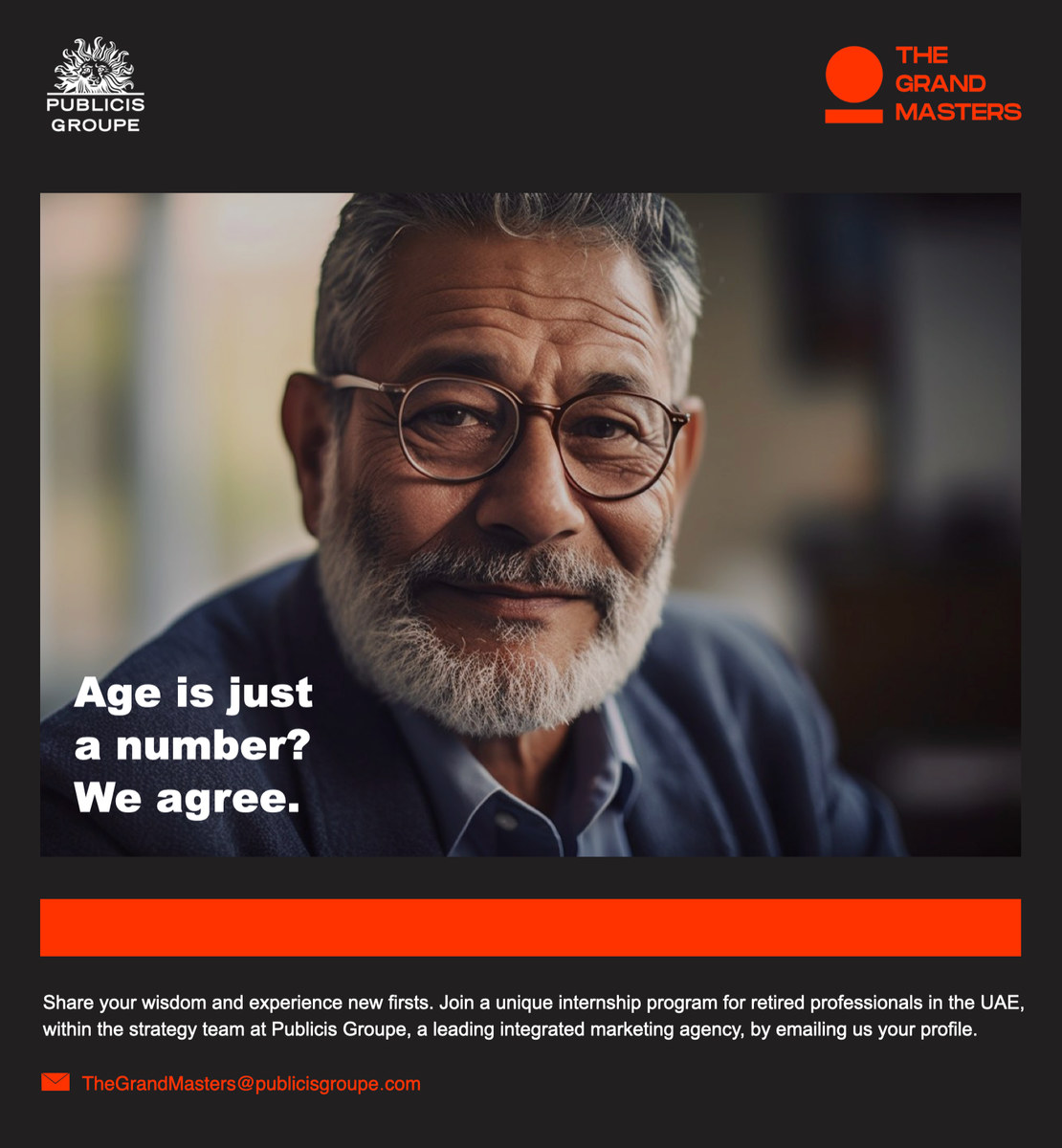
The program encourages different age groups to work together, “breaking down stereotypes and promoting understanding and appreciation between all,” she added.

Interns will be asked to generate insights that will inform the group’s campaigns and strategies for some of its clients. They will be required to brainstorm with the team, mine insights, and contribute to the company’s thought leadership strategies.

Participants are required to attend the program for a minimum of four hours a day, thrice a week, beyond which the company is flexible to accommodate their schedule.

Publicis Groupe is also launching a second internship program, The Apprentices, which targets university students.

Interns in this program will be tasked with creative brief writing, creative ideation, and insights generation. The group will also prioritize high-performing interns for full-time employment in the future.

The Apprentices program is open to students of 18 years and older who are currently enrolled at an accredited university or college where an internship is a requirement for graduation, and who are studying disciplines related to the creative industry or innovation.

Interns will be required to commit to a minimum of six hours a day, five days a week, or as required by the university. 

All interns will receive an official certification from Publicis Groupe at the end of the internship.

Both programs are being launched in the UAE initially, with plans underway to expand to other markets in the region.

Azzouni added: “Promoting and practicing equity means ensuring that everyone has the same opportunity, regardless of background, race, and inclusive of age.

“As we strive to create and maintain inclusivity in everything we do, we are excited to have the interns and grandmasters experience our engaging culture and a sense of belonging, allowing them to be their authentic selves.”


Keep it real: Tech giants urged to lead on safeguarding online privacy

Updated 09 December 2025
Follow

Keep it real: Tech giants urged to lead on safeguarding online privacy

  • AI, deepfakes, misinformation under scrutiny at Bridge Summit
  • Media, tech professionals discuss how to keep users safe

ABU DHABI: As AI-generated deepfakes and bots grow more sophisticated, online privacy and identity protection have become urgent global concerns, especially for journalists, influencers and media professionals, whose lives unfold in the digital spotlight.

The growing threats of impersonation, character assassination and coordinated online abuse was at the center of a high-stakes conversation on the second day of the Bridge Summit in Abu Dhabi, where regional and international leaders from the technology and media fields tackled the complex risks surrounding digital safety, security and trust in an AI-powered world.

Adeline Hulin, chief of unit, media and information literacy at UNESCO, highlighted the risks that many people, in particular children and women, are facing online. 

Although her work has long centered on promoting safe internet practices, she said that the onus of safeguarding online privacy and security rested primarily with technology companies — the only actors, she argued, capable of keeping pace with the rapid evolution of AI.

“It is going to be really important that instead of people constantly having to adapt to the technology, if the technology itself is more user-centric,” she told the summit.

“We can train people to recognize deepfakes, but technology can do that quicker.”

Major tech companies have come under fire in recent years for failing to tackle harassment and misinformation. This has led to a litany of legislation as governments try to gain control of a growing problem.

But some companies appear to be heeding the call. Erin Relford, senior privacy engineer at Google, said her company was working to embed privacy protections in the infrastructure level beneath the platform.

“We want to give consumers the choice of how much they can share data-wise,” she said.

“The biggest challenge is making sure you have the right people in the room to create these privacy protection platforms.”

Privacy enhancement technology would see several tools released that empowered users to understand how their data was being monetized and aggregated, Relford said.

Google had been working to change the parental controls and make it easier for users to understand their protection, she said, but admitted it was still difficult and more education was needed.

“Most of the power lies within the user. Consumers drive what is popular. In terms of organizations that protect your privacy, we want to encourage them and use their services rather than empowering websites that don’t,” she said.

Education is key 

Still, Relford argued that education was fundamental in rolling out privacy tools. Tech companies could only do so much if people did not increase their awareness online, she said.

“The better we educate people about privacy tools, the less harm we have from the ground up.”

Echoing similar sentiments, Hulin promoted the idea of including online literacy in school curricula. Even high-profile moves, like Australia’s recent headline-grabbing ban on under-16s using social media, would do little to reduce the risks without more education.

“Even if there is banning, it’s not going to change misinformation and disinformation. You still need to teach these kids about the information ecosystem,” she said.

“Parents need to be really interested in the news information that your children are consuming.”

Assel Mussagaliyeva-Tang, founder of Singapore-based startup EDUTech Future, said that the AI revolution demanded close collaboration between schools, universities and families to equip children with the skills to navigate new technologies safely and responsibly.

“We need to set up the guardrails and protection of the kids because they are not aware how the model will respond to their needs,” she said.

A UNESCO survey found that 62 percent of digital creators skip rigorous fact-checking, while a 2024 YouGov study showed only 27 percent of young adults feel confident about AI in education.

Mussagaliyeva-Tang said educators needed to focus on preparing and nurturing adults who were “ready for the world,” by integrating ethics, data literacy and critical thinking into curricula.

But she said that universities and the broader education system remained behind the curve in adapting to emerging technologies and equipping students with the skills needed for responsible digital engagement.

Likewise, tech companies needed to be transparent and inclusive in training their data in a way that represented different cultures, she said.

While global regulations on AI remain fragmented, Dr. Luca Iando, dean and distinguished chair at the Collins College of Professional Studies at St. John’s University, called on educational institutions to actively collaborate with technology platforms to help shape educational content and mitigate the potential harm of AI on children, especially as technologies continue to grow.

He warned of young people’s overreliance on AI and said that educators in the long term needed to focus on developing “durable, human skills” in students and transform the type of assignments and coursework to meet the new age of AI.

There needed to be guidelines for students on using AI responsibly, to prepare them for the workplace, he said.

Highlighting the skills gap between educational institutions and the modern workplace, Mussagaliyeva-Tang said: “Employers want professionals. They don’t have time and the budgets to retrain after the outdated curriculum of the university.”

The rise of AI demanded a rethinking of the true purpose of education to nurture individuals who strove to make a positive impact on a rapidly evolving world, she said.