



MAKKAH: Pilgrims from around the world are arriving in Makkah to perform Umrah during Ramadan, with many staying in neighborhoods known for accommodating people from their country of origin.
Ahmed Saleh Halabi, Hajj and Umrah services adviser, said: “The number of Hajj and Umrah performers we are witnessing today is higher than ever.
“Providing several services, such as food as well as workers speaking the same language of Hajj and Umrah performers, attracts pilgrims to reside in the region.
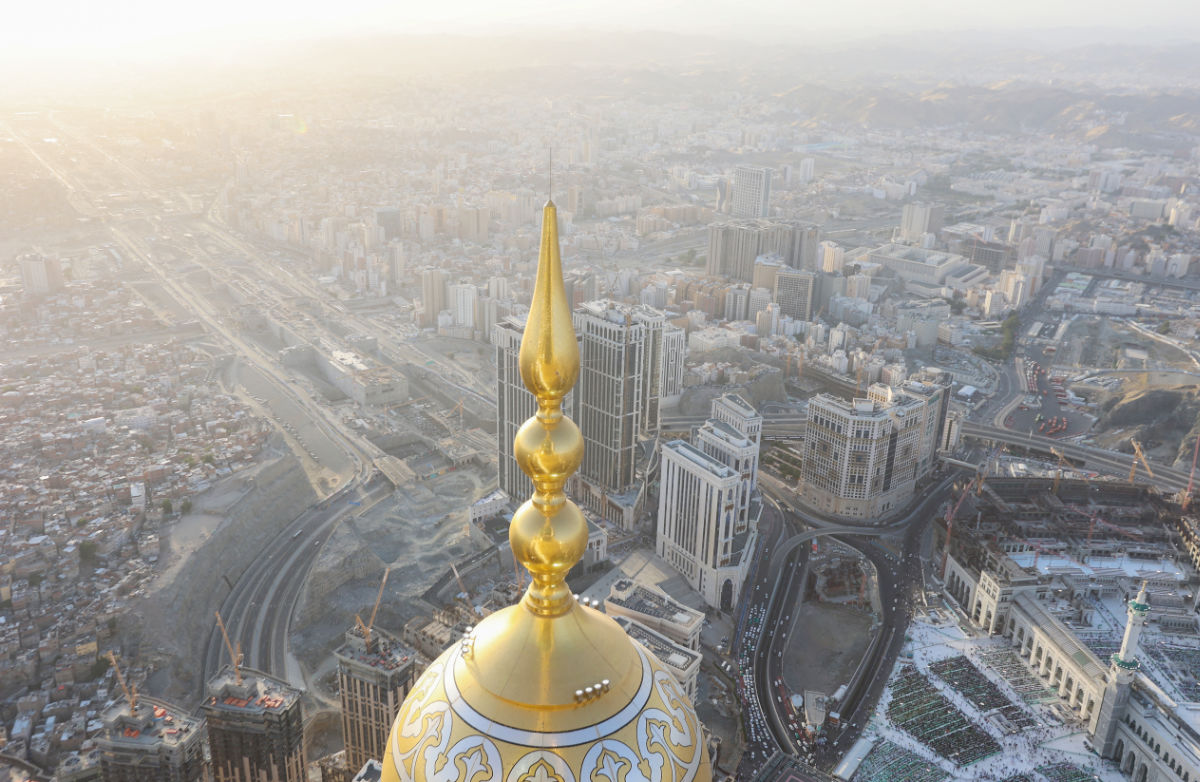
This photo taken on April 1, 2023 during the Muslim holy fasting month of Ramadan, from the Makkah Royal Clock Tower of the Abraj al-Bait skyscraper complex, shows an aerial view of the holy city of Makkah. (AFP)
“If pilgrims were to find grocers, bakers and barbers from their countries of origin, then residential housing units will see the most benefit,” he added.
Pilgrims usually divide themselves across the city depending on their country of origin.
Providing several services, such as food as well as workers speaking the same language of Hajj and Umrah performers, attracts pilgrims to reside in the region.
Ahmed Saleh Halabi, Hajj and Umrah services adviser
For decades, Arab pilgrims resided in areas near the Grand Mosque in Makkah, including Ajyad, Al-Shamiyah and Misfalah, namely in the Al-Bukhari and Al-Saqifah alleys.
“Turkish Hajj and Umrah performers used to reside in Al-Masafi and Bir Balila in Ajyad, while some of them resided in Misfalah, namely in the area between Palestine Hotel and Misfalah Municipality,” Halabi said.
“Pilgrims coming from South Asia used to reside in Ajyad Al-Sad and Misfalah, namely in the region located between Misial Al-Harsani and Bustan Al-Bukhari, while African pilgrims resided in Misfalah Al-Hafaer and Al-Mansour Street.
“As for Iranian pilgrims, they resided in Al-Maabadah and Alshaisha, while pilgrims from Southeast Asia preferred residing in the Al-Shamiya, Al-Naqa, As Sulaymaniyah and Al-Falq neighborhoods.”
With the beginning of the third expansion of the Grand Mosque, many of these neighborhoods near the holy site were demolished to make way for high-end residential towers.
“Since many pilgrims cannot afford such units, they shifted toward residing in areas far from, yet frequently providing transportation means to, the Grand Mosque.
“Turkish pilgrims headed towards Alshaisha, Al-Aziziyah and Al-Maabadah … these sites comprise restaurants and cafes, whose owners and workers speak the language of pilgrims and provide Turkish dishes,” said Halabi.
According to the adviser, pilgrims from South Asia moved to Al-Aziziya, in the region known as Mukhatat Albank. Many Arab pilgrims now stay in areas around the city center, including Jaroul and uptown Misfalah, while African pilgrims continue to stay in Al-Hafaer and Mansour Street.
Pilgrims from Southeast Asia moved to areas near the Grand Mosque, such as Ibrahim Al-Khalil Street and Mukhatat Bakhtama.


