

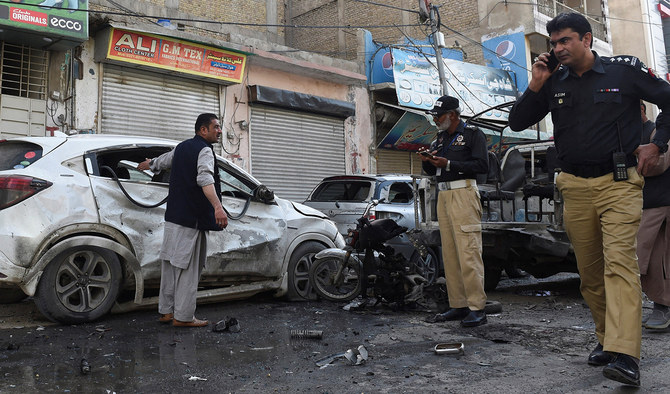
Four killed as blast targeting police hits southwestern Pakistan market crowded with Eid shoppers

Police officers gather as they survey after a blast in Quetta, Pakistan on April 10, 2023. (REUTERS)
Short Url
Updated 10 April 2023
Follow

Four killed as blast targeting police hits southwestern Pakistan market crowded with Eid shoppers

  • Police say remote-controlled explosive device caused blast in Quetta's market
  • Outlawed Baloch Liberation Army group claims responsibility for the attack 

QUETTA: At least four people, including two police officers and a minor girl, were killed on Monday when a blast targeted a police vehicle at a busy market in southwestern Pakistan, officials said. 

The blast struck the capital of southwestern Pakistan's Quetta city during the afternoon at the crowded Kandahari Bazar. A large number of people were present at the time of the explosion, mostly to shop for the upcoming Eid Al Fitr holidays. 

Balochistan, Pakistan's largest province by land size yet its most impoverished province, has been the center of an insurgency by separatist groups who say they are fighting what they see as the unfair exploitation of the province’s gas and mineral wealth by Pakistan’s richer, more powerful provinces.

Over the past couple of decades, the province has seen militants carry out sectarian attacks and target Pakistan's security forces.  

“A remote-controlled explosive device was fitted inside a motorbike which exploded when the vehicle of a senior police official was passing through the Kandhari Bazar,” Deputy Inspector General (DIG) of Quetta Police, Azfar Mahesar, told Arab News.

Mahesar confirmed the police officer's gunman, his driver and a minor girl were among the four who died in the blast, adding that 15 others were also injured in the explosion. 
Senior police officers and ministers visited the Civil Hospital Quetta where the injured were being treated. 

“We have shifted 15 injured, including women, to the Trauma Center for better medical care," Waseem Baig, the hospital's spokesperson, told Arab News. "We have injured people who are being operated on in the hospital."

In a statement released to the press, the outlawed Baloch Liberation Army (BLA) claimed responsibility for the attack, adding that its fighters had targeted SP Investigation Saddar Naseer-ul-Hassan Shah’s vehicle in the marketplace.

The group accused Hassan of being involved in "inhumane treatment" of Baloch civilians under the prefix of investigations. 

Prime Minister Shehbaz Sharif condemned the blast, expressing sorrow over the loss of lives and demanded an inquiry report on the incident. 

Chief Minister Balochistan Mir Abdul Qudus Bizenjo also condemned the attack and ordered Balochistan's top cop to strengthen security arrangements in the province before Eid.

“Terrorists targeting innocent people in the holy month of Ramadan don’t deserve to be called human,” Bizenjo said in his statement.
Balochistan has seen an uptick in violence over the past couple of days. On Sunday, two policemen of the special Eagle Force in Balochistan were attacked by militants on Sunday evening at a neighborhood in the Kuchlak district, located at the outskirts of Quetta. During the exchange of fire, one militant was killed.


Pakistan, global crypto exchange discuss modernizing digital payments, creating job prospects 

Updated 05 December 2025
Follow

Pakistan, global crypto exchange discuss modernizing digital payments, creating job prospects 

  • Pakistani officials, Binance team discuss coordination between Islamabad, local banks and global exchanges
  • Pakistan has attempted to tap into growing crypto market to curb illicit transactions, improve oversight

ISLAMABAD: Pakistan’s finance officials and the team of a global cryptocurrency exchange on Friday held discussions aimed at modernizing the country’s digital payments system and building local talent pipelines to meet rising demand for blockchain and Web3 skills, the finance ministry said.

The development took place during a high-level meeting between Finance Minister Muhammad Aurangzeb, Pakistan Virtual Assets Regulatory Authority (PVARA) Chairman Bilal bin Saqib, domestic bank presidents and a Binance team led by Global CEO Richard Teng. The meeting was held to advance work on Pakistan’s National Digital Asset Framework, a regulatory setup to govern Pakistan’s digital assets.

Pakistan has been moving to regulate its fast-growing crypto and digital assets market by bringing virtual asset service providers (VASPs) under a formal licensing regime. Officials say the push is aimed at curbing illicit transactions, improving oversight, and encouraging innovation in blockchain-based financial services.

“Participants reviewed opportunities to modernize Pakistan’s digital payments landscape, noting that blockchain-based systems could significantly reduce costs from the country’s $38 billion annual remittance flows,” the finance ministry said in a statement. 

“Discussions also emphasized building local talent pipelines to meet rising global demand for blockchain and Web3 skills, creating high-value employment prospects for Pakistani youth.”

Blockchain is a type of digital database that is shared, transparent and tamper-resistant. Instead of being stored on one computer, the data is kept on a distributed network of computers, making it very hard to alter or hack.

Web3 refers to the next generation of the Internet built using blockchain, focusing on giving users more control over their data, identity and digital assets rather than big tech companies controlling it.

Participants of the meeting also discussed sovereign debt tokenization, which is the process of converting a country’s debt such as government bonds, into digital tokens on a blockchain, the ministry said. 

Aurangzeb called for close coordination between the government, domestic banks and global exchanges to modernize Pakistan’s payment landscape.

Participants of the meeting also discussed considering a “time-bound amnesty” to encourage users to move assets onto regulated platforms, stressing the need for stronger verifications and a risk-mitigation system.

Pakistan has attempted in recent months to tap into the country’s growing crypto market, crack down on money laundering and terror financing, and promote responsible innovation — a move analysts say could bring an estimated $25 billion in virtual assets into the tax net.

In September, Islamabad invited international crypto exchanges and other VASPs to apply for licenses to operate in the country, a step aimed at formalizing and regulating its fast-growing digital market.