BEIJING: Chinese health officials defended their search for the source of the COVID-19 virus and lashed out Saturday at the World Health Organization after its leader said Beijing should have shared genetic information earlier.
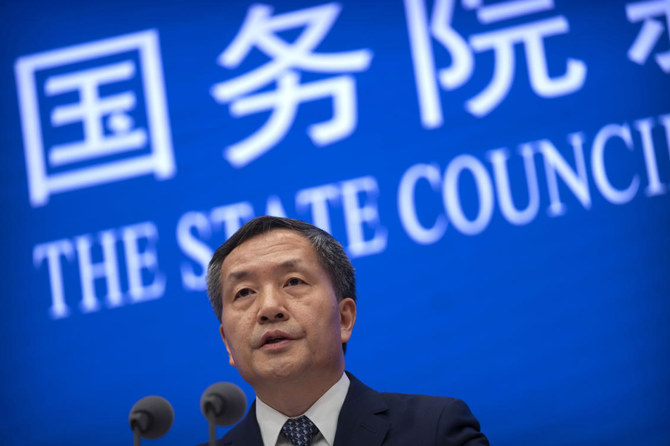
The WHO comments were “offensive and disrespectful,” said the director of the China Center for Disease Control and Prevention, Shen Hongbing. He accused the WHO of “attempting to smear China” and said it should avoid helping others “politicize COVID-19.”
The global health body’s director-general, Tedros Adhanom Ghebreyesus, said March 17 that newly disclosed genetic material gathered in Wuhan in central China, where the first cases were detected in late 2019, “should have been shared three years ago.”
“As a responsible country and as scientists, we have always actively shared research results with scientists from around the world,” Shen said at a news conference.
The origins of COVID-19 are still debated and the focus of bitter political dispute.
Many scientists believe it jumped from animals to humans at a market in Wuhan, but the city also is home to laboratories including China’s top facility for collecting viruses. That prompted suggestions COVID-19 might have leaked from one.
The ruling Communist Party has tried to deflect criticism of its handling of the outbreak by spreading uncertainty about its origins.
Officials have repeated anti-US conspiracy theories that the virus was created by Washington and smuggled into China. The government also says the virus might have entered China on mail or food shipments, though scientists abroad see no evidence to support that.
Chinese officials suppressed information about the Wuhan outbreak in 2019 and punished a doctor who warned others about the new disease. The ruling party reversed course in early 2020 and shut down access to major cities and most international travel to contain the disease.
The genetic material cited by the WHO’s Tedros was uploaded recently to a global database but collected in 2020 at a Wuhan market where wildlife was sold.
The samples show DNA from raccoon dogs mingled with the virus, scientists say. They say that adds evidence to the hypothesis COVID-19 came from animals, not a lab, but doesn’t resolve the question of where it started. They say the virus also might have spread to raccoon dogs from humans.
The information was removed by Chinese officials from the database after foreign scientists asked the CDC about it, but it had been copied by a French expert and shared with researchers outside China.
A CDC researcher, Zhou Lei, who worked in Wuhan, said Chinese scientists “shared all the data we had” and “adhered to principles of openness, objectivity and transparency.”
Shen said scientists investigated the possibility of a laboratory leak and “fully shared our research and data without any concealment or reservation.”
Shen said the source of COVID-19 had yet to be found, but he noted it took years to identify the AIDS virus and its origin still is unclear.
“Some forces and figures who instigate and participate in politicizing the traceability issue and attempting to smear China should not assume that the vision of the scientific community around the world will be blinded by their clumsy manipulation,” Shen said.


![]()

China health officials lash out at WHO, defend virus search
Short Url
https://arab.news/vqdhs
China health officials lash out at WHO, defend virus search
- The WHO comments were “offensive and disrespectful," said the director of the China Center for Disease Control and Prevention
- He accused the WHO of “attempting to smear China” and said it should avoid helping others "politicize COVID-19”


Latest updates


Recommended


© 2026 SAUDI RESEARCH & PUBLISHING COMPANY, All Rights Reserved And subject to Terms of Use Agreement.