

Rockets fired at Israel from Lebanon raise risk of conflict

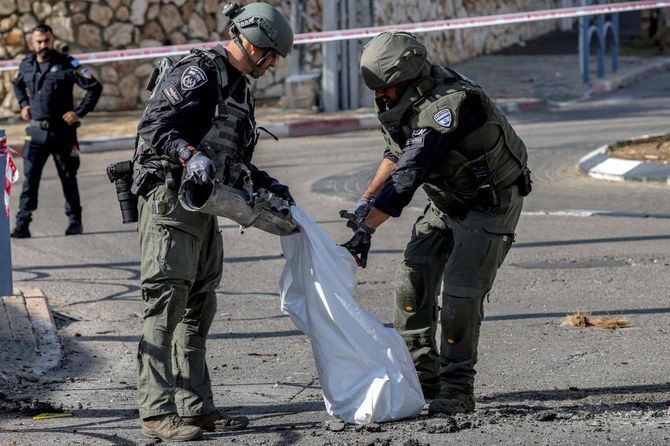
Israeli police bomb disposal unit members bag the remains of a shell fired from Lebanon and intercepted by Israel in its northern town of Shlomi on April 6, 2023. (AFP)
Short Url
Updated 06 April 2023
Follow

Rockets fired at Israel from Lebanon raise risk of conflict

  • The attack, one of the heaviest in years, ratcheted up regional tensions a day after Israeli police raided Jerusalem’s most sensitive holy site, Al-Aqsa Mosque
  • Israel’s military later said that 34 rockets had been fired from Lebanon in the 15-minute strike, with 25 intercepted, and at least four landing in Israel

BEIRUT: Militants in Lebanon launched a rocket barrage at villages across Israel’s northern frontier on Thursday, wounding two people and forcing hundreds to flee to bomb shelters, the Israeli military said.

The attack, one of the heaviest in years, ratcheted up regional tensions a day after Israeli police raided Jerusalem’s most sensitive holy site, Al-Aqsa Mosque.

Israel’s military later said that 34 rockets had been fired from Lebanon in the 15-minute strike, with 25 intercepted, and at least four landing in Israel.

Lebanese troops and the UN peacekeeping force were heavily deployed along the southern border with Israel on Thursday as investigations began into the attack.

The Israeli army said that its Iron Dome anti-missile system “intercepted multiple rockets fired from Lebanon.”

Earlier, warning sirens sounded in many Israeli settlements, prompting people to flee to shelters.

Media outlets in Israel initially estimated that up to 100 rockets were fired from Lebanon toward settlements and towns in the country’s north.

Israeli spy drones were seen flying over southern Lebanon following the attack.

UNIFIL described the situation in southern Lebanon as “extremely serious,” and urged “restraint and to avoid escalation.”

Candice Ardell, deputy director of UNIFIL Media Office, said in a statement: “Multiple rockets were fired from southern Lebanon toward Israel this afternoon. The Israeli army informed UNIFIL that it has activated its Iron Dome defense system in response to the attacks.”

She added that Maj. Gen. Aroldo Lazaro, UNIFIL head of mission and force commander, had been in contact with authorities on both sides of the demarcation line between Israel and Lebanon.

Social media activists on both sides of the border shared footage of the attack and rocket interceptions.

The Lebanese National News Agency said that Israeli artillery responded to the rocket strike by firing heavy shells from positions along the border with Lebanon.

According to the Israeli newspaper Maariv, security officials believe that the Palestinian militant group Hamas was behind the rocket attack.

A source close to Hezbollah said that the party had nothing to do with the incident, according to Al-Hadath channel.

“If we wanted to respond, it wouldn’t have been this way,” the source said.

Israeli Prime Minister Benjamin Netanyahu chaired a high-level security meeting to follow up on developments in the wake of the attack.

“No one should test us and we will take all the necessary measures to defend our country,” Israeli Foreign Minister Eli Cohen said.

Hamas political chief Ismail Haniyeh arrived in Beirut on Wednesday to take part in “events related to the Palestinian cause,” according to Hamas spokesperson in Lebanon, Walid Kilani.

Hezbollah usually commemorates “Al-Quds Day” during Ramadan every year.

Meanwhile, Lebanon condemned the Israeli attacks on Al-Aqsa Mosque.

Caretaker Prime Minister Najib Mikati said the raids “constitute a flagrant aggression and a transgression against holy sites,” and called on everyone with “a conscience to intervene and stop what is happening.”


UN force in Lebanon says peacekeeper wounded by Israeli fire

Updated 27 December 2025
Follow

UN force in Lebanon says peacekeeper wounded by Israeli fire

  • UNIFIL reiterated its call to the Israeli army to “cease aggressive behavior and attacks on or near peacekeepers working for peace and stability along the Blue Line”

BEIRUT, Lebanon: The United Nations Interim Force in Lebanon said an Israeli attack near their position in the country’s south wounded a peacekeeper on Friday, reiterating a call for Israel to “cease aggressive behavior.”
It is the latest incident reported by the peacekeepers in southern Lebanon, where UNIFIL acts as a buffer between Israel and Lebanon and has been working with Lebanon’s army to support a year-old truce between Israel and militant group Hezbollah.
“This morning, heavy machine gunfire from Israel Defense Forces (IDF) positions south of the Blue Line impacted close to a UNIFIL patrol inspecting a roadblock in the village of Bastarra. The gunfire followed a grenade explosion nearby,” UNIFIL said in a statement.
The force added that “the sound of the gunfire and the explosion left one peacekeeper slightly injured with ear concussion.”
Also on Friday, UNIFIL said “another patrol carrying out a routine operational task also reported machine gunfire from the Israeli side in immediate proximity to their position” in Kfarshuba, south Lebanon.
The peacekeeping force said it had informed the Israel army of its activities in these areas.
Earlier this month, UNIFIL said Israeli forces fired on its peacekeepers in southern Lebanon.
Last month it said Israeli soldiers shot at its troops in the south, while Israel’s military said it mistook blue helmets for “suspects” and fired warning shots.
In October, UNIFIL said one of its members was wounded by an Israeli grenade dropped near a UN position in the country’s south, the third incident of its kind in just over a month.
“Attacks on or near peacekeepers are serious violations of Security Council resolution 1701,” the peacekeeping force added, referring to the 2006 resolution that formed the basis of the November 2024 truce.
UNIFIL reiterated its call to the Israeli army to “cease aggressive behavior and attacks on or near peacekeepers working for peace and stability along the Blue Line.”
Israel carries out regular attacks on Lebanon despite the truce, usually saying it is targeting sites and operatives belonging to Hezbollah, which it accuses of rearming.
It has also kept troops in five south Lebanon areas it deems strategic.
