

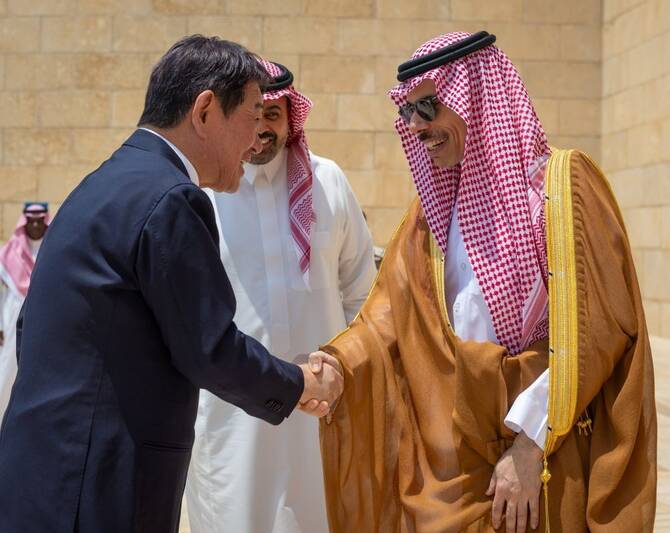

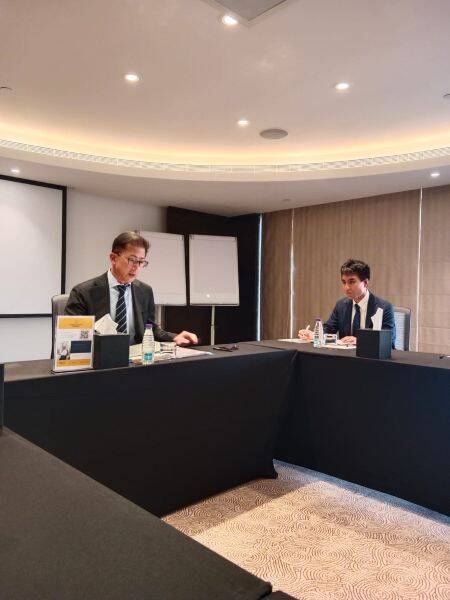
RIYADH: The Japanese foreign minister, Toshimitsu Motegi stressed the importance of peace and maritime security in the Middle East during talks in Riyadh with his Saudi counterpart, Prince Faisal bin Farhan, and the head of Yemen’s Presidential Leadership Council, Rashad Mohammed Al-Alimi.
Kitamura Toshihiro, the Japanese delegation’s foreign press secretary, said Motegi, whose two-day official visit to Riyadh concluded on Wednesday, discussed with Prince Faisal efforts to secure lasting peace in the region.
“As a maritime nation, we believe that the freedom and safety of navigation is quite important, especially for international trade,” Toshihiro said.
“We are wonderful friends so we can reaffirm the necessity of ensuring the freedom and safety of navigation in the Strait of Hormuz. We work closely, so would like to contribute to creating a safe environment.”
He said the foreign minister similarly stressed the importance of peace in the region during a meeting with Al-Alimi in Riyadh on Tuesday. Al-Alimi leads Yemen’s interim government, which operates in exile because of the civil war with the Houthis in the country.
Bab Al-Mandeb Strait, which links the Gulf of Aden with the Red Sea, has served as an alternative crude oil-shipping route while the Strait of Hormuz is blocked during the conflict between the US and Iran, but has faced threats from the Houthis.
Motegi said Japan would continue to support Yemen’s internationally recognized government, and added that stability in the country, which is adjacent to Bab Al-Mandeb, was directly linked not only to stability and development in the Middle East but the entire international community.
The minister reiterated the importance of achieving peace in Yemen, strongly denounced recent attacks on international shipping by the Houthis, and said Japan had asked Iran to urge the group to exercise restraint.
On the issue of trade and bilateral relations, Motegi said: “We would like to work together with Saudi Arabia, that’s the vision we have for a joint Saudi-Japan Vision for 2030. So we like to discuss our cooperation in the context, especially, (of) the economy and security.
“We have a long-standing relationship in the petroleum sector. Last year we celebrated 70 years of our diplomatic relations.”
Saudi-Japan Vision 2030 is a comprehensive strategic framework for economic cooperation that was launched in March 2017. It aims to expand ties between the countries beyond the traditional oil trade and auto imports into a deeper, diversified partnership spanning advanced technology, clean energy and cultural exchanges.
“We know that the government has announced its support for Vision 2030,” Motegi said, referring to Saudi Arabia’s plan for national development and diversification.
“We have decided to promote our cooperation under the common title of Japan-Saudi Arabia Vision 2030. We are also looking forward to working together and promoting seawater desalination projects.”
This collaboration on desalination technology focuses on energy-efficient reverse osmosis membrane systems powered by sustainable renewable energy, and the localization of manufacturing to reduce costs and carbon footprints.
Artificial intelligence is another key area in which the countries are collaborating, Toshihiro added.




