

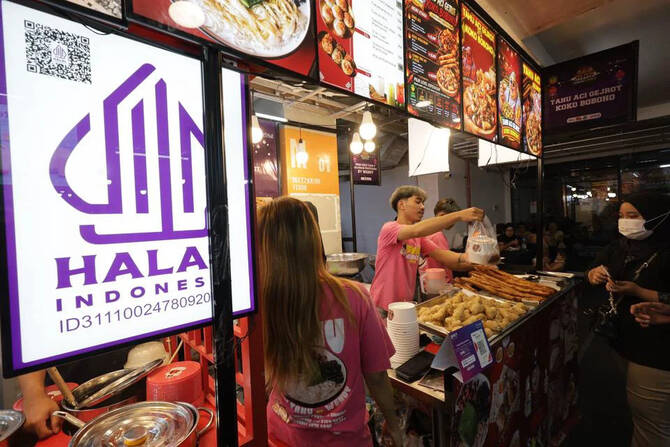

JAKARTA: Indonesia wants to join hands with countries in the Middle East to advance the global halal ecosystem, eyeing a partnership that combines its production capabilities with the region’s market and investment potential, the Ministry of Trade told Arab News recently.
Southeast Asia’s biggest economy was ranked fourth in the Global Islamic Economic Indicator, behind Malaysia, the UAE and Saudi Arabia.
Indonesia is racing to become a global halal hub by 2029, leveraging its demographic advantage as the world’s largest Muslim-majority country. It has stepped up efforts to boost the sector in recent years, including by promoting Muslim-friendly tourism and enforcing mandatory halal certification from October this year.
“Indonesia sees the halal economy as an important driver of sustainable economic growth and international collaboration,” said Fajarini Puntodewi, the ministry’s director-general of national export development.
“We see the Middle East not only as an important market, but also as a strategic partner in advancing the global halal ecosystem. By combining Indonesia's production capabilities with the region’s strong halal market and investment potential, we believe there are significant opportunities to build more integrated and sustainable halal value chains.”
Indonesian exports to the Middle East have seen an annual growth of around 17 percent over the past five years, reaching nearly $9.9 billion in 2025, trade ministry data showed.
Trade officials have been promoting Indonesian halal products through international exhibitions, business forums and business-matching programs, while also encouraging stronger relations between Indonesian companies and Middle East partners.
Jakarta has representation in Jeddah and Dubai through its Indonesian Trade Promotion Centers, and trade attaches in Riyadh and Cairo.
“Looking ahead, we believe Indonesia and the Middle East share complementary strengths and common interests, particularly in the halal economy, food security, manufacturing, and sustainable industries,” Puntodewi said.
Food and beverages, modest fashion products, cosmetics, and furniture are sectors where Indonesia “has both strong capabilities and significant potential to deepen commercial cooperation,” she added.
Indonesian business leaders also see the Middle East, particularly the Gulf region, as an important market for the country’s economic growth.
While the Gulf only makes up only around 3 percent of Indonesia’s non-oil exports, the “room to grow is significant, not only for trade but for investment,” said Arsjad Rasjid, founder and chairman of private equity firm Sriwijaya Capital.
“The first reason is complementarity. The GCC supplies energy and industrial inputs Indonesia doesn’t produce enough of, while Indonesia supplies palm oil, processed food and manufactured goods the Gulf can’t produce domestically,” he told Arab News, adding that economic diversification efforts among GCC countries also opens up opportunities for investment.
Rasjid, who also chairs the B57+ Asia Pacific Regional Chapter, a private sector initiative launched in February to strengthen collaboration among countries in the Muslim world, highlighted Indonesian capabilities in food production, pharmaceuticals and cosmetics as well as opportunities for partnership in hospitality and men’s modest fashion.
While practically speaking Indonesia’s “halal ecosystem is still fragmented,” Rasjid said there are ongoing efforts among businesses, government and other stakeholders to align it.
“The goal is clear: Indonesia should be a producer in this halal economy, not only a consumer. We can be a global hub,” he said.
“Our invitation to Gulf partners is not just to trade with Indonesia, but to invest in Indonesia. We have the production base, the certification framework, and 240 million Muslim consumers in one market.
“What we’re missing is the capital layer. Invest in Indonesia. Build it with Indonesia.”


