

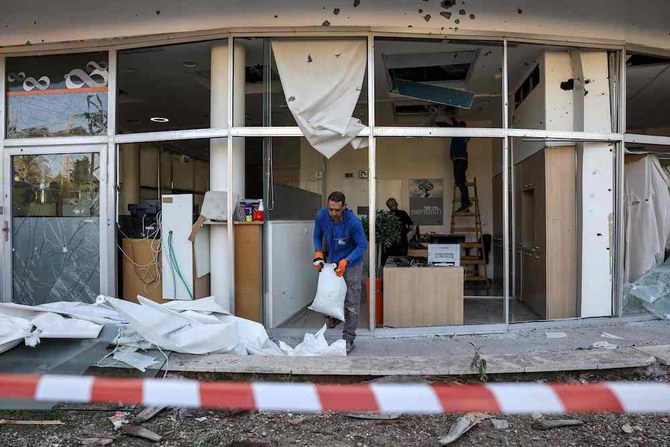

TEL AVIV: More than 30 rockets were fired from Lebanon into Israel on Thursday, Israel’s military said, amid escalating tension following Israeli police raids on the Al-Aqsa mosque in Jerusalem this week.
Prime Minister Benjamin Netanyahu was set to hold a meeting of the security cabinet to decide a response to the attack, the biggest rocket attack on Israel from Lebanon since 2006, when Israel fought a war with the heavily armed Lebanese Hezbollah.
An Israeli military spokesman blamed the Hamas group for the rocket attacks on Thursday, and also said that Israel held the Lebanese government responsible for rockets launched from its territory.
“The party that fired the rockets from Lebanon is Hamas in Lebanon,” Avichay Adraee said in a tweet.
“No one should test us, we will take all necessary measures to defend our country and people,” Foreign Minister Eli Cohen said on Twitter.
The Israeli military said 34 rockets were launched from Lebanon, of which 25 were intercepted by Israel’s Iron Dome, anti-missile system. Israel’s ambulance service said one man had sustained minor shrapnel injuries.
The incident came as Israel faced worldwide pressure following police raids on the Al-Aqsa mosque compound in Jerusalem during the Muslim holy month of Ramadan, which this year coincides with the Jewish Passover holiday that started on Wednesday evening.
There was no claim of responsibility but an Israeli military official also said that Israel was working on the assumption that the attack was Palestinian-linked.
Three non-Israeli security sources also said Palestinian factions in Lebanon, not Hezbollah, were believed to be responsible for the rocket fire although it was widely assumed that Hezbollah would have to have given its permission.
“It’s not Hezbollah shooting, but it’s hard to believe that Hezbollah didn’t know about it,” Tamir Hayman, a former head of Israeli military intelligence said on Twitter.
Ismail Haniyeh, head of the Islamist group Hamas, which controls the Gaza Strip, was visiting Lebanon but there was no immediate comment from the group. There was also no immediate comment from the Lebanese military or Hezbollah.
TV footage showed large plumes of smoke rising above the northern Israeli border town of Shlomi with wrecked cars in the streets. Public sector broadcaster Kan said the Israel Airports Authority closed the northern airports in Haifa and Rish Pina.
“I’m shaking, I’m in shock,” Liat Berkovitch Kravitz told Israel’s Channel 12 news, speaking from a fortified room in her house in Shlomi. “I heard a boom, it was as if it exploded inside the room.”
CALLS FOR RESTRAINT
In a written statement, the United Nations peacekeeping force in south Lebanon (UNIFIL) described the situation as “extremely serious” and urged restraint. It said UNIFIL chief Aroldo Lazaro was in contact with authorities on both sides.
Amid fears that the confrontation could spiral further, following a year of escalating Israeli-Palestinian violence, the United Nations Security Council held a closed door meeting to discuss the crisis.
The US Deputy Ambassador to the United Nations, Robert Wood, described the situation in the Middle East as serious and said tensions should not be exacerbated.
“It’s going to be important for everyone to do what they can to calm tensions,” he told reporters on the way into the Security Council meeting.
The rocket fire adds a further complication for the religious-nationalist government of Prime Minister Benjamin Netanyahu, who before the violence this week at Jerusalem’s Al-Aqsa mosque had faced mass protests against his proposals to rein in the Supreme Court.
Netanyahu last week delayed the bitterly contested plans for a judicial overhaul.
Thursday’s rocket attack followed strikes from Gaza where Palestinian militants fired a number of rocket salvoes toward Israel following the police operation at the Al-Aqsa mosque, a site which is also holy to Jews, who know it as the Temple Mount.
In response, Israel has hit targets in Gaza linked to Hamas, which it holds responsible for any attacks from the blockaded coastal strip.
Speaking from Gaza, Mohammad Al-Braim, spokesman for the Palestinian Popular Resistance Committees, praised the rocket strikes from Lebanon, which he linked to the Al-Aqsa incidents, but did not claim responsibility.
He said “no Arab and no Muslim would keep silent while (Al-Aqsa) it is being raided in such savage and barbaric way without the enemy paying the price for its aggression.”


