

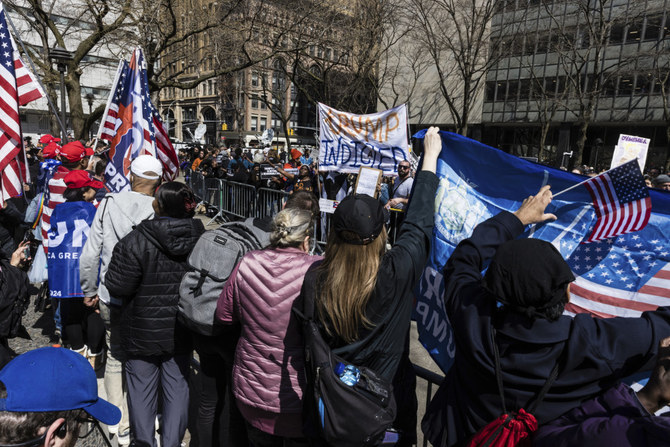

NEW YORK: Former US President Donald Trump’s surrender on criminal charges Tuesday was marked by clashes between his fans and foes outside a downtown Manhattan courtroom, and a now-familiar cycle of name-calling and outrage from lawmakers and Trump himself.
But many Americans who say they are watching this case and other Trump investigations play out aren’t looking for political point-scoring — they’re holding out hope that the US democracy delivers justice.
“It’s what the system is for,” said Carla Sambula, who said she had driven an hour from her Rockland County, New York, home to sit in line outside a Manhattan courthouse so she could witness Trump’s indictment firsthand. “It’s hard to say if they’ll get it right, especially as a woman of color,” said Sambula, who is Black, adding she has not cast a vote since one for President Barack Obama in 2016.
Americans’ trust in such institutions as Congress, television news and the presidency, fell to the lowest average level in more than 40 years last year, Gallup polling shows. Just 14 percent say they have a great deal or “quite a lot” of confidence in the criminal justice system, half the level of a decade ago.
Manhattan District Attorney Alvin Bragg’s case is the first of several involving Trump as the country braces for a 2024 presidential election in which Trump is the leading Republican candidate. Trump pleaded not guilty Tuesday.
“There’s a lot of cynicism on the far right and the far left,” said Richard Painter, a former White House ethics lawyer and a professor of law at University of Minnesota. Both sides have coalesced around the idea that “the law is not about law, it is just about politics and power.”
Trump himself has over the years complained that law enforcement was targeting him for political purposes, and his rhetoric has heightened since the New York case surfaced.
On Wednesday, Trump called on his fellow Republicans in Congress to slash funding for the US Justice Department and the FBI. A number of Republicans have expressed concern the case is a test of whether government can be weaponized against disfavored politicians.
About half of Americans think the investigations against Republican Trump are politically motivated actions by Democrats, a new Reuters/Ispos poll shows — including 36 percent of Democrats. Half of Americans, meanwhile believe Trump and some members of the Republican party are working to delegitimize law enforcement to prevent charges against Trump — including 30 percent of Republicans.
Americans, however, say they want accountability — about 70 percent disagree with the idea of US presidents having immunity from all but the most serious criminal charges, the Reuters/Ipsos poll finds. An even higher level agree that no one in America should be “above the law.”
The US judicial system will be under intense scrutiny in the months ahead, as multiple track investigations continue.
The Manhattan case, which relates to hush money to a porn star, could last a year or more. An investigation into Trump’s attempt to overturn his 2020 election defeat in Georgia may result in an indictment this spring, and the Department of Justice is investigating a related transfer-of-power issue as well as Trump’s retention of classified documents. A civil trial over voting machine company Dominion’s defamation allegations against Fox News over the 2020 election could start this month.
“One of the pillars of democracy is to hold elected leaders accountable. Usually we think of that politically, but it also applies legally when crimes have been committed,” said Vince Warren, the executive director of the Center for Constitutional Rights, a legal and advocacy group.
The flurry of legal actions against Trump “could signal an era where presidential actions are subjected to legal accountability moving forward,” Warren said.
Amir Ali, executive director at the MacArthur Justice Center, pointed to the disproportionate incarceration of minorities and lower income people in the United States and said the system “has routinely given people with power a free pass.”
“It’s obvious the criminal legal system can punch down — it’s proven that, and oppressively so,” Ali said.
Yusef Salaam, one of five Black teenagers wrongfully convicted in a 1989 rape case wrote a full-page newspaper advertisement echoing one Trump paid for decades ago calling for Salaam and others dubbed the “Central Park Five” to face the death penalty.
“Even though thirty-four years ago you effectively called for my death and the death of four other innocent children, I wish you no harm,” Salaam, now a Democratic candidate for the New York City Council, wrote in his ad. “Rather, I am putting my faith in the judicial system to seek out the truth.”
The issues that will be addressed in multiple Trump-related cases coming up “reflect the fragility of any democracy,” said Adav Noti, vice president with the Campaign Legal Center, a non-partisan government watchdog. “People may try to stay in power illegally,” he said.
At least two ongoing probes into Trump deal with questions of whether he tried to block the lawful transfer of power to his successor, Democrat Joe Biden. Trump continues to assert falsely that the 2020 election was stolen from him through widespread voting fraud
The way to prevent the sabotage of a future election is for “high level people to do prison time for trying to overturn the 2020 election,” said Noti.
“There’s a good reason,” for the cynicism Americans feel, he said. But “it doesn’t have to be this way.”


