

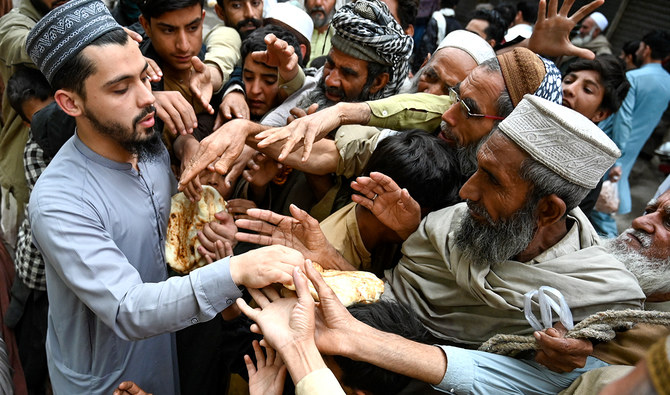

KARACHI: Seven-year-old Saad Umer joined a crowd in a poor neighborhood in the Pakistani city of Karachi rushing to get a handout of flour and a little cash from a charity trying to help the most vulnerable cope with runaway prices.
But in the surge, a melee broke out and some people fell.
Saad and 10 others, all women and children, were killed in the latest in a series of deadly scrambles for food as Pakistan struggles with its most serious economic crisis in years.
“He was a beautiful kid. I’ll never get over his death as long as I live,” his father, Umer Zada, told Reuters.
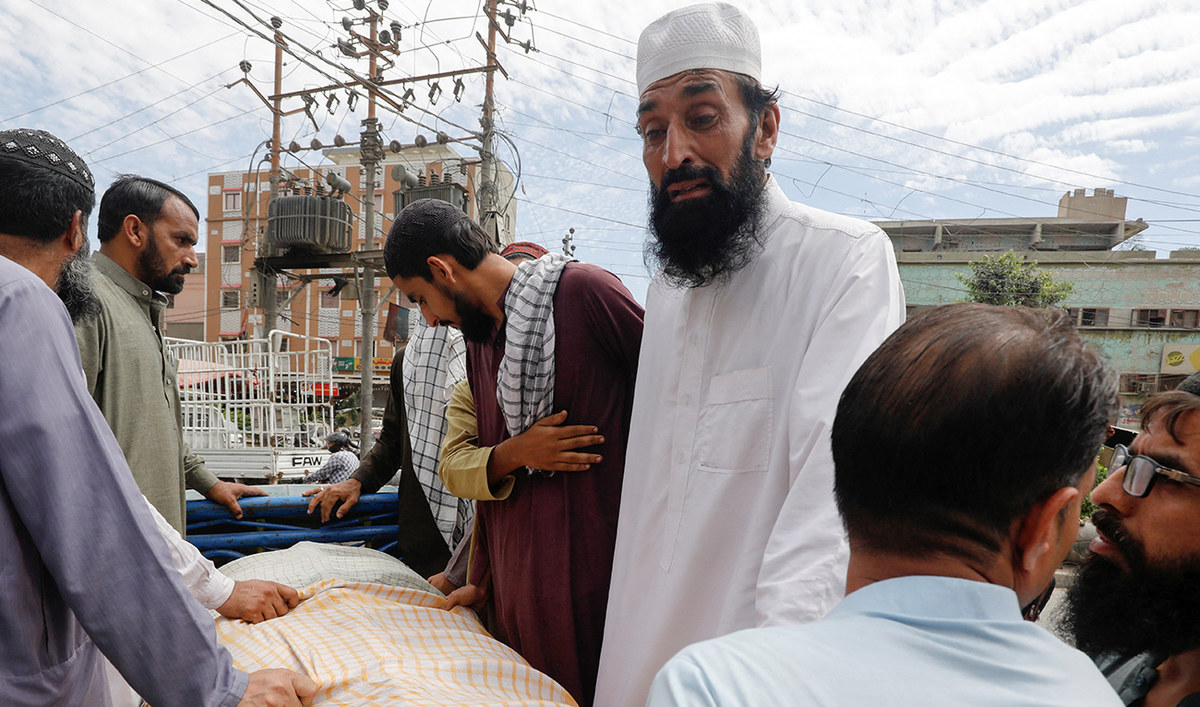
People gather as they attend the funeral of seven year-old Saad Umer, in Karachi. (Photo courtesy: Reuters)
Zada said the distribution of aid should have been better organized, with police supervision of the hungry and desperate seeking help.
“There were no rules or regulations as my son got trampled.”
Last week, in another incident, police fired tear gas in a bid to control a frenzied crowd trying to get their hands on food supplies at a site in Kyber Paktunkwa province.
In all, 16 people have been killed in chaos at charity distributions, shocking Pakistan, especially during the Islamic fasting month of Ramadan, a time for giving and spiritual reflection.
But this year, economic malaise seems to be eroding society’s ability to cope.
Global factors have compounded consumer inflation as the country of 220 million people tries to finalize a bail-out agreement with the International Monetary Fund.
Prices have been pushed higher by a weakening currency, energy tariff increases and a usual Ramadan spike.
Pakistan’s inflation soared to a record 35 percent last month. Food inflation in March was at 47.1 percent and 50.2 percent for urban and rural areas respectively.
The turmoil as charities try to help the poorest lays bare the desperation that is likely to get worse as the impact of inflation is compounded by smaller donations of the traditional zakat alms for the poor, according to five aid groups that Reuters spoke to.
“People that would donate small amounts are now showing up asking for help while people that used to donate large amounts are saying they’re struggling and scaling back,” Ansar Burney, head of the Ansar Burney Trust told Reuters.
“There has been a 50 percent reduction in donations this year, while there has been a 50 percent increase in people seeking help.”
'DONOR FATIGUE'
With prices rising, the funds that donors are giving are not stretching as far as they did.
“Charities are struggling to deal with rising inflation and costs the same way households are. There has also been a rise in the number of people heading our way for help,” said Ramzan Chhipa, founder of the Chhipa welfare association.
Higher fuel prices make providing an ambulance service ever more difficult, says Faisal Edhi, a philanthropist and chief of Pakistan’s largest charity operation the Edhi Foundation. The group’s ambulances took away the injured and the bodies of Saad and the others killed in the Karachi crush.
“Our services are becoming costly and we aren’t always able to reach the people ... We’ve already spent a substantial amount from our reserves,” Edhi said.
Edhi said there had also been an increasing number of men committing suicide because they could not support their families, including one man who was a friend of his.
The Saylani Welfare Trust runs soup kitchens in Karachi’s poorest neighborhoods where surging numbers of people are hoping for a meal but donations to fund the service are falling.
Trustee Arif Lakhani said where in the past up to 500 people would turn up, now it is up to 1,000 while donations have fallen by about half.
“In fact, I’d say donations are 40 percent of what they were,” he said.
Sikander Bizenjo, co-founder of the Balochistan Youth Action Committee, which helps out in the remotest villages, said after a year in which floods devastated huge areas, it was not surprising people felt they could not help as much as before.
“There is some form of donor fatigue,” he said.
Like everyone, Zada is struggling with inflation but he also has to contend with grief and questions that torment him.
“I’m totally devastated. There are other people like me whose children were killed, martyred,” he said.
“The women who had nothing to eat went there. Can’t the government see that people are dying of hunger?”


