

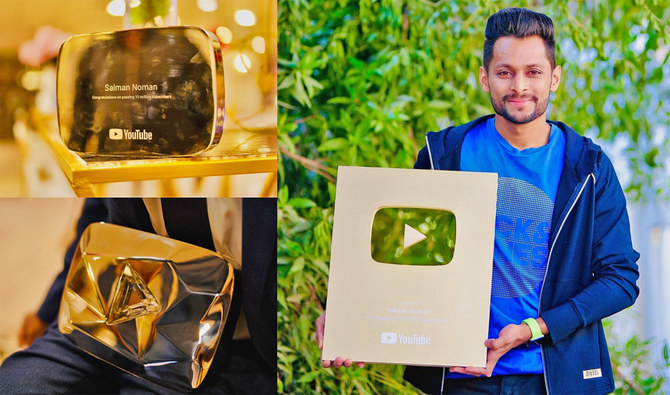

KARACHI: Thirty-year-old Salman Noman from Karachi’s impoverished Korangi suburb started making musical videos on YouTube in 2021 but didn’t get much traction and gave up on creating social media content.
But last January, after about seven months of quitting, Noman came back to digital content with an entirely different approach — comedy short videos — that has proved a roaring success.
The first video he posted became an overnight hit, garnering 15 million views and today, Noman’s YouTube channel has crossed 13.5 million subscribers, the highest number ever recorded by a Pakistani content creator.
“Since then [January 2022] in 13 months, I have got 13 million subscribers,” Noman told Arab News in an interview in Karachi.
In December this year, Google gave Noman a Diamond Play Button, awarded to channels that reach or surpass 10 million subscribers. Last month, the Sindh government arranged a special ceremony to celebrate the YouTuber, conferring a gold medal and certificates on him.
“I am a simple boy from Karachi, [but] I had dreams to do something in life … I always wanted to make others laugh but I had never thought I would do it through YouTube videos,” Noman, for whom legendary Pakistani comedian Umer Sharif was a big inspiration, added.
Along his journey, Noman says his “best friends” have been his cellphone and his originality. Content creation, he believes, is all about fresh ideas rather than resources or fancy equipment.
“I have never thought that I should purchase a big camera, purchase big mics [or] purchase big lights. I go into public wearing the same collar mic and take my mobile and make videos, and my content works,” the creator said. “I am myself a writer, director, editor and I myself post videos, I do all things myself.”
Noman’s videos are mostly shot at food stalls and an adjacent shop that his father owns in Qur’angi, lending themselves to street life and humor in Karachi. One of his biggest successes on YouTube, a short video where he pretends to be selling ice lollies but runs out of dye to the anger of his customers, has 177 million views.
“Short videos make less money, but a good amount for a Karachi-based middle-class man,” Noman said. “I started my life with a Cultus [car] and today I drive a Civic.”
But neither Noman nor his family believed he would become this successful with digital content and his family always urged him to opt for a more traditional profession.
“When I got the Google award, and when I got the gold medal [from the Sindh government], my father was crying [with happiness],” he said.
The key to his success, Noman explained, was creating original content.
“I always do original content, that is why I have reached this far,” the creator said. “If I started copying, then people would have already seen whoever made the original content. In the past 13 months, there has not been a single day in which I haven’t made or posted a video.”
Though he now largely makes comedy videos, the YouTuber has also covered serious issues like divorce, the adoption of homeless children, and coronavirus precautions.
“Comedy and singing is my genre and I want to do that, but when I see something hurting society, as an influencer I feel a responsibility to give out a message,” he said.
Noman had initially intended on becoming a singer but when his comedy got more traction, he started making parody versions of famous songs instead, including Kaifi Khalil’s Kahani Sono and Ali Zafar’s Laila O Laila.
“When a song gets viral, [I feel like it’s] my duty to twist it to make people laugh,” he said, smiling.
The idea has made him famous:
“There was a time when I wanted to meet celebrities, now Allah has brought me to this position that I have myself become a celebrity and people are coming to meet me. It makes me very happy.”
Asked about his future plans, Noman said he wanted to return to his first love, music.
“I will return to my goal,” he said. “Now I will start singing and try to release a song after Eid.”


